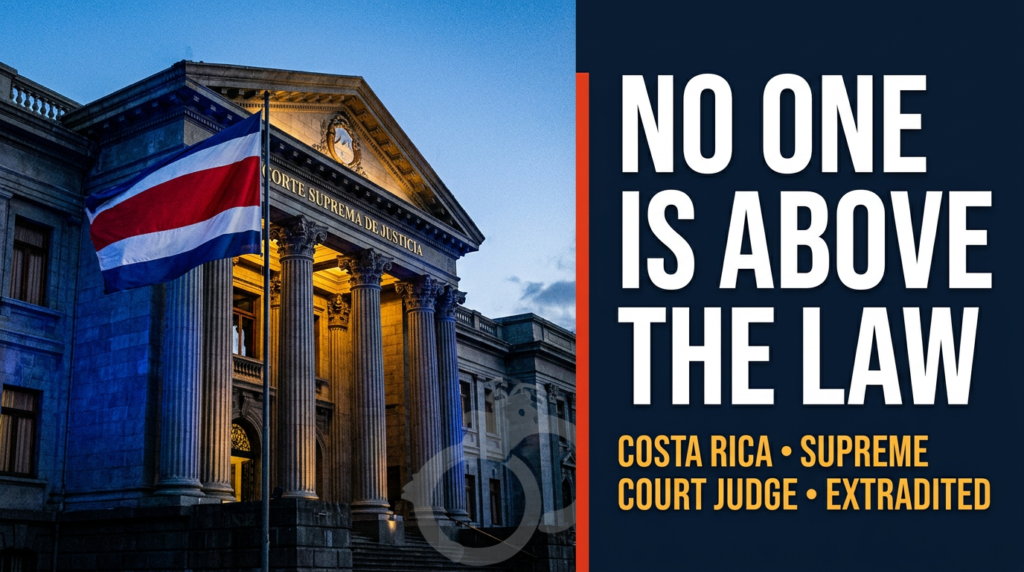
No One Is Above the Law: Costa Rica’s Historic Extradition of a Supreme Court Judge Should Inspire Every Nation
When the Gavel Is Corrupt, Justice Must Still Prevail
Imagine a man who spent years overseeing your nation’s justice system — sitting on its highest court, commanding its national police, directing its intelligence services — while allegedly helping international drug cartels move cocaine into the United States. Imagine that for years, his nationality alone kept him shielded from accountability, wrapped in a legal cloak that made prosecution functionally impossible.
That was the reality in Costa Rica. Until now.
On March 20, 2026, former Costa Rican Supreme Court magistrate and Security Minister Celso Manuel Gamboa Sánchez, 49, was loaded onto a DEA-linked aircraft at Juan Santamaría International Airport under heavy security escort and flown to Texas — making history as Costa Rica’s first-ever extradited national. He faces federal charges in the Eastern District of Texas for manufacturing and distributing cocaine knowing it would be unlawfully imported into the United States, and conspiracy. If convicted, he faces a minimum of ten years and a maximum of life in federal prison.
Support Independent Local Journalism
TheTownHall.News is a non-profit reader-supported journalism. Just $5 helps us hire local reporters, investigate important issues, and hold public officials accountable across Alameda County. If you believe our community deserves strong, independent journalism, please consider donating $5 today to support our work.This is not just a story about one corrupt official. It is a story about what happens when a nation finally decides that law and order means everyone — no exceptions, no carve-outs, no protected class.
The Anatomy of Betrayal: Who Is Celso Gamboa?
Celso Gamboa was not some backroom operator. He was the establishment. He served as Minister of Public Security in 2014, the very office responsible for overseeing crime prevention in Costa Rica. He later served as a Supreme Court judge from 2016 to 2018, when he was removed amid corruption allegations. He also held roles as intelligence director and deputy minister to the presidency.
According to a federal grand jury indictment returned in the Eastern District of Texas in 2024, Gamboa allegedly “conspired with and assisted other international drug traffickers to manufacture, distribute, and transport significant quantities of cocaine, much of which was trafficked through Costa Rica and ultimately into the United States for further distribution.”
In plain terms: the man in charge of stopping drugs was allegedly helping move them.

He was arrested in Costa Rica on June 23, 2025 — the same day Costa Rican authorities arrested his alleged associate, Edwin Danny López Vega, known as “Pecho de Rata” (Rat’s Chest), a drug trafficker also indicted in the Eastern District of Texas. Both were held in Costa Rica’s La Reforma prison for nine months before being extradited together on the same U.S. government flight.
Costa Rica’s Attorney General Carlo Díaz put it plainly: “Costa Rica is sending a strong message: no one can use our nationality to evade justice.”
The Legal Shield That Enabled Years of Impunity
For decades, Costa Rica’s constitution contained a provision that shielded its own citizens from extradition. Article 32 effectively guaranteed that no Costa Rican national could be handed over to a foreign country — regardless of the crime. In a nation proud of its democratic traditions, the rule was seen as a protection of citizens’ rights.
But protections, when exploited by the powerful, become instruments of impunity. Criminals and corrupt officials understood that holding a Costa Rican passport was, functionally, a get-out-of-jail-free card from international prosecution.
That changed in May 2025, when Costa Rica’s Congress unanimously voted to amend Article 32, opening the door to extradition for cases involving international drug trafficking and terrorism. President Rodrigo Chaves signed the reform into law. It was a direct, courageous acknowledgment that some legal protections had been weaponized — and that genuine law and order requires closing those loopholes.
Support Independent Local Journalism
TheTownHall.News is a non-profit reader-supported journalism. Just $5 helps us hire local reporters, investigate important issues, and hold public officials accountable across Alameda County. If you believe our community deserves strong, independent journalism, please consider donating $5 today to support our work.The Gamboa extradition is the first real test of that reformed framework. And it passed with flying colors.
A Conservative Principle in Action: Accountability Has No Rank
Conservatives have long insisted on a foundational principle: the rule of law must apply equally to everyone. Not just to the poor, the powerless, or the politically disfavored — to everyone, including judges, ministers, and those who wear the robes of institutional authority.
The Gamboa case is a textbook example of what happens when that principle is abandoned. For years, a man who allegedly used his position to protect and facilitate drug cartels operated within the very institutions designed to stop them. The idea that he was untouchable — protected by his title, his connections, and his nationality — is precisely what conservatives mean when they warn against a two-tiered justice system.
President Rodrigo Chaves, who recently attended an anti-crime summit with U.S. President Donald Trump and other regional leaders in Florida, called Gamboa “the tip of the iceberg” — a chilling admission that the rot runs deeper. Gamboa himself told Reuters he is willing to testify in U.S. courts and name other co-conspirators, provided his family’s safety is guaranteed. That offer, if acted upon, could unravel a network that reaches far into Costa Rican political life.
This is what real accountability looks like: uncomfortable, politically inconvenient, and absolutely necessary.
The U.S. Role: Why International Law Enforcement Cooperation Matters
This case did not happen in isolation. It is part of Operation Take Back America — a DOJ initiative marshaling the DEA, the FBI, and the North Texas Strike Force to dismantle cartels and transnational criminal organizations. The indictment was brought by the U.S. Attorney’s Office for the Eastern District of Texas, with substantial assistance from the Justice Department’s Office of International Affairs.
For conservatives who believe in sovereignty and strong borders, there is a critical lesson here: meaningful drug enforcement is not achieved by walls alone. It requires bilateral accountability frameworks that compel other nations to stop being safe harbors for those who traffic destruction into American communities. The Gamboa extradition is proof that when that framework exists — and when partner nations have the political will to use it — results follow.
Costa Rica’s Wake-Up Call: A Nation Confronts Its Own Darkness
Costa Rica abolished its army in 1948. Its literacy rate is among the highest in the hemisphere. By almost every metric, it is a Central American success story. That makes the Gamboa case all the more sobering. Rising cartel activity has not spared Costa Rica — and this case reveals that the threat has, at times, operated from within the highest institutions of government.
The new extradition law includes important guardrails: extradited nationals cannot face the death penalty, and sentences cannot exceed 50 years. These are reasonable sovereign conditions that reflect a nation enforcing accountability while maintaining its own legal principles — exactly the kind of measured, principled governance that distinguishes serious rule-of-law from mob justice.
Conclusion: Justice Doesn’t Expire — It Just Takes Longer for Some
For years, Celso Gamboa may have believed the law had a blind spot with his name on it. He sat on the highest court. He commanded the security forces. He had the right title, the right credentials, and the right passport.
None of it was enough.
The DEA aircraft that carried him to Texas was not just a flight. It was a statement: the law is patient, but it is not blind, and it is not for sale. Costa Rica chose accountability over comfort. The United States upheld its obligation to pursue justice across borders. Together, they demonstrated what genuine law and order looks like when nations have the will to enforce it.
That is a model worth defending — and worth demanding everywhere.
✊ Call to Action
This story matters — and so does staying informed. Share this article with friends and fellow citizens who believe in accountability and a justice system that applies equally to everyone. Subscribe to our newsletter for news and analysis that cuts through the noise. And if you believe that no judge, minister, or official should be above the law — make your voice heard.
→ Share this article | Subscribe to our newsletter | Leave your thoughts below
Sources: U.S. Department of Justice – Eastern District of Texas (July 11, 2025) · Reuters (March 20, 2026) · The Tico Times (March 20, 2026) · Al Jazeera · EFE · France24