Russia’s Gen Z Is Defying Putin: Inside the Youth Protest Movement the Kremlin Can’t Stop
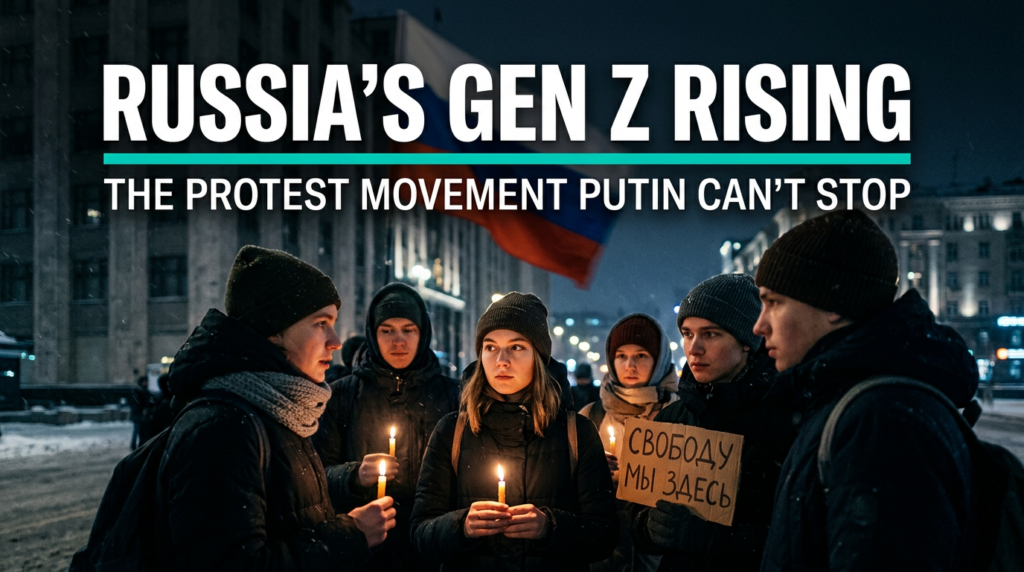
The young people Vladimir Putin counted on to carry his war forward are quietly, and sometimes not so quietly, saying no. From street musicians arrested for singing the wrong songs to mass protests over internet censorship, Russia’s Generation Z is becoming the regime’s most unpredictable threat.
It was supposed to be a routine afternoon on Nevsky Prospect, St. Petersburg’s grand boulevard. Instead, 18-year-old Diana Loginova — known online as “Naoko” — stood with her guitar and sang. Not propaganda anthems. Not war hymns. Anti-war songs. She was arrested. Released. Arrested again. Released again. Arrested a third time. Three “carousel arrests” in as many weeks, each stretch in detention lasting 13 days.
Her story went viral on TikTok under the hashtag #свободанаоко — “Free Naoko.” And when it did, something unexpected happened: dozens of young musicians across Russia took to the streets in solidarity. In Yekaterinburg. In Samara. In cities whose names rarely appear in Western headlines. They weren’t organized. They had no manifesto. They just picked up their instruments and played.
Support Independent Local Journalism
TheTownHall.News is a non-profit reader-supported journalism. Just $5 helps us hire local reporters, investigate important issues, and hold public officials accountable across Alameda County. If you believe our community deserves strong, independent journalism, please consider donating $5 today to support our work.That is the texture of Russia’s Gen Z resistance — decentralized, deeply personal, and impossible to fully crush without the Kremlin revealing exactly how afraid it is.
Why This Movement Matters Right Now
The timing could not be more significant. As ceasefire negotiations over Ukraine inch forward and Western attention drifts, the question of what happens inside Russia is often overlooked. The assumption — convenient for authoritarian apologists and lazy analysts alike — is that Russians are a monolith, passively obedient to whatever Putin dictates.
The data says otherwise.
A Levada Center survey published in April 2025 found that only 33% of Russians aged 18–24 believe the government should suppress anti-war sentiment — a striking rejection of state-enforced conformity by the very generation Putin’s propaganda machine most aggressively targeted. Separately, the Journal of Democracy published polling data showing 80% of young Russians support an immediate ceasefire with no preconditions, compared to just 55% of all respondents. Some 50% of 18-to-24-year-olds say they would have halted the invasion before it began.

These are not the numbers of a conquered generation.
The Free Speech Flashpoint: Russia’s Telegram Crisis
If the buskers and street artists represent Russia’s cultural resistance, the battle over Telegram represents something louder — a flashpoint that has united citizens across the political spectrum in rare open defiance.
In early March 2026, Russian authorities began throttling Telegram, the messaging platform used by an estimated 76% of the Russian population — roughly 93.6 million monthly users as of late 2025. The Kremlin cited regulatory violations. A total ban was threatened. Citizens in at least 11 Russian cities attempted to organize protests.
The regime’s response was almost comically authoritarian. In one city, a permitted rally was canceled two hours before it was set to begin. The official excuse? A “tree inspection.” In the Siberian city of Novosibirsk, authorities blocked the protest site with tape and detained 16 people who showed up anyway. Undeterred, 105 Novosibirsk residents filed a formal lawsuit against Roskomnadzor, Russia’s internet regulator.
What makes this story particularly striking is who is angry. Not just liberals or dissidents — but pro-Kremlin military bloggers who use Telegram to coordinate crowdfunding for troops and communicate from the front lines in Ukraine. Putin’s censorship machine, in its zeal for control, managed to alienate its own base.
Support Independent Local Journalism
TheTownHall.News is a non-profit reader-supported journalism. Just $5 helps us hire local reporters, investigate important issues, and hold public officials accountable across Alameda County. If you believe our community deserves strong, independent journalism, please consider donating $5 today to support our work.“When a government bans the tool its own soldiers depend on, it has stopped governing and started grasping.”
A Generation Built for Independent Thought
Understanding why Russian Gen Z resists requires understanding what shaped them. Unlike their parents — who came of age amid Soviet collapse, economic chaos, and a desperate craving for stability — young Russians grew up with the internet. They accessed information the state didn’t curate. They used VPNs. They watched YouTube. They compared notes with peers globally.
Only 18% of Russian youth fully trust government war information, according to 2023 polling. Their definition of patriotism also diverges sharply from the state’s. A 2023 survey found that just 15% of Gen Z respondents agreed that supporting the war constitutes “authentic patriotism.” The majority — 69% — defined patriotism as “doing something for your country that makes life better.” More than 80% of those aged 18–30 say patriotism is a personal choice, not a state mandate.
This is not apathy. It is a coherent, values-driven rejection of coerced loyalty — echoing the civic traditions that free societies have long held dear: personal responsibility, earned trust, and the right to dissent without being labeled a traitor.
What Critics Get Wrong
Some Western commentators dismiss Russian Gen Z resistance as marginal, pointing to high official approval ratings for Putin and the war. This misreads the evidence.
The Wilson Center and multiple independent researchers have documented “preference falsification” — Russians giving pro-regime answers on polls out of genuine fear. Researchers attribute much of the apparent rise in patriotic sentiment not to authentic feeling but to self-protective conformity in an environment where the wrong answer can mean arrest.
The real tell is behavioral data. Between 800,000 and 1.3 million Russians — disproportionately young, educated, and creative — fled the country following the February 2022 invasion. Those who stayed are not all silent either. Seventeen-year-old student Arseny Turbin has been imprisoned for over two years. Theater director Zhenya Berkovich and playwright Svetlana Petriychuk are both behind bars. According to “First Department,” a Russian legal defense project, 2025 broke the record for treason and espionage cases filed against Russian citizens.
Regimes that feel secure don’t arrest teenagers for playing guitar.
How This Affects the Broader Democratic World
The resistance of Russian youth is not just a domestic story. It has direct implications for the future of Ukraine, the long-term stability of Russia, and the credibility of authoritarian governance as a model worldwide.
Polling shows 70% of young Russian adults favor better relations with the West, compared to 58% of all Russians. Nearly half of 18-to-24-year-olds want Russia to rank among the world’s top economically developed nations — not a nuclear-armed superpower projecting force abroad. This is a generation with more in common with young Europeans and Americans than with the aging security-state officials who dominate the Kremlin.
Whether they shape Russia’s future depends, in part, on whether the democratic world pays attention.
Key Takeaway
Russia’s Generation Z is not the obedient nationalist cohort Putin’s propaganda promised. They overwhelmingly favor peace, distrust state media, and define patriotism in terms of civic contribution — not blind military loyalty. From street musicians to Telegram protesters, they are resisting in ways both small and significant. The Kremlin knows it. That’s why the arrests keep coming.
Conclusion: The Crack in the Wall
Authoritarianism is most dangerous when it looks invincible. It is most vulnerable when the generation it sought to mold refuses to be molded.
Russia’s Gen Z protesters are not storming the Kremlin. They are playing guitars on sidewalks, filing lawsuits over banned apps, and refusing to say what they’re supposed to say. These are not revolutionary acts in the Hollywood sense. But they are the oldest form of civic courage there is: the refusal, at personal cost, to pretend.
History suggests that when enough people stop pretending, even the most fortified walls develop cracks. The free world should be watching, should be supporting, and — above all — should not make the mistake of writing Russia’s youth off as just another column of marching soldiers.
Stay informed. Share this article. Independent journalism depends on readers who refuse to look away from stories that matter.