Should Banks Be Required to Verify Customer Citizenship? The Debate Every American Needs to Follow
A Question of Identity — and Accountability
Every American who opens a bank account hands over their name, address, date of birth, and a government-issued ID. It is a basic exercise in accountability — the kind of personal responsibility that underpins the entire financial system. So why, for decades, has the federal government asked banks to do almost nothing to verify whether a customer is legally present in the country at all?
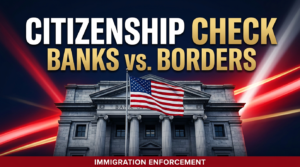
That question is now front and center in Washington. The Trump administration is reportedly considering an executive order that would require banks to collect citizenship information from customers — not just new account holders, but existing ones too. Reported first by the Wall Street Journal and confirmed by outlets including Axios, Bloomberg, and The Hill, the potential order would direct federal regulators, including the Treasury Department, the Office of the Comptroller of the Currency (OCC), and the Federal Deposit Insurance Corporation (FDIC), to build citizenship verification into existing Know Your Customer (KYC) banking rules.
The policy is still under deliberation. White House spokesman Kush Desai has cautioned that “any reporting about potential policymaking that has not been officially announced by the White House is baseless speculation.” But the debate it has sparked is real, and it matters — to every law-abiding American, every bank customer, and everyone who believes that a nation without enforceable borders is not a nation at all.
Support Independent Local Journalism
TheTownHall.News is a non-profit reader-supported journalism. Just $5 helps us hire local reporters, investigate important issues, and hold public officials accountable across Alameda County. If you believe our community deserves strong, independent journalism, please consider donating $5 today to support our work.What the Law Currently Requires — and What It Doesn’t
Under current federal law, U.S. banks are required to collect a customer’s name, date of birth, address, and an identification number — typically a Social Security number or Individual Taxpayer Identification Number (ITIN). These requirements, established under the Bank Secrecy Act and reinforced after 9/11, are designed to prevent money laundering and terrorist financing. What they do not require is any verification of citizenship or immigration status.
This is not an oversight. It is a policy choice — one that has allowed millions of people who are in the country illegally to access the American financial system. ITINs, issued by the IRS for tax purposes, have long served as a workaround. Federal law does not prohibit undocumented immigrants from opening bank accounts, and many large financial institutions actively market services to this population.
Senator Tom Cotton (R-Ark.) has called on Treasury Secretary Scott Bessent to investigate the issue and has pledged to introduce legislation, arguing that “preventing illegal migrants from accessing our banking system” is a logical extension of enforcing the law. Both sides raise legitimate points. But the core question is this: in a country that requires a passport to board a plane, a license to drive, and a background check to purchase a firearm — is it unreasonable to ask banks to know who their customers are?
The Conservative Case: Law, Order, and Accountability
The conservative argument rests on three pillars: the rule of law, fiscal accountability, and national sovereignty.

The rule of law is the foundation upon which every individual right and economic freedom in this country rests. When federal immigration law is systematically undermined — not by a court ruling or an act of Congress, but by bureaucratic inaction — the damage is real. A person who enters illegally has declined to participate in the legal process through which residency is lawfully granted. Extending full access to the American banking system is not compassion. It is the normalization of lawbreaking.
Fiscal accountability demands that public institutions not be turned into instruments of lawlessness. Banks operate under federal charters and enjoy federal deposit insurance — a framework the taxpayer ultimately backstops. When those institutions serve customers who are present illegally, they are, in a meaningful sense, using federally guaranteed infrastructure to subsidize illegal immigration.
National sovereignty extends to who participates in the economic life of the nation. Remittances — money wired from the U.S. to foreign countries — totaled over $60 billion in 2023, according to World Bank data. A significant portion originates with individuals not legally authorized to work or reside here. The distinction being drawn is not between American and foreign. It is between lawful and unlawful — a distinction a functioning society cannot afford to abandon.
The Practical Challenges: Honest Objections Deserve Honest Answers
Conservative credibility requires engaging seriously with the complications — and there are real ones.
The banking industry has already signaled concern. One financial services lobbyist described the proposed order as a “complete nightmare” logistically. Peter Dugas, CEO of Regulatory Intelligence Group, told American Banker that implementation would be a “heavy lift” for large institutions and an even greater burden for community banks, which lack the software infrastructure for citizenship documentation. Current account-opening platforms have no fields for citizenship verification, no image-scanning capability for birth certificates, and would cost tens of thousands of dollars per institution to update.
Support Independent Local Journalism
TheTownHall.News is a non-profit reader-supported journalism. Just $5 helps us hire local reporters, investigate important issues, and hold public officials accountable across Alameda County. If you believe our community deserves strong, independent journalism, please consider donating $5 today to support our work.There is also a legitimate concern for American citizens. The State Department reports that only about half of Americans hold a valid passport. Young adults, recently naturalized citizens, and married women whose legal names differ from birth certificates could all face friction. Comptroller of the Currency Jonathan Gould has suggested alternative documentation processes — similar to I-9 employment verification — could address this, and that is a workable model worth developing carefully.
These are not reasons to abandon the policy. They are reasons to implement it thoughtfully — with clear timelines, defined standards, and an explicit safe harbor for law-abiding citizens who face legitimate documentation hurdles. Policy that upholds the rule of law need not be punitive toward the law-abiding. That is the entire point.
A Broader Strategy: Making Illegal Presence Difficult to Sustain
This proposal does not exist in isolation. It is part of a broader strategy to reduce illegal immigration not only at the border but throughout the interior — by making it harder to work, access public benefits, and bank in the United States without legal status. The Small Business Administration took a parallel step this month, banning foreign nationals from accessing SBA-backed loans. FinCEN, Treasury’s financial intelligence unit, is also reportedly involved in the banking order discussions.
Critics call this “self-deportation.” Supporters call it something simpler: enforcement. The distinction matters. Sustained illegal presence depends on access to infrastructure — employment, housing, financial services. When that infrastructure is available regardless of legal status, illegal presence becomes rational and sustainable. When it is not, the incentive structure shifts. That is not cruelty. That is policy working as intended.
Conclusion: This Is About Principle, Not Politics
The debate over bank citizenship verification is, at its core, a debate about what kind of country the United States intends to be — one that enforces its laws consistently, or one that enforces them selectively depending on which enforcement is inconvenient.
Personal responsibility, accountability, and the rule of law are not abstract values. They are the operating system of a free and ordered society. When the government asks its citizens to follow the rules — and then refuses to apply those same rules to those who arrived by breaking them — it sends a message that the rules themselves are optional. That message is corrosive.
This proposal deserves serious, substantive national debate — not dismissal, not panic, and not demagoguery. Americans should ask hard questions about implementation and civil liberties. But they should also ask the harder question underneath: Does the law mean what it says? If it does, applying it here is not radical. It is simply governing.
📣 Call to Action
This debate is moving fast. Decisions made in Washington in the coming weeks will have lasting consequences for immigration enforcement, the banking industry, and the rule of law. Stay informed. Follow the legislative proposals from Sen. Tom Cotton and regulatory guidance from the Treasury Department and OCC.
If you believe that a secure, accountable, and lawful immigration system is essential to the future of this country — share this article, discuss it with your community, and contact your elected representatives. Policy is shaped by citizens who show up and speak up.
The conversation is happening. Make sure your voice is in it.
Sources: Wall Street Journal, The Hill, Axios, Bloomberg, American Banker, World Bank, U.S. State Department, Sen. Tom Cotton press release, White House statement.