Six Airmen Died in a KC-135 Crash During Operation Epic Fury — America Owes Them More Than Condolences
When six Americans fall from the sky in an aircraft older than their grandparents, it’s time to ask hard questions — and demand real answers.
A Nation Mourns — But Grief Without Accountability Is Not Enough
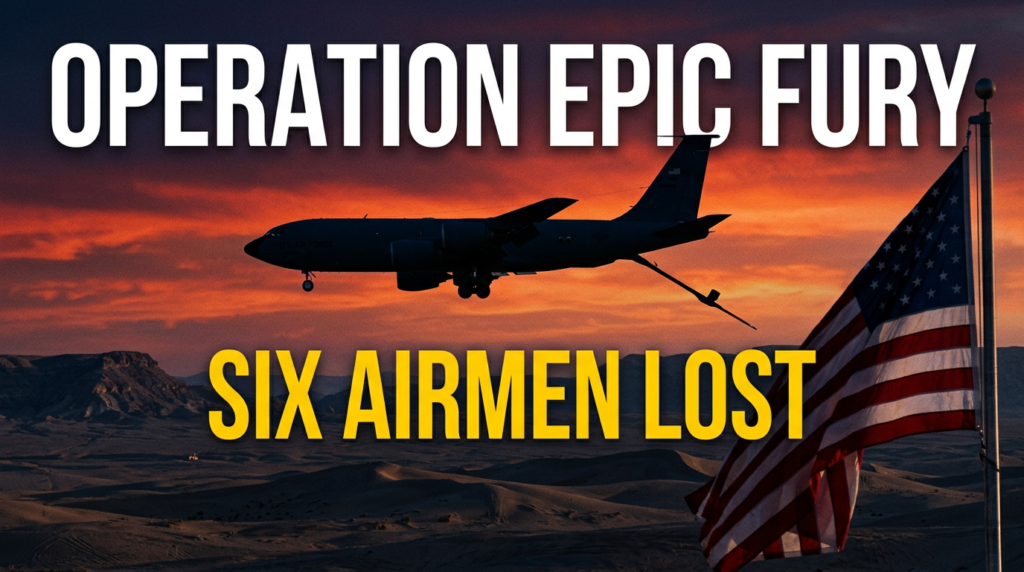
On the night of March 12, 2026, a U.S. Air Force KC-135 Stratotanker went down over western Iraq. All six crew members aboard were confirmed dead the following morning. They were flying a combat mission in support of Operation Epic Fury, America’s ongoing military campaign against Iran. The military confirmed the crash was not caused by hostile fire or enemy action. A second KC-135, also involved in the incident, landed safely — though with serious damage to its vertical stabilizer. Early indications suggest a midair collision between two American aircraft.
Let that sink in. Six Americans — sons, brothers, fathers, husbands — killed not by the enemy, but in circumstances that are now under investigation. Their deaths bring the total U.S. fatality count in Operation Epic Fury to thirteen in under three weeks.
Support Independent Local Journalism
TheTownHall.News is a non-profit reader-supported journalism. Just $5 helps us hire local reporters, investigate important issues, and hold public officials accountable across Alameda County. If you believe our community deserves strong, independent journalism, please consider donating $5 today to support our work.The nation is right to grieve. But grief, without accountability, is a disservice to the fallen. Honoring these airmen means asking the hard questions their sacrifice demands — about aging equipment, fiscal stewardship, military readiness, and the true cost of war. These are not partisan questions. They are patriotic ones.
Flying on Borrowed Time: The KC-135 Crisis
The KC-135 Stratotanker first entered U.S. Air Force service in 1957. Read that again: 1957. The average KC-135 in the fleet today is over 66 years old — older than most of the generals commanding the missions they support. These aircraft were built during the Eisenhower administration, when the Soviet threat defined American military doctrine and the first commercial jets were just entering service.
Today, they are the backbone of America’s aerial refueling capability, making up roughly 80% of the tanker fleet. Without them, American air power — the F-15s, the B-1 bombers, the surveillance aircraft — cannot project force across the vast distances of the Middle East. They are not optional. They are essential. And they are ancient.
The Air Force has known this for years. In fact, just this past February, the commander of Air Mobility Command testified that the service is “woefully behind” on modernizing its mobility aircraft, with a next-generation tanker not expected to be fielded until at least 2038. The KC-46A Pegasus was supposed to begin bridging that gap, but it has been plagued by delays, cost overruns, and capability shortfalls. Meanwhile, the men and women of the Air Force keep climbing into 66-year-old aircraft and flying into combat.
This is not a conservative or liberal failure. It is a Washington failure — the product of decades of budget gamesmanship, Pentagon bureaucracy, and the political cowardice to make long-term investments over short-term optics. Conservatives who believe in a strong national defense must be willing to hold their own institutions accountable. Strength is not a bumper sticker. It requires investment, discipline, and follow-through.
The Bill Is Coming Due: Fiscal Accountability in Wartime
Operation Epic Fury is, by any measure, an extraordinarily expensive undertaking. The Center for Strategic and International Studies estimated the first 100 hours of operations alone cost approximately $3.7 billion — or nearly $900 million per day. Broader estimates put the total direct cost to taxpayers at upward of $65 billion for the full operation. For context, that is more than the entire annual budget of the Department of Homeland Security.
Fiscal conservatives are right to support a strong military. But supporting the military is not the same as writing a blank check with no oversight. The same principles that demand accountability in domestic spending — where every dollar must be justified and waste must be rooted out — apply equally on the battlefield. War is not an exemption from fiscal responsibility; it is precisely where fiscal responsibility matters most.
That means Congress must ask: Are these resources being allocated wisely? Are we investing adequately in equipment that keeps our people alive? Are we getting measurable results commensurate with the cost? The fact that America is spending nearly a billion dollars a day while its airmen fly in aircraft built before the Vietnam War is not a sign of strength. It is a sign of misplaced priorities that have compounded over decades.
Personal Responsibility Runs Upward, Too
Conservatives have long championed the principle of personal responsibility — the idea that individuals must answer for their choices, that leadership carries weight, and that accountability is not optional. That principle does not stop at the individual. It runs upward through every institution: through squadron commanders, through Pentagon procurement offices, through congressional defense committees, and through the civilian leadership that sends men and women into harm’s way.
Support Independent Local Journalism
TheTownHall.News is a non-profit reader-supported journalism. Just $5 helps us hire local reporters, investigate important issues, and hold public officials accountable across Alameda County. If you believe our community deserves strong, independent journalism, please consider donating $5 today to support our work.The KC-135 has no ejection seats. When something goes wrong at 30,000 feet — a mechanical failure, a midair collision, a catastrophic systems error — the crew has no escape. They ride the aircraft to whatever fate awaits. That is not a fact to be accepted with a shrug. It is a moral weight that should sit heavily on the shoulders of every official who has signed off on keeping this aging fleet in combat rotation while modernization plans drift further into the future.
These six airmen upheld their end of the bargain. They showed up. They flew the mission. They served with honor. The question is whether Washington is upholding its end — equipping them properly, training them thoroughly, and deploying them wisely.
Law, Order, and the Rules of Engagement
It is also worth noting, plainly and without sensationalism, that this is the fourth American crewed aircraft lost in Operation Epic Fury — and none have been shot down by Iran. Three F-15s were destroyed in a friendly fire incident involving Kuwaiti aircraft on March 1. All three pilots ejected safely. Now a KC-135 is gone under circumstances that suggest a collision between allied aircraft.
None of this diminishes the legitimacy of the mission or the courage of those who fly it. But it does underscore a critical point: operational order, clear rules of engagement, and rigorous coordination in a complex, multi-national combat theater are not bureaucratic niceties. They are life-or-death imperatives. Law and order in war is not just about defeating the enemy — it is about protecting your own forces from the chaos and fog that combat inevitably generates.
Investigations must be thorough, transparent, and consequential. The American public deserves to know what happened on the night of March 12, and those charged with overseeing these operations must be held to account when systemic failures cost American lives.
Honor the Fallen by Demanding Better
The names of the six airmen have not yet been released — their families must be notified first, as decency and law require. But when those names are made public, they will represent six complete lives: six people who chose to serve, who accepted extraordinary risk on behalf of 330 million Americans, and who did not come home.
The best way to honor them is not simply to post their names on social media and move on. It is to demand that their deaths mean something — that they accelerate the modernization of aging fleets, sharpen operational coordination, and reinforce the principle that the United States government has a solemn obligation to give its warriors every possible advantage before asking them to risk their lives.
Traditional values include gratitude, duty, and the honoring of sacrifice. True gratitude is not passive. It calls us to act — to hold institutions accountable, to demand competent stewardship of military resources, and to ensure that no future crew climbs into a 66-year-old aircraft without the confidence that Washington has done everything in its power to bring them home.
A Call to Action
The story of these six airmen must not fade quietly into the news cycle. Stay informed — follow the investigation into this crash and demand transparency from CENTCOM and the Pentagon. Contact your representatives in Congress and urge them to prioritize real military modernization, not just defense budget headlines. Share this article with others who believe that supporting the troops means more than words — it means accountability, investment, and the moral seriousness that service demands. And when those six names are released, say them out loud. They earned that, at minimum.
Sources: U.S. Central Command (CENTCOM), Air & Space Forces Magazine, Breaking Defense, The Hill, CSIS, Defense One.