Taking the Fight to the Cartels: Why the US-Ecuador Military Alliance Is America’s Most Important Drug War Yet
When Anarchy Wins, Everyone Loses
On the morning of January 9, 2024, Ecuadorians watched in horror as masked, armed cartel members stormed a live television broadcast in Guayaquil, holding journalists hostage on air. At the same moment, gang leaders posted videos from inside prisons, knives pressed to the necks of guards, while other cells staged violent jailbreaks across the country. It wasn’t a movie. It was Tuesday in Ecuador.
That moment — brazen, choreographed, and utterly terrifying — crystallized what happens when a government loses control of its own territory. Cartels don’t just sell drugs. They seize institutions, silence the press, corrupt the judiciary, and terrorize ordinary families trying to live their lives in peace. Ecuador, once one of Latin America’s most stable nations with a homicide rate of just 6.7 per 100,000 in 2020, had become one of the most dangerous countries on earth. By 2025, that rate had exploded to 50.91 per 100,000 — surpassing Mexico, El Salvador, and Honduras, and making Ecuador the second most violent nation in Latin America, behind only war-torn Haiti.
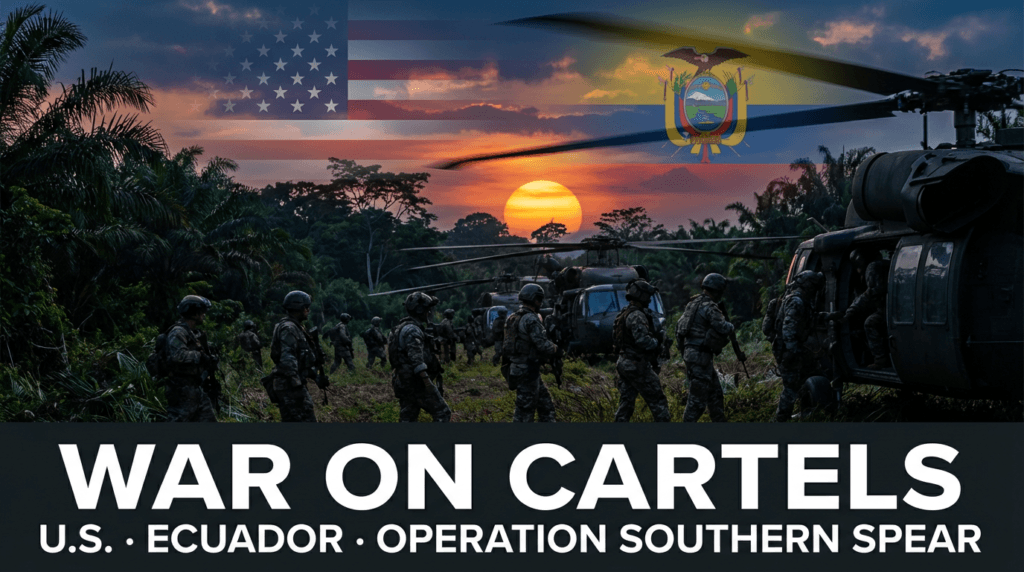
On March 3, 2026, the United States and Ecuador launched joint military raids against designated narco-terrorist organizations operating inside Ecuador. It was a decisive, long-overdue signal: the Western Hemisphere will no longer tolerate the cartel cancer that has metastasized from the cocaine fields of Colombia and Peru to the port cities of Ecuador — and ultimately to the streets of American towns.
A Nation Overrun: How Ecuador Got Here
Understanding why this joint operation matters requires understanding the full scope of Ecuador’s collapse — and the conservative lesson it teaches about the cost of weak governance.
Ecuador’s strategic Pacific coast ports made it an irresistible prize for transnational drug traffickers. When the Colombian FARC guerrillas demobilized in 2016, they left behind a power vacuum that dozens of competing criminal networks rushed to fill. Corruption in the judiciary reached staggering levels — one gang leader, Colón Pico of the Los Lobos gang, was released from prison six separate times by the same judge. With a 90% impunity rate for crimes in 2023, the message to criminals was clear: Ecuador is open for business.
The human cost is devastating. Child homicides increased by 640% between 2019 and 2024. Massacres surged from 30 in 2022 to 834 in 2023, spilling out of prisons and into civilian neighborhoods. In the coastal city of Durán — one of the world’s murder capitals — gangs extort residents, recruit schoolchildren, and have effectively replaced the government as the provider of basic services. This is what a failed state looks like from the inside.
The consequences have crossed borders. Irregular Ecuadorian migration to the United States jumped from 24,936 encounters at the southern border in 2022 to over 124,000 in 2024, as families flee a country where the rule of law has collapsed. Their desperation is a direct consequence of a governance failure that demands a serious response — not more of the same.
Noboa’s Mandate: Order Over Chaos
To his credit, Ecuadorian President Daniel Noboa has not flinched. Reelected in 2025 on a platform of law and order, Noboa declared an “internal armed conflict,” deployed the military, and committed a record $230 million toward security in 2026, including helicopters, drones, naval vessels, and new prison infrastructure. On March 3, just hours before the joint US raids were announced, Noboa imposed a nightly curfew — running 11 p.m. to 5 a.m. — in four of Ecuador’s most violence-ravaged provinces: Guayas, Los Ríos, Santo Domingo de los Tsáchilas, and El Oro.
His Interior Minister did not mince words: “Stay in your homes. We are at war.”
This is precisely the kind of decisive, unapologetic governance that conservatives have long argued is government’s most fundamental obligation. The first duty of any state is to protect its citizens. Not to manage crime. Not to study it. To confront it. Ecuador’s government is finally doing that — and it asked for America’s help.
That distinction matters enormously. This is not unilateral American adventurism. This is a sovereign nation, facing an existential threat, inviting a trusted ally to stand alongside it. The joint raids announced by US Southern Command on March 3 were led by Ecuadorian forces, with American personnel providing intelligence support and advisement. SOUTHCOM Commander Gen. Francis L. Donovan put it plainly: “Together, we are taking decisive action to confront narco-terrorists who have long inflicted terror, violence, and corruption on citizens throughout the hemisphere.”
Operation Southern Spear: America Takes the Gloves Off
The Ecuador raids did not emerge from a vacuum. They are the ground-level evolution of Operation Southern Spear, the Trump administration’s sweeping counter-narco-terrorism campaign launched in September 2025. Beginning with a decisive naval strike in the Caribbean that killed 11 Tren de Aragua members, the operation has expanded to include 44 confirmed strikes across the Caribbean Sea and Eastern Pacific Ocean, targeting drug-trafficking vessels operated by some of the hemisphere’s most dangerous criminal organizations.
President Trump made his position unambiguous when he declared drug cartels “unlawful combatants” and formally notified Congress in October 2025 that the United States was engaged in a “non-international armed conflict” with narco-terrorist networks. Secretary of State Marco Rubio summarized the doctrine with characteristic directness: “Instead of interdicting it, on the president’s orders, we blew it up. And it’ll happen again.”
Critics have raised objections, as they always do when America chooses action over passivity. But the strategic logic is sound — and the moral case is compelling. Over 107,000 Americans died from drug overdoses in 2023 alone, with fentanyl responsible for roughly 199 deaths every day. More than a quarter of a million Americans have been killed by fentanyl overdoses since 2021. The cocaine and fentanyl precursors flowing through Ecuador’s ports don’t stay in Ecuador. They end up in American communities, destroying families, overwhelming emergency rooms, and hollowing out the workforce.
When the drug trade is treated as a law enforcement nuisance rather than a national security threat, it wins. Operation Southern Spear — and now its land-based extension into Ecuador — reflects a clear-eyed understanding that this is a war, and wars must be fought to be won.
What’s at Stake: Conservative Principles in Practice
The US-Ecuador alliance embodies several principles that conservatives rightly hold dear.
Law and order is not optional. The breakdown of public safety in Ecuador is a case study in what happens when a society tolerates institutional corruption and criminal impunity. Noboa’s willingness to say “we are at war” and mean it — backed by military force, curfews, and real investment — reflects the conservative conviction that order is the prerequisite for freedom.
Sovereignty includes the right to defend it. Ecuador invited this partnership. That is multilateral cooperation at its best — strong nations standing together voluntarily against a common threat, without waiting for the approval of international bodies that have done nothing while Ecuadorian children were being slaughtered.
Fiscal accountability demands results. With Ecuador pledging $230 million and the US committing significant military assets, taxpayers on both sides deserve honest measurement of outcomes. The goal isn’t perpetual operations — it’s a degraded cartel infrastructure, reduced violence, and restored order. Those benchmarks must be tracked and published.
Protecting families is a moral imperative. Behind every overdose statistic is a mother, a father, a child. Behind every massacre number is a neighborhood terrorized into silence. The cartel economy is built on the destruction of families — and dismantling it is not just a security objective. It is a moral one.
The Road Ahead
Joint military operations are a beginning, not an ending. Ecuador’s long-term recovery will depend on judicial reform, anti-corruption efforts, and economic opportunity that gives young people a reason to reject gang recruitment. The United States can and should support those efforts too — through strategic aid, trade incentives, and technical assistance, not blank checks.
But the raids of March 3, 2026 are a statement of intent that deserves recognition. A beleaguered country finally has a government willing to fight, and an ally willing to stand beside it. After years of watching cartels act with impunity — kidnapping journalists, corrupting judges, and shipping poison to American streets — the tide may finally be turning.
The cartels bet that weak governance, slow institutions, and political timidity would always protect them. They may be reconsidering that bet.
The Bottom Line
Ecuador’s crisis did not develop overnight, and it will not be resolved overnight. But the joint US-Ecuador military operations launched this week represent the kind of bold, principled action that the moment demands. When law and order collapse, freedom collapses with it. When families can’t walk their children to school without fear, no amount of economic policy matters. And when drug cartels ship their product to American communities unchallenged, every American has a stake in the outcome.
This is not a war of choice. It is a war of necessity — and it is being fought the right way: with a willing partner, a clear objective, and the resolve to see it through.
📣 Call to Action
This story is bigger than the headlines. The US-Ecuador alliance is a front line in a battle that reaches into every American community touched by the drug crisis. Stay informed — follow developments from US Southern Command and credible regional news sources. Share this article with friends and family who believe in strong national security, law and order, and protecting American families from the cartel threat. And if you have a voice — in your community, your church, your local government — use it. Demand that your representatives treat the narco-terrorism crisis with the seriousness it deserves.
The cartels are organized. It’s time we are too.