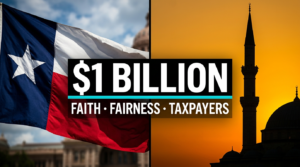
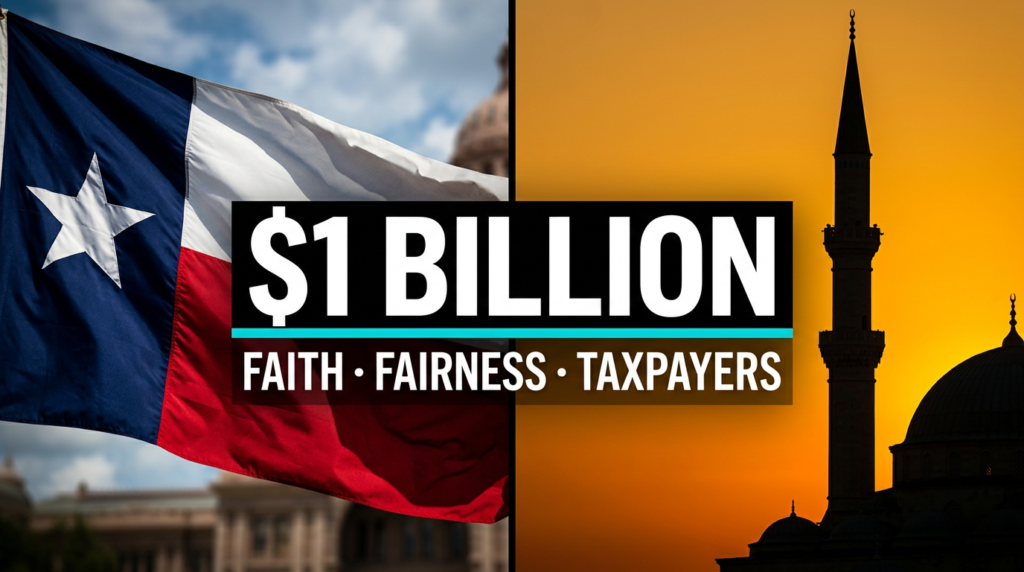
Texas School Vouchers and Islamic Schools: A $1 Billion Fight Over Faith, Fairness, and Taxpayer Money
A Bold Experiment With High Stakes
Texas just launched the largest day-one school choice program in American history — and within weeks, it was already in federal court.
Senate Bill 2, signed into law in 2025 by Governor Greg Abbott, created the Texas Education Freedom Accounts (TEFA) program and authorized $1 billion in public funding to give families real alternatives to a one-size-fits-all public school system. Families of private school students can receive up to $10,474 per child annually. Families of students with disabilities may access up to $30,000. Homeschoolers qualify for $2,000 per year.
Over 229,000 students applied — in a six-week window. The demand alone tells a story: Texas parents are hungry for choice.
Support Independent Local Journalism
TheTownHall.News is a non-profit reader-supported journalism. Just $5 helps us hire local reporters, investigate important issues, and hold public officials accountable across Alameda County. If you believe our community deserves strong, independent journalism, please consider donating $5 today to support our work.But the program’s promising debut has collided with a serious and unresolved controversy. Acting Comptroller Kelly Hancock excluded roughly two dozen Islamic private schools from participating, citing alleged ties to terrorist organizations. Muslim families sued. A federal judge intervened. And now the nation is watching Texas navigate a collision between national security concerns, religious freedom, fiscal accountability, and the foundational promise of school choice itself.
This is not a simple story — and it deserves more than simple takes.
The Case for School Choice: Parents Know Best
Let’s start with first principles. The core argument for school vouchers is not partisan; it is deeply American. Parents — not bureaucrats, not school boards, not teachers’ unions — are the most qualified people to determine what kind of education their children receive.
For decades, low- and middle-income families have been locked into assigned public schools based solely on their ZIP code, while wealthier families exercised choice freely by either paying private school tuition or simply moving to a better district. School choice programs level that playing field.

Texas’s TEFA program reflects exactly that philosophy. The $10,474 voucher represents 85% of the statewide average per-pupil spending in public schools — meaning the state still retains 15% per departing student, and public school districts are not left entirely empty-handed. Families gain access to private education that might otherwise cost $15,000–$30,000 per year.
Early demographic data from the Comptroller’s Office shows that 35% of applicants come from households earning $66,000 or less annually — working and middle-class families who have never had this kind of opportunity. That is not a giveaway to the elite. That is empowerment for the everyday Texan.
The Taxpayer Question: Is This Really New Spending?
Critics have been quick to paint TEFA as a $1 billion raid on the public treasury. The reality is more nuanced — but also carries a legitimate concern that fiscal conservatives should take seriously.
The $1 billion cap is fixed for the 2026–27 school year. The lottery system — which prioritizes students with disabilities from lower-income families first — means not every applicant will receive funding. Roughly 90,000 to 100,000 students are expected to be funded in year one.
Here’s the complication: approximately 71% of applicants were already attending private school or homeschooling before they applied. That means for the majority of TEFA recipients, the state is funding students it was not previously paying to educate in the public system. This is genuinely new expenditure, not a simple redirection of existing dollars.
Support Independent Local Journalism
TheTownHall.News is a non-profit reader-supported journalism. Just $5 helps us hire local reporters, investigate important issues, and hold public officials accountable across Alameda County. If you believe our community deserves strong, independent journalism, please consider donating $5 today to support our work.Supporters correctly argue that every child in Texas is entitled to a state education investment — and that families who have been paying taxes while educating their children privately have been subsidizing the public system without benefit for years. That argument has real moral weight. But policymakers must be honest: scale this program significantly beyond $1 billion, and the fiscal math demands scrutiny.
Fiscal responsibility is a conservative virtue. School choice can be — and should be — structured so that expanded opportunity doesn’t come at the cost of long-term budget discipline. Transparency, enrollment-linked funding mechanisms, and regular program audits are not enemies of school choice. They are the guarantors of its long-term credibility.
The Islamic Schools Controversy: Security, Faith, and the Law
Now to the most explosive dimension of this story.
Acting Comptroller Kelly Hancock excluded roughly 24 Islamic schools from TEFA participation, citing concerns that some were accredited by Cognia — an accrediting body whose events allegedly involved the Council on American-Islamic Relations (CAIR). Governor Abbott designated CAIR a terrorist organization in 2025. Attorney General Ken Paxton issued a legal opinion supporting the Comptroller’s authority to exclude schools linked to foreign terrorist organizations or foreign adversaries.
One Cognia-accredited school was further alleged to be “owned or controlled” by a group tied to the Chinese Communist government — though no specific evidence was publicly cited.
The question of how to handle organizations with alleged terrorist ties is not a trivial one. Law and order — including the enforcement of anti-terrorism statutes — is a bedrock conservative principle. If credible evidence exists that a school is materially linked to organizations that seek to harm Americans, no public dollar should flow there. Full stop.
But here’s where the argument must be intellectually honest: CAIR has not been designated a terrorist organization by the U.S. State Department, the FBI, or any federal authority. Governor Abbott’s designation carries political weight in Texas, but it does not carry the legal force of a federal designation. CAIR has sued Abbott over the label, calling it defamatory. A federal judge found the exclusion troubling enough to intervene — twice.
U.S. District Judge Alfred Bennett ordered the application deadline extended to March 31, required the state to allow the suing Islamic schools to register, and called it “troubling” that no Muslim schools had been approved. After the order, four of the suing schools were admitted.
Conservatives who believe in the rule of law must grapple with this: applying a terrorism label to dozens of schools based on a state-level executive designation — without federal backing, without a transparent evidentiary standard, and without due process — is not law and order. It is executive overreach. The same government power that can exclude Islamic schools today can be turned against any religious institution tomorrow. That is not a hypothetical; it is the lesson of every era in which government has been trusted to selectively define legitimacy in matters of faith.
Parental Rights Cannot Be Selectively Applied
There is another principle at stake here that conservatives should not sidestep: parental rights must be universal to be meaningful.
If the animating philosophy of TEFA is that parents — not the government — should direct their children’s education, then that right cannot be reserved only for families whose faith the state finds acceptable. Muslim families in Texas pay taxes. They work, build businesses, serve in the military, and raise children they love. The promise of school choice was that government would get out of the business of telling families where their children must learn.
Excluding Muslim schools wholesale — without individualized findings of wrongdoing, without transparent criteria applied equally to all religious institutions — undermines the very principle the program is built on. Conservatives who would rightly object to a liberal administration excluding Christian schools from a voucher program on ideological grounds must apply that same standard here.
Religious freedom and parental rights are not cafeteria principles. They apply to every American, regardless of their faith tradition.
What a Principled Path Forward Looks Like
Texas has built something genuinely historic with TEFA. The demand from families — across income levels, across regions — is proof that school choice works. The program deserves to succeed, and it can. But doing so requires getting the fundamentals right.
On fiscal accountability: The state must be transparent about how many TEFA recipients were already outside the public school system, and model the long-term budget impact honestly. Choice should not become an unfunded mandate.
On security and exclusions: Any school excluded from a public program must be excluded based on clear, federally recognized, legally defensible criteria — applied uniformly across all faiths. Evidence should be public. Due process must exist. Executive proclamations alone are not sufficient grounds to deny public benefits.
On parental rights: Extend the promise consistently. If school choice is a right, it should not come with a religious litmus test administered by the governor’s office.
Conclusion: Freedom Means Freedom for Everyone
Texas’s school voucher program represents one of the most significant expansions of parental rights and educational freedom in modern American history. It is a model worth protecting — and worth getting right.
The Islamic school controversy is not a sideshow. It is a test of whether Texas conservatives believe in the principles they champion. Fiscal discipline, the rule of law, parental rights, and religious freedom are not contradictions. Upheld together, they make the case for school choice unassailable. Compromised selectively, they invite the very legal and political chaos now unfolding in federal court.
Stand for choice. Stand for accountability. Stand for freedom — for every Texas family.
Call to Action
Stay informed and get involved. The next court hearing in this case is set for late April 2026 — and its outcome could shape school choice programs across the country. Share this article with fellow Texans who care about parental rights, fiscal responsibility, and religious freedom. Contact your state legislators to demand transparent, legally sound criteria for school eligibility in TEFA. And if you have a child who qualifies, visit EducationFreedom.Texas.Gov before the March 31 application deadline. The future of Texas education is being written right now — make sure your voice is part of it.
Sources: Texas Tribune · Texas Comptroller’s Office, Fiscal Notes (February 2026) · Houston Chronicle · The Hill · AP News · Community Impact · San Antonio Report · Houston Public Media · Texas Attorney General’s Office · Washington Post