The $120-to-$81 Oil Crash in One Day: A Wake-Up Call America Cannot Afford to Ignore
The Day the Market Went Manic
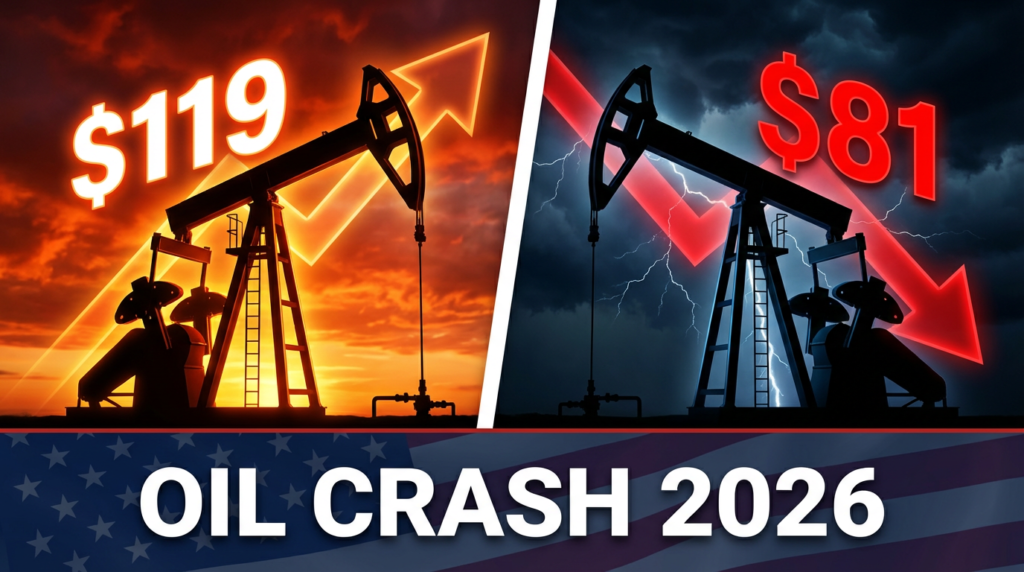
On the morning of Monday, March 9, 2026, American consumers woke up to something unprecedented in modern financial history. Crude oil, which had surged to a stunning $119.48 per barrel — its highest price in years — came crashing back below $84, and then below $81, all within a single 24-hour window. The swing represented a jaw-dropping 32% collapse, the largest single-day percentage drop in oil market history. Gas prices, which had already climbed to a national average of $3.45 per gallon as recently as March 8, had been threatening record highs. Families planning their weekly commutes, small business owners managing fleets, and farmers pricing their harvests were caught in the crossfire of a geopolitical crisis that should never have been allowed to reach this level.
This is not just a story about commodity markets. It is a story about what happens when America’s energy security is held hostage to foreign conflict, when government indecision whips financial markets like a toy, and when working families — not Wall Street traders — pay the ultimate price.
How We Got Here: The Hormuz Hostage Crisis
The root cause of this historic volatility is not mysterious. The Strait of Hormuz — the narrow waterway between Iran and Oman through which approximately one-fifth of the world’s oil supply passes — was effectively shut down following U.S. and Israeli military operations against Iran. Tanker traffic through the strait dropped sharply. Major Gulf producers, including Saudi Arabia, the UAE, Kuwait, and Iraq, began cutting output as storage facilities filled with crude they could no longer ship. The result was a textbook supply shock, and oil markets responded accordingly, surging over 40% in just days.
Support Independent Local Journalism
TheTownHall.News is reader-supported journalism. Just $5 helps us hire local reporters, investigate important issues, and hold public officials accountable across Alameda County. If you believe our community deserves strong, independent journalism, please consider donating $5 today to support our work.Then, just as suddenly, President Trump told CBS News that the United States was “thinking about taking over” the Strait of Hormuz to ensure shipping continuity, and added that the war with Iran would end “very soon.” Markets instantly reversed. Traders who had bet on a prolonged blockade liquidated their positions in a panic. Oil collapsed.
To be clear: the President’s swift, assertive posture — committing U.S. naval power to protect global shipping lanes — was the right instinct. American strength has always been the best guarantor of international stability. But the episode lays bare a deeper, more uncomfortable truth: the United States should never be in a position where a single presidential statement can move oil markets by 30% overnight. That kind of vulnerability is not strength. It is exposure — and American families are the ones who bear it.
Working Americans Don’t Have a Hedge Fund
While commodity traders scrambled to cover short positions and investment banks issued breathless bulletins, the reality for most Americans was far less abstract. Gasoline had already jumped more than 50 cents per gallon in a matter of weeks, touching $3.60 per gallon in many markets. Economists warned that if crude had stabilized near $125 per barrel, U.S. GDP could have contracted by at least 0.8% and consumer inflation could have pushed toward 4% — a number that would have devastated household budgets still recovering from years of post-pandemic price pressure.
Small business owners running delivery routes, construction contractors managing diesel costs, and rural families who drive long distances every day do not have the luxury of “hedging” their fuel exposure. They simply pay more — or they go without. Every spike at the pump is a regressive tax on the working and middle class. Conservative principles have long recognized this truth: inflation is not an abstraction. It is a direct assault on the purchasing power and personal dignity of every hardworking American.
The fact that markets can gyrate this violently — that $120 oil and $81 oil can coexist in the same calendar day — is not a sign of a healthy, functional energy economy. It is a symptom of dangerous overdependence on a single chokepoint controlled, in effect, by a hostile foreign regime.
The Conservative Case for Energy Independence
This crisis is, at its core, an argument for what conservatives have championed for decades: robust, unapologetic American energy independence. The United States has the natural resources, the technological capability, and the workforce to produce enough oil, natural gas, and alternative energy to insulate itself — and its allies — from the kind of geopolitical blackmail that just sent markets into a historic tailspin.
For years, common-sense energy development in America has been slowed by regulatory overreach, permitting bottlenecks, and an ideologically driven hostility toward domestic fossil fuel production. Every time a drilling permit is denied, a pipeline is blocked, or a refinery project is killed in committee, America becomes a little more vulnerable to exactly the kind of crisis we just witnessed. Energy policy is national security policy. They are inseparable.
The G7’s announcement that it stood ready to release strategic petroleum reserves was welcome, but it is also a reminder that strategic reserves are meant to be a backstop — not the primary plan. A nation that must constantly dip into emergency buffers has failed to build the baseline resilience that responsible governance demands. Fiscal conservatism means building strength before a crisis, not scrambling after one.
Markets Cannot Replace Strategy
There is a temptation, in watching the oil price swing reverse so sharply, to conclude that the market “worked.” But this misreads what actually happened. The market did not solve the problem. One statement from one official, interpreted one way by traders, caused a forced liquidation event. The underlying physical reality — restricted tanker traffic, curtailed Gulf production, genuine supply tightness — had not changed.
Analysts noted the situation remains binary: if tanker traffic through Hormuz stays restricted and production cuts continue, oil could roar back toward $100 per barrel or beyond. The Brent crude futures market had already been showing strong backwardation — a technical signal that physical supply shortages were real, not imagined. One reassuring presidential comment does not reopen a strait or restart a refinery.
This is precisely why law, order, and strategic resolve — not wishful market optimism — must anchor American energy policy. The job of government is not to react to crises with press statements. It is to prevent crises through strength, preparation, and principled leadership.
What Must Come Next
The immediate volatility may subside. Oil is trading around $87 per barrel — still elevated, still uncertain. But the structural lesson of this week must not be lost in the relief of a price correction. America needs:
- Expanded domestic energy production — streamlined permitting, support for U.S. oil, gas, and refining capacity, and an end to regulatory warfare against American energy workers.
- Strategic reserve replenishment and reform — reserves should be rebuilt and managed as true national security assets, not political tools.
- Diversified allied supply chains — stronger energy partnerships with Canada, Australia, and other stable allies reduce the leverage of hostile regimes.
- Fiscal discipline in energy policy — subsidies and mandates that distort markets create fragility. Real energy security is built on production capacity, not government engineering.
Conclusion: Strength Is the Only Stability
What happened on March 9, 2026, was not just an extraordinary day in commodity markets. It was a warning. A nation that allows a foreign chokepoint to determine the price of heating a home, filling a gas tank, or moving goods across the country has surrendered something essential.
Conservative principles are ultimately about ensuring that the American people remain masters of their own destiny: free to work, free to build, free to prosper, without being held hostage to foreign adversaries or perpetually reactive government policy. Energy independence is not a luxury. It is a prerequisite for freedom.
The question is not whether America can achieve it. We have the resources, the ingenuity, and the workforce to do it. The question is whether our leaders have the will.
📣 Call to Action
Don’t let this story disappear in the next news cycle. The energy crisis of March 2026 is a direct consequence of years of policy failures — and the next one will be worse if we do nothing. Share this article with your network, contact your representatives, and demand a serious, long-term American energy strategy. Stay informed at The Town Hall for ongoing coverage of the issues that matter most to hardworking Americans.