The 2026 Iran War: Why Decades of Weakness Made This Inevitable — and What America Must Get Right Now
A World Changed in 12 Hours
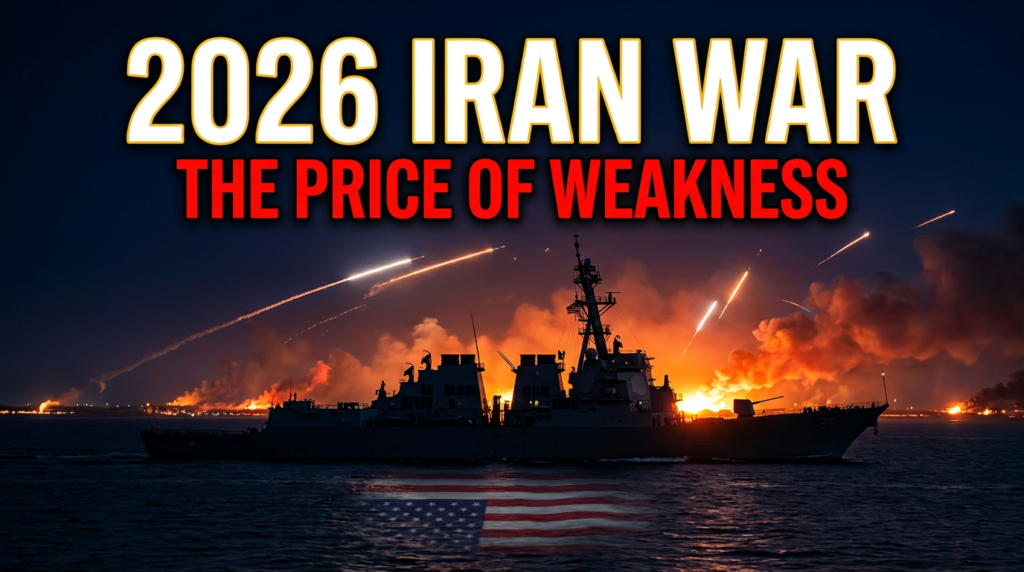
At dawn on February 28, 2026, the United States and Israel launched one of the most decisive and concentrated military campaigns in modern history. In just twelve hours, approximately 900 airstrikes sliced through Iran’s military infrastructure — missile launchers, air defense systems, IRGC command centers, and the very institutions that had enabled three decades of Iranian-sponsored terrorism and regional destabilization. Supreme Leader Ali Khamenei, the theocratic architect of so much Middle Eastern suffering, was killed in the opening wave.
The 2026 Iran War — dubbed Operation Epic Fury — did not begin on February 28. It began in 1979, when the international community first failed to hold Iran accountable. What we are witnessing today is not the recklessness of a trigger-happy administration. It is the long-overdue reckoning for generations of diplomatic half-measures, appeased dictators, and failed nuclear deals that kicked the can down the road while Iran armed itself to the teeth.
For those who believe in peace through strength, limited government, and fiscal and moral accountability on the world stage, the lessons from this war are both vindicating and sobering — and the stakes could not be higher.
Support Independent Local Journalism
TheTownHall.News is a non-profit reader-supported journalism. Just $5 helps us hire local reporters, investigate important issues, and hold public officials accountable across Alameda County. If you believe our community deserves strong, independent journalism, please consider donating $5 today to support our work.Decades of Weakness Built This Crisis
To understand what is happening in the Persian Gulf today, you must understand what was allowed to fester for decades. Iran’s ballistic missile program didn’t materialize overnight. By the time Operation Epic Fury launched, Iran possessed approximately 470 operational missile launchers capable of striking targets across the entire Middle East. Tehran had supplied Hezbollah with hundreds of thousands of rockets, backed the Houthis in Yemen, funded militias across Iraq and Syria, and — most alarmingly — continued its uranium enrichment program despite international prohibitions.
The 2015 Joint Comprehensive Plan of Action (JCPOA), sold to the American public as a diplomatic triumph, bought Iran billions in sanctions relief while allowing it to maintain its nuclear infrastructure and — critically — placed no meaningful restrictions on its ballistic missile program. When the Trump administration withdrew from the JCPOA in 2018, critics screamed. History is now rendering its verdict: the deal was a delay, not a solution.
Those who champion limited government and fiscal responsibility understand a foundational truth that the foreign policy establishment has repeatedly ignored: you cannot negotiate with an actor whose stated goal is your destruction. Containment without consequence is not a policy — it is a subsidy for aggression.
Kuwait: An Ally in the Crossfire
One of the most under-reported stories of this conflict is what has happened to Kuwait — a close American ally and a nation that knows the horror of invasion firsthand, having endured Saddam Hussein’s brutal occupation in 1990.

Since February 28, Iran has launched hundreds of retaliatory ballistic missiles and drones at US military bases and civilian infrastructure across the Gulf — striking Kuwait, Bahrain, the UAE, Saudi Arabia, Iraq, Qatar, Jordan, and Oman. Kuwait’s air defenses have neutralized at least 26 Iranian projectiles. Kuwait City has suffered explosions, transmission line damage, and deep civilian anxiety. On March 20, Iran struck a Kuwaiti oil refinery in a direct attack on the Gulf nation’s economic lifeline.
This is not a war Kuwait chose. It is a war that came to Kuwait because Iran uses terror and indiscriminate missile fire as tools of statecraft. Every Iranian drone that Kuwaiti soldiers shot down is a reminder that American alliances have real value — and that when America projects strength, its friends benefit. When America retreats or appeases, its friends bleed.
The traditional conservative principle here is clear: America’s word must mean something. Alliances built on American strength protect not just our interests, but the lives of civilians in Kuwait City, Bahrain, and Tel Aviv.
The Fiscal and Strategic Cost of Delay
Conservatives have long argued for fiscal accountability in government — the idea that every dollar spent must be justified, that waste and inefficiency carry real consequences. The same logic applies to foreign policy.
Consider the arithmetic of appeasement. The Obama administration’s JCPOA released an estimated $150 billion in frozen Iranian assets. Iran used those funds to deepen its proxy network — funding Hezbollah, arming the Houthis, and accelerating missile production. The billions now being spent on Operation Epic Fury, the destruction of Gulf infrastructure, the disruption of global oil markets (20% of the world’s oil transits the Strait of Hormuz), the more than 2,000 dead across Iran, Lebanon, and Israel, the hundreds of thousands displaced in Lebanon — this is the compound interest on a debt of diplomatic negligence.
Support Independent Local Journalism
TheTownHall.News is a non-profit reader-supported journalism. Just $5 helps us hire local reporters, investigate important issues, and hold public officials accountable across Alameda County. If you believe our community deserves strong, independent journalism, please consider donating $5 today to support our work.Fiscal accountability is not just about balancing budgets. It is about making hard decisions today to prevent catastrophically expensive crises tomorrow. A military strike against Iran’s nuclear infrastructure a decade ago would have been controversial. The bill the world is now paying — in blood, treasure, and economic disruption — is incomparably higher.
Law, Order, and the Rules-Based World
Conservatives believe in law and order — not as a slogan, but as a foundational principle of civilized society. That principle does not stop at America’s borders.
Iran has spent decades violating international law with near-total impunity: seizing oil tankers, sponsoring designated terrorist organizations, assassinating dissidents on foreign soil, and — on January 8, 2026 — killing at least 30,000 of its own citizens who rose up in protest against the regime. Thirty thousand people. Let that number sit for a moment.
A world in which state sponsors of terrorism face no meaningful consequence is not a world governed by law. It is a world governed by fear — and by whoever is willing to be the most ruthless. The Israeli Defense Forces have now destroyed or rendered inaccessible approximately 330 of Iran’s 470 missile launchers. That is not aggression. That is the disarmament of a regime that, by any honest accounting, forfeited its right to those weapons through decades of their threatened and actual use against civilians.
What Must Come Next: Accountability, Not Chaos
This is where conservative principles must guide the post-conflict vision. Military strength is necessary — but it is not sufficient. What comes after Operation Epic Fury matters enormously, and it is here that American leadership must be sober, strategic, and principled.
The Trump administration has signaled openness to a negotiated arrangement with Iran’s new leadership — an Iran that ceases uranium enrichment, relinquishes its nuclear stockpiles, and pulls back its missile posture. That is the right framework, if — and only if — it is enforced with real mechanisms and real consequences for violation. A deal without structural reform will simply rebuild the threat on a delayed timeline.
The Iranian people — millions of whom took to the streets in protest before being slaughtered by their own government — deserve more than a reshuffled theocracy. America’s commitment to free speech, individual liberty, and government accountable to its people is not merely domestic policy. It is, at its best, a beacon. Post-war Iran must see a genuine path toward those values, not simply a new set of rulers operating with the same ideological DNA.
Parental rights and traditional values remind us that ordinary Iranian families — mothers, fathers, children — are victims of this regime, not its authors. A just peace must account for their dignity, not just strategic interests.
Conclusion: The Price of Strength Is Worth Paying
The 2026 Iran War is a tragedy. Every war is. But it is a tragedy with a traceable cause: the sustained failure of the international community — and several American administrations — to hold a dangerous, destabilizing, and openly hostile regime accountable for its actions.
Conservatives have argued for decades that strength deters conflict, that accountability prevents catastrophe, and that the costs of action must always be weighed against the far greater costs of inaction. The Persian Gulf is now a case study in what happens when those arguments are ignored long enough.
America has a responsibility to its allies in Kuwait, Bahrain, and across the Gulf. It has a responsibility to the people of Israel, who have absorbed over 400 Iranian ballistic missiles since February 28. It has a responsibility to the global economy, to the families of its service members stationed across the region, and to future generations who will inherit whatever order — or disorder — this moment produces.
That responsibility demands clarity, resolve, and — above all — the willingness to finish what has been started with the same strength and seriousness with which it began.
📣 Call to Action: Don’t Let the Narrative Be Written Without You
The mainstream media is already muddying the waters on who is responsible for this conflict and what American principles demand of our leadership. Don’t stand on the sidelines.
📌 Share this article with friends, family, and fellow citizens who care about American strength, accountable governance, and a world where law and order prevail over terror and appeasement.
📌 Contact your representatives in Congress and demand that any post-war Iran agreement includes iron-clad enforcement mechanisms — not another deal built on good faith with a regime that has earned none.
📌 Subscribe to The Town Hall News for daily fact-checked, principled coverage of the 2026 Iran War and its implications for America and the world.
The stakes are too high for silence. Speak up, get involved, and never stop holding power accountable.
Sources: Britannica (2026 Iran War), Institute for the Study of War (ISW) Special Report, March 23, 2026 · CNN · Times of Israel · BNN Bloomberg · Iran International · ACLED Middle East Special Report, March 2026