The Epstein Files Debacle: How Government Incompetence Failed Victims Again
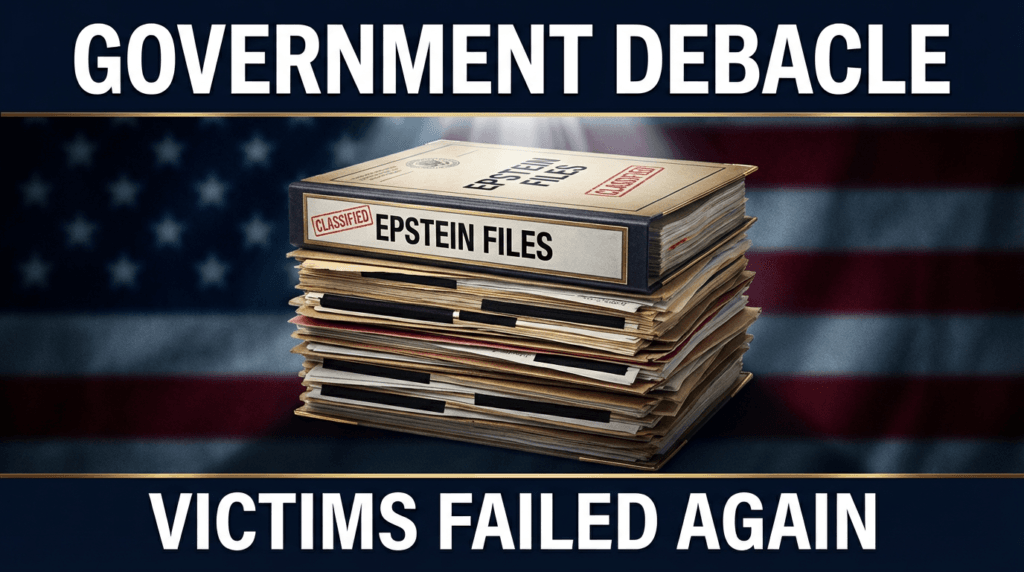
On January 30, 2026, the Department of Justice released 3.5 million pages of investigative files related to convicted sex offender Jeffrey Epstein—a document dump so massive it included 2,000 videos and 180,000 images. For Americans who believe in the rule of law, government accountability, and justice for victims, this moment represents both a long-overdue victory for transparency and a damning indictment of institutional failure.
The release, mandated by the Epstein Files Transparency Act signed into law on November 19, 2025, should never have required congressional intervention. That it did reveals a troubling pattern: government agencies protecting their own interests over the public’s right to know, and victims’ rights taking a back seat to bureaucratic convenience.
For those who value limited government, the rule of law, and personal accountability, the Epstein case—and the government’s handling of it—offers critical lessons about what happens when institutions prioritize self-preservation over justice.
Support Independent Local Journalism
TheTownHall.News is a non-profit reader-supported journalism. Just $5 helps us hire local reporters, investigate important issues, and hold public officials accountable across Alameda County. If you believe our community deserves strong, independent journalism, please consider donating $5 today to support our work.The Transparency Fight: Why It Took an Act of Congress
The Epstein Files Transparency Act passed both the House and Senate with overwhelming bipartisan support, giving Attorney General Pam Bondi just 30 days to release all unclassified documents related to the Epstein investigation. The law’s passage came after months of public pressure, broken promises, and mounting frustration from Americans across the political spectrum who demanded answers.
This shouldn’t have been necessary. The Department of Justice works for the American people, not the other way around. When government agencies hoard information about one of the most notorious criminal cases in modern history—a case involving the exploitation of minors by a well-connected predator who moved freely among the nation’s elite—something is fundamentally broken.
The DOJ initially missed its December deadline, claiming it needed more time to process materials. Deputy Attorney General Todd Blanche announced Friday that the department had now fulfilled its legal obligations, releasing what he described as “substantially all” relevant records. But even this supposedly comprehensive release raises serious questions about government competence and commitment to transparency.
Protecting Victims or Protecting Institutions?
Perhaps the most disturbing revelation from Friday’s release is that numerous victims’ names appear unredacted throughout the documents—despite explicit DOJ assurances that personally identifying information would be protected.

Brad Edwards, an attorney representing hundreds of Epstein’s survivors, told ABC News his office was “getting constant calls from victims because their names, despite them never coming forward, being completely unknown to the public, have all just been released for public consumption.” He described “literally thousands of mistakes” in the redaction process.
ABC News independently confirmed multiple instances of victims’ names appearing in the released documents—women whose names had never before been publicly associated with the case, now exposed to the world because of government incompetence.
This is inexcusable. These women suffered unimaginable trauma at the hands of a predator. They deserved better from the justice system then, and they deserve better now. The government’s failure to properly redact their information isn’t just sloppy—it’s a violation of their fundamental rights to privacy and dignity.
Edwards’s proposed solution was straightforward: “Take the thing down for now. There’s no other remedy to this. It just runs the risk of causing so much more harm unless they take it down first, then fix the problem and put it back up.”
That the DOJ released millions of pages without conducting basic quality control on victim identification speaks to a deeper problem: government agencies more concerned with checking boxes and meeting deadlines than actually protecting the people they’re supposed to serve.
Support Independent Local Journalism
TheTownHall.News is a non-profit reader-supported journalism. Just $5 helps us hire local reporters, investigate important issues, and hold public officials accountable across Alameda County. If you believe our community deserves strong, independent journalism, please consider donating $5 today to support our work.The Cost of Institutional Self-Protection
The Epstein case has been plagued by institutional failure from the beginning. In 2006, Florida federal prosecutors charged Epstein with having sex with a minor. What should have been a straightforward prosecution of a wealthy predator instead became a case study in how power and connections can corrupt justice.
Epstein reached a secret nonprosecution agreement that allowed him to plead guilty to state charges involving a single underage victim. The result? Thirteen months in a Palm Beach County jail, where he was permitted to leave almost daily via a work-release program and maintain his own private security detail.
This sweetheart deal—orchestrated behind closed doors, hidden from victims—represented everything wrong with a two-tiered justice system. Regular Americans who commit far lesser crimes face harsh sentences and public condemnation. Yet a man who systematically exploited dozens of minors received treatment more befitting a white-collar criminal who’d committed accounting fraud.
When Epstein was finally charged again in 2019 by Manhattan federal prosecutors with sex trafficking of minors, justice seemed within reach. Then he died in a New York jail cell while awaiting trial—a death ruled a suicide that fueled years of conspiracy theories and public skepticism about official narratives.
The government’s response? In July 2025, the DOJ and FBI announced that an “exhaustive review” had uncovered no evidence justifying further investigation of other individuals. Despite earlier pledges of transparency, they declared no more information would be released.
This decision sparked outrage among Americans who believed—rightly—that Epstein didn’t operate alone. His black book contained names of presidents, princes, billionaires, and celebrities. His private island saw a parade of powerful visitors. Yet the government expected the public to accept that no one else warranted investigation?
The Principle of Equal Justice Under Law
At its core, the Epstein case raises fundamental questions about whether America truly maintains equal justice under law—a principle conservatives hold sacred.
The Constitution doesn’t guarantee special treatment for the wealthy and well-connected. It doesn’t create carve-outs for those who vacation with presidents or donate to the right causes. Yet the Epstein case suggests that in practice, our justice system operates with a sliding scale based on power and influence.
This should offend anyone who believes in the rule of law. Justice isn’t justice if it’s selective. Accountability isn’t accountability if it only applies to the powerless.
The fact that it took massive public pressure, congressional action, and a new administration to force the release of these files demonstrates how resistant government institutions are to transparency—especially when that transparency might expose their own failures or implicate powerful people.
What the Files May Reveal—and What They Won’t
Deputy Attorney General Blanche pushed back Friday on speculation that the DOJ possessed a secret “client list” of men who abused women in connection with Epstein. He insisted the department “did not protect President Trump” or anyone else.
These denials may be technically accurate, but they miss the larger point. The public’s demand for transparency isn’t about partisan witch hunts or conspiracy theories. It’s about accountability—ensuring that anyone who participated in or enabled Epstein’s crimes faces consequences, regardless of their wealth, status, or political connections.
The released materials include “large quantities of commercial pornography and images that were seized from Epstein’s devices,” some taken by Epstein himself, according to Blanche. They include correspondence, court documents, and photos—some marked “CSAM” (child sex abuse material)—that paint a disturbing picture of systematic abuse.
But what they likely won’t include is a comprehensive accounting of everyone who knew what Epstein was doing and looked the other way. They won’t explain why so many powerful people maintained relationships with a known predator. They won’t detail which institutions failed to act on warning signs.
Those answers require not just document releases, but genuine investigation and accountability—something the government has shown little appetite for.
The Broader Implications for Limited Government
The Epstein case offers important lessons for those who advocate limited government and skepticism of unchecked institutional power.
First, it demonstrates that government agencies, left to their own devices, will prioritize self-protection over transparency. The DOJ fought against releasing these files, missed deadlines, and only complied when forced by law. This pattern repeats across agencies and administrations: information is hoarded, mistakes are buried, and accountability is avoided.
Second, it shows that government competence cannot be assumed. The failure to properly redact victim information in a release this significant isn’t a minor oversight—it’s evidence of systemic dysfunction. If the DOJ cannot execute basic quality control on its most high-profile transparency effort, what does that say about its handling of routine matters the public never sees?
Third, it reinforces that power corrupts, and concentrated power corrupts absolutely. The original Epstein plea deal happened because prosecutors, operating with minimal oversight and maximum discretion, chose to accommodate a wealthy defendant. The subsequent cover-ups and resistance to transparency happened because institutions protect themselves first and serve the public second.
The Path Forward: Real Accountability Requires Real Consequences
Releasing documents is a start, but it’s not enough. True accountability requires consequences.
Congress should investigate why the DOJ initially resisted transparency, missed deadlines, and failed to protect victim information. Those responsible for the redaction failures should face professional consequences. The attorneys who negotiated Epstein’s 2008 sweetheart deal should answer for their decisions.
More broadly, Americans should demand reforms that make government agencies more accountable and less able to operate in secrecy. Transparency shouldn’t require acts of Congress. Protecting victims shouldn’t be an afterthought. Equal justice shouldn’t be a slogan—it should be a reality.
The victims in this case deserved better from the justice system. They deserved prosecutors who fought for them rather than accommodating their abuser. They deserved a government that protected their privacy rather than exposing them through incompetence. They deserved justice.
We owe them—and all Americans—a system that delivers on those basic promises.
A Test of Our Commitment to Justice
The Epstein files release represents more than just another news cycle. It’s a test of whether our society genuinely values accountability, transparency, and equal justice—or whether those principles are merely rhetoric deployed when convenient.
For conservatives who believe in limited government, this case demonstrates why that limitation matters. Powerful, unaccountable institutions will abuse their power. They will protect themselves. They will resist oversight. The solution isn’t to give them more authority or trust them to police themselves—it’s to constrain their power, demand transparency, and hold them accountable when they fail.
For those who believe in the rule of law, this case shows why that rule must apply equally. A justice system that treats wealthy predators differently than ordinary criminals isn’t a justice system at all—it’s an aristocracy dressed in legal language.
For Americans who value personal responsibility, this case reminds us that responsibility must flow upward as well as downward. We demand accountability from individuals, families, and communities. We should demand no less from the institutions that wield power over our lives.
Call to Action: Stay Informed, Demand Accountability, Make Your Voice Heard
The release of 3.5 million pages of Epstein files is significant, but the story is far from over. Journalists, researchers, and concerned citizens will spend months analyzing these documents, uncovering new information, and connecting dots the government failed or refused to connect.
Here’s what you can do:
Stay Informed: Follow credible news sources as they work through these documents. Share accurate information with your networks. Don’t let this story disappear from public consciousness just because the initial release has happened.
Demand Accountability: Contact your representatives in Congress. Ask them to investigate the DOJ’s handling of this case, the failures in protecting victim information, and the original plea deal that let Epstein off easy. Make it clear that you expect answers and consequences.
Support Victims: Organizations working with trafficking survivors need resources and support. Consider donating to reputable groups that help victims rebuild their lives. Remember that behind these documents are real people who suffered real trauma.
Share This Article: The mainstream media may move on quickly, but the principles at stake—transparency, accountability, equal justice—remain critical. Share this article with friends, family, and on social media. Keep the pressure on for real reform.
Vote for Accountability: In every election, from local prosecutors to members of Congress, support candidates who prioritize transparency, equal justice, and institutional accountability. Make it clear that voters won’t tolerate a two-tiered justice system.
The Epstein case is a stain on American justice. The government’s handling of the files release is the latest chapter in that failure. But we don’t have to accept it. We can demand better. We can hold institutions accountable. We can ensure that justice—real justice, equal justice—prevails.
The victims in this case deserved better. So does every American who believes in the rule of law. The question is whether we’re willing to fight for it.