The Iran War and International Law: Is Europe Right, or Just Afraid to Act?
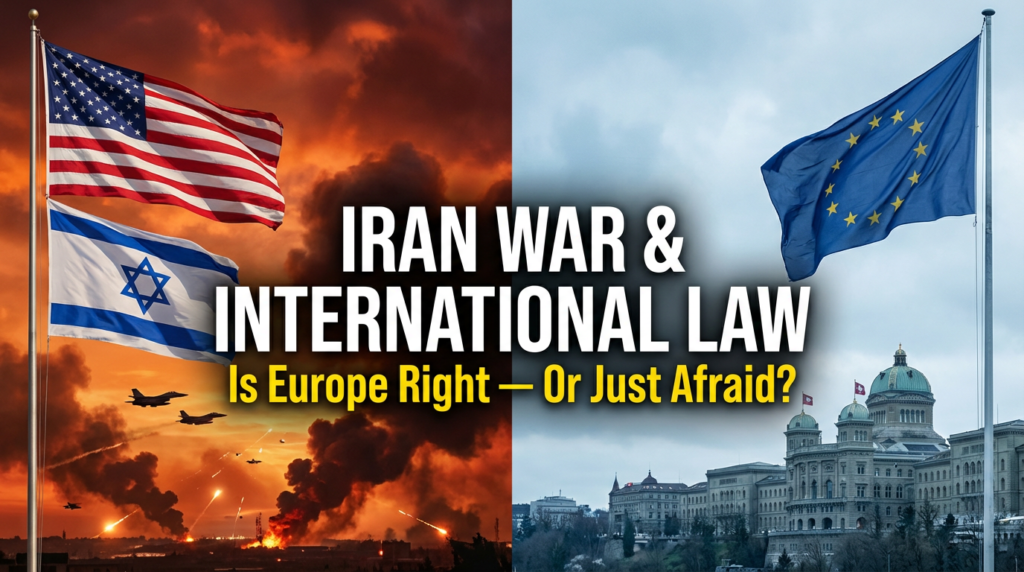
When allies cry foul, America must ask: who defines the rules — and who actually enforces them?
The bombs had barely stopped falling before the lectures began.
On March 8, 2026, Swiss Defence Minister Martin Pfister declared to the SonntagsZeitung newspaper that the United States and Israel had violated international law with their military strikes against Iran. Germany’s Vice Chancellor Lars Klingbeil echoed the sentiment, announcing with characteristic European caution that the war is “not our war.” Spain piled on, calling the bombings “reckless and illegal.” And so, as American and Israeli forces worked to dismantle one of the world’s most dangerous nuclear programs, the continent that has sheltered under American military protection for eight decades reached for its most reliable weapon: moral indignation.
This is a moment that demands clear thinking, not reflexive deference to institutions that have repeatedly failed to keep the world safe. The question isn’t simply whether the strikes on Iran were legal under the United Nations Charter. The deeper question is this: when the rules-based international order fails to prevent rogue regimes from threatening global stability, who bears the responsibility to act — and who bears the cost?
Support Independent Local Journalism
TheTownHall.News is reader-supported journalism. Just $5 helps us hire local reporters, investigate important issues, and hold public officials accountable across Alameda County. If you believe our community deserves strong, independent journalism, please consider donating $5 today to support our work.Europe’s Comfortable Condemnation
Let’s be precise about what European leaders are actually arguing. Their legal position rests on Article 2(4) of the UN Charter, which prohibits the use of force against another state without either UN Security Council authorization or a legitimate claim of self-defense. Legal scholars who oppose the strikes argue Iran had not yet directly attacked the United States, making the pre-emptive military action difficult to justify under existing treaty frameworks.
That is a fair legal point — and it deserves a fair response.
But notice what European leaders are not doing. They are not offering an alternative strategy to stop Iran’s nuclear program. They are not proposing to shoulder the defense burden that America has carried for generations. Germany, which spent decades underfunding NATO commitments, is drawing firm moral lines about what constitutes legitimate use of force. Switzerland — a nation that spent the entirety of World War II in prosperous neutrality — is now positioning itself as the arbiter of international conduct.
This is the height of fiscal and strategic irresponsibility dressed up as principled diplomacy. It is easy to preach the rule of law when you have no intention of enforcing it and no stake in the consequences of inaction.
The Real Question: What Has “International Law” Actually Prevented?
Conservatives rightly understand that law without enforcement is merely suggestion. The United Nations Security Council — the body whose authorization would supposedly legitimize military action — is structurally incapable of confronting Iran, because Russia and China hold permanent vetoes and have routinely used them to shield bad actors from accountability.
Iran has spent years arming terrorist proxies across the Middle East, threatening the destruction of Israel, and advancing a nuclear program that independent analysts widely assessed as moving toward weapons capability. The International Atomic Energy Agency (IAEA) repeatedly flagged Iran’s non-compliance with its obligations under the Nuclear Non-Proliferation Treaty. The UN did not act decisively. Europe did not act at all. Diplomatic frameworks, sanctions regimes, and strongly worded resolutions produced no meaningful change in Iranian behavior.
What European leaders are essentially arguing is that America should have continued waiting for a multilateral consensus that was never coming — while Iran ticked closer to a nuclear threshold that would permanently alter the strategic balance of the Middle East and beyond.
Personal responsibility and accountability — principles conservatives champion in domestic life — apply equally on the world stage. Nations, like individuals, cannot indefinitely defer hard decisions to committees and expect that threats will simply resolve themselves.
Sovereignty, Strength, and the Order That Actually Keeps the Peace
There is a broader principle at stake here that goes beyond the legal technicalities of UN Charter interpretation. The post-World War II international order was not built on paperwork. It was built on American power, American sacrifice, and American willingness to act when institutions faltered. From Korea to Kuwait, the peace that Europe now enjoys — and takes for granted — was purchased at a cost borne overwhelmingly by American soldiers and American taxpayers.
Germany’s Vice Chancellor warned ominously of a world where “only the law of the strongest applies.” But consider the alternative he is implicitly defending: a world where rogue regimes face no consequences because the veto-wielding members of the Security Council protect them from accountability. That is not the rule of law. That is the law of the most obstructionist.
Traditional conservative foreign policy has always understood that strength is not the enemy of order — it is its precondition. Reagan didn’t ask Soviet permission to confront communism. Margaret Thatcher didn’t wait for a UN resolution to retake the Falklands. The Founding Fathers themselves understood that a republic’s security ultimately rests on its own capacity and resolve, not on the goodwill of international bodies.
Free Speech and the Right to Disagree — But Let’s Be Honest About Motivations
To be clear: European leaders have every right to voice their disagreement. Free expression and open debate are values worth protecting, even — especially — when the criticism is directed at American policy. A healthy democracy, and a healthy alliance, requires honest dialogue.
But honesty cuts both ways. When Germany says “this is not our war,” it is worth asking why. Not because German values are suspect, but because Germany imports significant quantities of energy and has deep economic ties in the broader Middle East region. When Switzerland — a nation whose entire identity rests on standing apart from conflict — proclaims itself a moral authority on the use of force, that neutrality deserves scrutiny, not reverence.
The conservative tradition of calling things as they are demands we name this clearly: some of Europe’s outrage is principled, and some of it is convenient. That distinction matters enormously when framing how America should weigh allied criticism going forward.
What Law and Order Actually Requires
Conservatives believe deeply in law and order — not as a slogan, but as a moral foundation for a functioning society. That commitment extends internationally. America should strive to operate within legal frameworks where those frameworks are functional and enforceable. It should work with allies, seek legitimacy, and minimize civilian harm. Those are not weaknesses — they are the marks of a serious nation.
But law and order also means that threats to civilized life cannot be allowed to fester simply because the international bureaucracy cannot agree on a response. A world where a theocratic regime with a documented record of funding terrorism and threatening genocide can develop nuclear weapons unchallenged — because a procedural veto blocks action — is not a world governed by law. It is a world governed by paralysis.
The strikes on Iran may yet prove controversial in their details. Questions about proportionality, civilian protection, and post-conflict strategy deserve rigorous scrutiny, and conservatives should demand those answers as vigorously as anyone. Fiscal accountability applies here too — the American people deserve transparency about what this military campaign costs and what it is intended to achieve.
But the core principle — that America retains the right and the responsibility to act in defense of its security and that of its allies when multilateral institutions fail — is one that should not be surrendered to European lecture circuits.
Conclusion: Strength Is Not a Crime
Switzerland is a beautiful country. Its watches are precise, its banks are discreet, and its moral proclamations arrive on schedule. But the free world was not saved by Swiss neutrality. It was saved by nations willing to act.
European leaders calling the Iran strikes illegal are raising legitimate legal questions that deserve serious engagement. They are not, however, offering a serious alternative. And that gap — between the comfort of criticism and the burden of responsibility — is exactly where American leadership has always lived.
The rules-based international order is worth defending. But defending it requires more than strongly worded press releases. It requires the will to confront those who violate it at the most fundamental level — and the courage to act when words alone have failed.
Stay informed. The decisions being made today about Iran, international law, and American leadership will shape the world your children inherit. Share this article, follow the developments closely, and hold your elected representatives accountable for where they stand. A well-informed citizenry is the strongest check on bad policy — foreign or domestic.