The Monroe Doctrine: America’s 200-Year Shield Against Foreign Threats—And Why We Need It Now
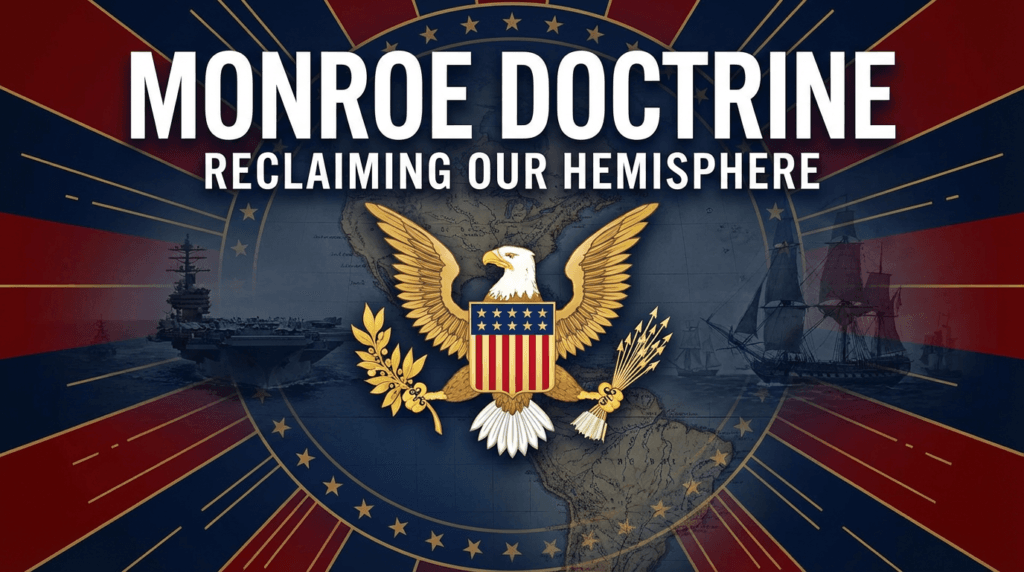
On December 2, 1823, President James Monroe delivered his seventh annual message to Congress—a speech that would fundamentally reshape American foreign policy for two centuries. Buried within that address were 1,200 words that would become known as the Monroe Doctrine, arguably the most consequential foreign policy statement in American history. Today, as China operates spy facilities in Cuba, Russia backs Venezuela’s dictatorship, and Iran spreads terrorism throughout Latin America, understanding the doctrine’s origins, authority, and application has never been more critical.
The Monroe Doctrine wasn’t just a policy—it was a bold assertion of American sovereignty that transformed a young republic into the guardian of an entire hemisphere. For conservatives who value national security, constitutional governance, and American exceptionalism, the doctrine represents everything right about strategic, principled foreign policy. But to understand its relevance today, we must first understand where it came from and how it actually worked.
The Birth of a Doctrine: 1823 and the Threat of European Reconquest
The Monroe Doctrine didn’t emerge in a vacuum. By 1823, the Spanish Empire in the Americas had collapsed, with nearly all of Latin America achieving independence. But freedom remained fragile. The Holy Alliance—a coalition of Russia, Prussia, Austria, and France—was actively suppressing liberal revolutions across Europe and eyeing the restoration of Spanish colonial rule in the Americas. Spain desperately wanted its empire back. Russia was expanding southward from Alaska along the Pacific coast. France harbored ambitions in the Caribbean.
Support Independent Local Journalism
TheTownHall.News is a non-profit reader-supported journalism. Just $5 helps us hire local reporters, investigate important issues, and hold public officials accountable across Alameda County. If you believe our community deserves strong, independent journalism, please consider donating $5 today to support our work.The threat was real and immediate. European monarchies viewed republican government as a dangerous contagion that needed to be contained or crushed. If they succeeded in re-establishing colonial control in Latin America, the United States would be surrounded by hostile European powers—north, south, and potentially west.
President Monroe, working closely with his brilliant Secretary of State John Quincy Adams (who largely authored the doctrine), faced a strategic choice. Britain had offered a joint declaration opposing European intervention, but Adams convinced Monroe that America should act unilaterally. As Adams famously argued, the United States should not appear “as a cock-boat in the wake of the British man-of-war.”
The result was a clear, unambiguous statement of American policy. Monroe declared to Congress that “the American continents, by the free and independent condition which they have assumed and maintain, are henceforth not to be considered as subjects for future colonization by any European powers.” He went further, stating that any European attempt to extend their political system to the Western Hemisphere would be considered “dangerous to our peace and safety.”
The doctrine established three core principles: no new European colonization in the Americas, no European interference in the internal affairs of independent American nations, and American non-interference in European affairs. It created two separate spheres of influence—Europe could manage its affairs, and America would manage ours.
The Constitutional Authority: Where Does the Power Come From?
Here’s where conservative principles of constitutional governance become essential. The Monroe Doctrine was not a treaty ratified by the Senate. It was not legislation passed by Congress. It was a unilateral declaration of executive policy announced in a presidential message to Congress.
This raises a fundamental question: Where did Monroe derive the constitutional authority to make such a sweeping foreign policy declaration?
The answer lies in Article II of the Constitution, which vests executive power in the President and designates him Commander-in-Chief of the armed forces. The President’s constitutional role in conducting foreign policy—receiving ambassadors, negotiating treaties, and serving as the nation’s chief diplomat—provides the foundation for such declarations. As Lawfare Media noted, “Monroe’s proclamation is a momentous example of the president’s vast constitutional power to set and communicate U.S. foreign policy.”
Importantly, the doctrine didn’t commit the United States to specific military action—that would require congressional authorization under Article I’s war powers. Instead, it established a policy framework and signaled American intentions. It was strategic ambiguity with teeth: European powers would have to assume the United States might respond militarily to violations, even without an explicit guarantee.
This balance between executive foreign policy authority and congressional war powers reflects the Constitution’s careful separation of powers. The President can declare policy and position forces, but Congress controls funding and war declarations. The Monroe Doctrine operated within this framework, making it a model of constitutional foreign policy—bold in principle, but requiring congressional cooperation for enforcement.
Support Independent Local Journalism
TheTownHall.News is a non-profit reader-supported journalism. Just $5 helps us hire local reporters, investigate important issues, and hold public officials accountable across Alameda County. If you believe our community deserves strong, independent journalism, please consider donating $5 today to support our work.How the Doctrine Was Actually Used: From Theory to Practice
The Monroe Doctrine’s real power lay not in its initial announcement—which European powers largely dismissed as an empty threat from a weak nation—but in how it was applied and expanded over two centuries.
The Early Years: More Bark Than Bite (1823-1860s)
Initially, the doctrine had limited practical effect. The United States lacked the military power to enforce it. When Britain occupied the Falkland Islands in 1833, America protested but could do nothing. When France intervened in Mexico in the 1860s, installing Maximilian as emperor, the U.S. was too consumed by the Civil War to respond effectively—though after the war, American pressure contributed to France’s withdrawal.
The Roosevelt Corollary: From Defense to Police Power (1904)
The doctrine’s real transformation came under Theodore Roosevelt. In 1904, facing a crisis where European powers threatened to use force to collect debts from Venezuela and the Dominican Republic, Roosevelt announced what became known as the Roosevelt Corollary.
Roosevelt declared that “chronic wrongdoing” by Latin American nations might require “intervention by some civilized nation,” and that in the Western Hemisphere, the Monroe Doctrine required the United States to exercise “international police power.” This dramatically expanded the doctrine from preventing European intervention to justifying American intervention.
The results were extensive. Between 1898 and 1934, the United States intervened militarily in Cuba (1906-09, 1912, 1917-22), Haiti (1915-34), Dominican Republic (1916-24), Nicaragua (1912-25, 1926-33), Mexico (1914, 1916-17), Panama (1903, 1918-20), and Honduras (1903, 1907, 1911, 1912, 1919, 1924, 1925). The Platt Amendment, inserted into Cuba’s constitution, gave the U.S. the right to intervene militarily in Cuban affairs—which it did repeatedly.
These interventions were controversial then and remain so today. Critics called it imperialism. Defenders argued it prevented European colonization and protected American security interests. What’s undeniable is that the doctrine had evolved from a defensive principle into an active assertion of American hegemony in the hemisphere.
The Cold War: The Doctrine’s Finest Hour (1947-1991)
The Monroe Doctrine found renewed purpose during the Cold War, when the threat came not from European colonialism but from Soviet communist expansion. Here, the doctrine returned to its defensive roots—keeping a hostile foreign power out of our hemisphere.
The most dramatic invocation came during the Cuban Missile Crisis of October 1962. When the Soviet Union secretly installed nuclear missiles in Cuba, President John F. Kennedy explicitly cited the Monroe Doctrine in justifying the American response. “It shall be the policy of this nation,” Kennedy declared, “to regard any nuclear missile launched from Cuba against any nation in the Western Hemisphere as an attack by the Soviet Union on the United States, requiring a full retaliatory response.”
Kennedy’s naval blockade of Cuba and his ultimatum to Soviet Premier Nikita Khrushchev brought the world to the brink of nuclear war—but it worked. The Soviets removed the missiles. The Monroe Doctrine, backed by overwhelming American military power and presidential resolve, had prevented a hostile foreign power from establishing a military foothold in our hemisphere.
This wasn’t the only Cold War application. The doctrine was invoked to justify opposition to communist movements in Guatemala (1954), Cuba (1961), Chile (1973), Nicaragua (1980s), and Grenada (1983). Whether these interventions were wise or justified remains debated, but they demonstrated that the doctrine remained a living principle of American foreign policy.
The Post-Cold War Decline (1991-Present)
After the Soviet collapse, the Monroe Doctrine fell into disuse. With no peer competitor threatening the hemisphere, successive administrations focused elsewhere—the Middle East, Afghanistan, Iraq, the “pivot to Asia.” Latin America was taken for granted.
This complacency created the opening that China, Russia, and Iran now exploit. Without the organizing principle of the Monroe Doctrine, America has allowed hostile powers to establish economic, military, and intelligence footholds throughout our hemisphere—precisely what the doctrine was designed to prevent.
Why the Doctrine Matters More Than Ever
The threats facing America today eerily mirror those of 1823, just with different actors. Instead of the Holy Alliance, we face an axis of authoritarian powers seeking to undermine American security and influence.
China’s Economic Colonialism: Beijing has invested over $140 billion in Latin America since 2005, building ports, telecommunications networks, and infrastructure that come with political strings attached. China now operates a signals intelligence facility in Cuba capable of intercepting American military communications. This isn’t investment—it’s strategic positioning.
Russia’s Military Adventurism: Moscow has conducted joint military exercises with Venezuela and Nicaragua, provided military aid to Cuba, and established intelligence facilities throughout the region. Russia is doing in Latin America exactly what it did in Syria—using military presence to expand influence and challenge American interests.
Iran’s Terrorist Networks: Tehran has established Hezbollah cells throughout Latin America, particularly in the tri-border area of Argentina, Brazil, and Paraguay. These networks engage in drug trafficking, money laundering, and potential terrorist planning—all aimed at undermining American security.
These aren’t abstract concerns. When hostile powers establish military and intelligence capabilities in our hemisphere, they threaten our security directly. They can monitor our defenses, threaten our supply chains, support drug cartels and terrorism, and potentially stage attacks against our homeland.
The Conservative Case for Reviving the Doctrine
For conservatives, the Monroe Doctrine represents the ideal foreign policy framework: strategically focused, constitutionally grounded, and prioritizing American interests.
National Sovereignty First: The doctrine begins with the principle that nations have the right to self-governance without foreign interference. This is fundamentally conservative—it respects sovereignty, opposes globalist entanglement, and asserts that America’s first responsibility is to Americans.
Limited but Effective Government: The doctrine doesn’t call for nation-building or endless interventions. It simply asserts clear red lines: hostile foreign powers will not be permitted to establish military or intelligence footholds in our hemisphere. This is government doing what it should do—defending national security—without overreach.
Fiscal Responsibility: Every dollar spent countering Chinese influence in Africa or the Middle East is a dollar not spent securing our own neighborhood. The Monroe Doctrine offers a framework for prioritizing resources where they matter most: protecting American sovereignty and security in our own hemisphere.
Defending Liberty: The original doctrine opposed European monarchical tyranny. Today’s version opposes communist China, authoritarian Russia, and theocratic Iran—regimes that crush freedom wherever they gain influence. By keeping these powers out of Latin America, we protect not just American security but the cause of liberty itself.
The Path Forward: Enforcing the Doctrine in the 21st Century
Reviving the Monroe Doctrine requires both strategic clarity and political will:
First, clear communication: The United States must explicitly tell China, Russia, Iran, and other adversaries that their military and intelligence activities in the Western Hemisphere are unacceptable and will be countered. No ambiguity. Clear red lines, clearly enforced.
Second, economic alternatives: We must offer Latin American nations a better option than Chinese debt-trap diplomacy. This means facilitating private investment, negotiating fair trade agreements, and supporting free markets—not massive government aid programs.
Third, security partnerships: Strengthen intelligence sharing and military cooperation with hemispheric allies who share our commitment to freedom and sovereignty. Coordinate action against transnational threats like cartels and terrorism.
Fourth, border security: The Monroe Doctrine rings hollow if we can’t control our own borders. National sovereignty begins at home.
Finally, presidential leadership: The doctrine has always required presidents with the courage to assert American interests unapologetically. From Monroe to Roosevelt to Kennedy, the doctrine worked when backed by presidential resolve.
Conclusion: A Doctrine for Our Time
The Monroe Doctrine succeeded for 200 years because it was based on timeless conservative principles: national sovereignty, constitutional governance, strategic realism, and the defense of liberty against tyranny. These principles haven’t become outdated—we’ve simply forgotten them.
As China builds spy facilities 90 miles from Florida, as Russia arms Venezuela’s dictatorship, as Iran spreads terrorism through our hemisphere, the question isn’t whether the Monroe Doctrine is relevant. The question is whether we have the courage to enforce it.
President Monroe understood that American security begins in our own hemisphere. Secretary Adams understood that America must act independently to defend its interests. President Roosevelt understood that the doctrine requires backing threats with power. President Kennedy understood that some principles are worth risking everything to defend.
Two centuries later, that wisdom remains as vital as ever. The Monroe Doctrine isn’t a relic of history—it’s a roadmap for the future.
Call to Action
The Monroe Doctrine won’t revive itself. It requires engaged citizens demanding that leaders prioritize American security over globalist fantasies. Learn the doctrine’s history. Understand its constitutional foundation. Recognize the threats in our hemisphere. Contact your representatives and demand they support policies that reassert American leadership where it matters most—in our own backyard. Share this article with everyone who cares about national sovereignty and security. The threats are real, the stakes are existential, and the time to act is now. America’s future depends on whether we have the courage to reclaim the principles that secured our past.