The Pipeline That Could Save the West: Saudi Arabia’s Bold Reroute Through the Red Sea
When Choke Points Choke the World
On February 28, 2026, the United States and Israel launched strikes against Iran. Within hours, the world’s most consequential stretch of water — the Strait of Hormuz — became a war zone. Iran retaliated by targeting commercial ships, mining the narrow corridor, and effectively shutting down a maritime passage through which nearly 20 million barrels of oil flow every single day. That’s roughly 20% of global oil supply, gone — just like that.
The immediate consequences were swift and painful. Brent crude surged to nearly $120 a barrel within days. Gas prices spiked at the pump across the United States and Europe. Global markets trembled. Analysts warned of up to $2.2 trillion in global GDP losses if the closure dragged on for weeks.
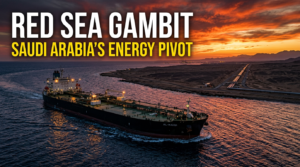
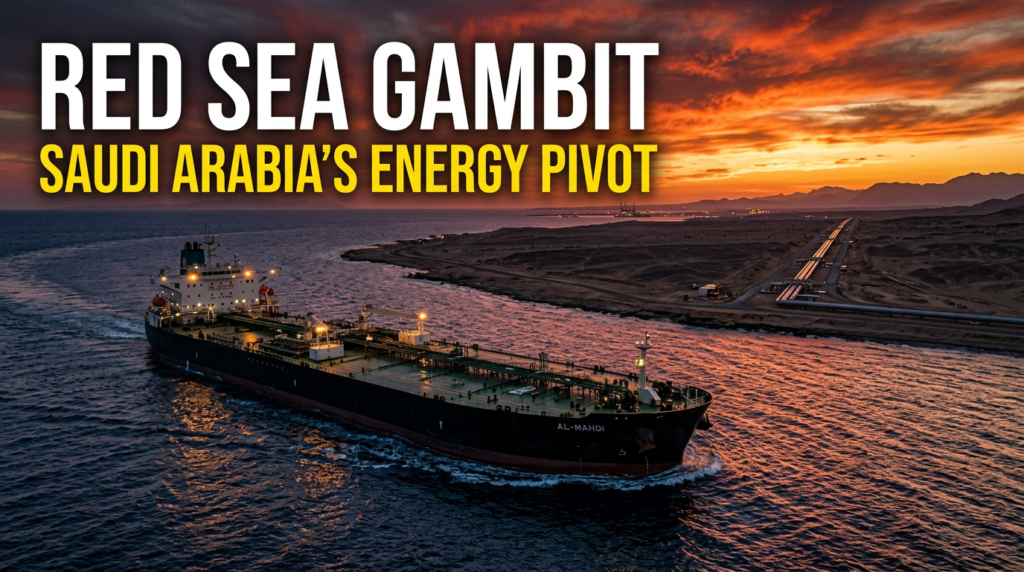
And yet, in the middle of this crisis, one nation moved with decisive, pre-planned speed: Saudi Arabia. Rather than panicking or waiting for a diplomatic resolution, the Kingdom activated a decades-old infrastructure investment — the East-West Pipeline, known as Petroline — and began rerouting its oil exports through the Red Sea. It was a masterclass in strategic preparation, private-sector execution, and the kind of practical, results-driven governance that conservative thinkers have long championed.
Support Independent Local Journalism
TheTownHall.News is a non-profit reader-supported journalism. Just $5 helps us hire local reporters, investigate important issues, and hold public officials accountable across Alameda County. If you believe our community deserves strong, independent journalism, please consider donating $5 today to support our work.The story of Saudi Arabia’s oil pivot is not just about barrels and tankers. It’s about the price of energy dependence, the necessity of strategic infrastructure, and the real-world consequences of foreign policy decisions — all of which land squarely on the wallets and daily lives of working Americans.
The Petroline: Decades of Investment, Days of Payoff
The East-West Pipeline — or Petroline — is an engineering feat that doesn’t get the attention it deserves. Stretching roughly 750 miles across the Arabian Peninsula, it connects the oil-rich eastern coast at Abqaiq to the Red Sea port of Yanbu in the west. Built with long-term strategic foresight, the dual-pipe system has a design capacity of 7 million barrels per day (bpd) following recent expansions.
Before the Iran war, Saudi Arabia was exporting approximately 6 million bpd through the Strait of Hormuz. Almost overnight, those routes became untenable. So Aramco did what well-run enterprises do: it executed. Arab Light crude volumes were redirected onto the Petroline, and the port of Yanbu was thrown into overdrive.
The results were staggering. According to maritime AI firm Windward and data from S&P Global, Yanbu’s oil exports surged 330% in just 11 days, reaching approximately 2.47 million bpd — a record high. At least 50 supertankers were observed heading to Yanbu by mid-March. Saudi Aramco CEO Amin Nasser confirmed the pipeline would reach its full 7 million bpd capacity within “the next couple of days.”
This was not luck. This was planning, investment, and execution — precisely the kind of disciplined, long-term infrastructure thinking that governments and energy companies should be commended for.
The Hard Limits and What They Reveal
For all its impressive capacity, the Petroline pivot has real ceilings — and those limits carry important lessons.
The pipeline itself can handle 7 million bpd, but Yanbu’s terminal loading capacity is estimated at just 3 to 4 million bpd, according to analysts at Vortexa and Reuters. Prior to the conflict, Saudi Arabia exported around 6 million bpd through Hormuz — meaning even at full Red Sea capacity, there is a gap of 2–3 million bpd that simply cannot be replaced through this route alone.
Reuters reported in March that Saudi Arabia has also been cutting production — with output reportedly falling by as much as 20% to around 8 million bpd — partly due to an inability to export crude that can no longer flow through Hormuz. Aramco’s CEO warned of “catastrophic consequences” for global oil markets if the strait remains closed, estimating nearly 350 million barrels of disruptions even accounting for western exports.
Meanwhile, analysts at Solability estimate the Hormuz closure costs the global economy $1.1 billion per day. Oxford Economics placed an additional geopolitical risk premium of roughly $9 per barrel on top of baseline prices. These numbers are not abstractions. They are grocery bills, gas receipts, and heating costs for millions of working families.
Support Independent Local Journalism
TheTownHall.News is a non-profit reader-supported journalism. Just $5 helps us hire local reporters, investigate important issues, and hold public officials accountable across Alameda County. If you believe our community deserves strong, independent journalism, please consider donating $5 today to support our work.America’s Energy Lesson: Dependence Is a Liability
Conservatives have long argued that energy independence is a national security imperative, not just an economic preference. The Hormuz crisis validates that argument with devastating clarity.
The United States has made remarkable strides in domestic energy production over the past decade. American shale output transformed the global market and reduced — though did not eliminate — U.S. vulnerability to Middle Eastern disruption. But the global oil market is interconnected. When 20 million barrels per day are threatened at a single choke point, oil prices rise everywhere, regardless of where a barrel is produced.
This is precisely why permitting reform, pipeline construction, LNG export expansion, and a stable domestic energy policy are not optional luxuries — they are strategic necessities. Every regulatory obstacle thrown in front of American energy infrastructure is a gift to adversaries and a tax on the American people. Every pipeline blocked by bureaucratic overreach or activist litigation is a vulnerability baked into the national balance sheet.
Saudi Arabia built the Petroline as a hedge against exactly this kind of crisis. America should be asking: where are our hedges? Where is our infrastructure redundancy? Where is the long-term planning that prioritizes the livelihoods of American families over the preferences of political activists?
Fiscal Accountability and the Cost of Getting It Wrong
The economic toll of the Hormuz closure is a textbook case of what happens when strategic preparation is replaced by optimistic assumptions.
Yahoo Finance and Oxford Economics estimate that a medium-length conflict lasting four to six weeks could result in approximately $770 billion in global GDP losses, a 1 percentage point increase in global inflation, and an 11% decline in Gulf GDP. Those figures compound daily, and the burden falls disproportionately on lower- and middle-income families who spend a higher share of their income on energy and consumer goods.
For American conservatives committed to fiscal responsibility and protecting the purchasing power of working families, this is a direct argument for sound energy policy. Inflation is a hidden tax. When government inaction or poor strategic planning allows energy markets to spiral, ordinary citizens pay the price.
Law, Order, and the Freedom of the Seas
There is a deeper principle at stake that goes beyond oil prices and pipeline capacity. Iran’s blockade of an internationally recognized maritime corridor is an act of economic warfare — not only against its enemies, but against the entire global trading order.
The freedom of navigation is a cornerstone of the rules-based international order that has underpinned global prosperity since World War II. When a rogue regime can hold the world’s energy supply hostage by threatening a 21-mile-wide strait, the question is not just economic — it is one of law, sovereignty, and the willingness to uphold order.
Conservatives understand that peace is maintained through strength, not appeasement. The current crisis is a direct consequence of years of inconsistent deterrence, sanctions relief that gave Iran financial breathing room, and a broader reluctance to impose real costs on state actors who threaten the global commons. The answer is clear-eyed engagement, credible deterrence, and the resolve to defend the principles of international order that protect American interests.
Conclusion: Pipelines, Principles, and Preparedness
Saudi Arabia’s East-West Pipeline is, right now, one of the most important pieces of infrastructure on Earth. Its activation in the face of Iran’s blockade is a testament to the value of long-term investment, strategic planning, and decisive execution under pressure.
But the broader lesson is one that conservatives have been making for years: dependence is a vulnerability. Preparation is strength. And the cost of unpreparedness is always paid by ordinary people.
As oil flows through Yanbu and supertankers queue in the Red Sea, Americans watching their gas prices rise should understand what is at stake. Energy independence, infrastructure investment, fiscal discipline, and a foreign policy grounded in deterrence are not partisan talking points. They are practical imperatives for national resilience.
The world just got a very expensive reminder of that fact.
📣 Call to Action
Stay informed. Stay engaged. Share this article with family, friends, and colleagues who want to understand how global energy markets connect directly to their daily lives. Demand that your elected representatives commit to a coherent domestic energy strategy — one that prioritizes American resilience, reduces our vulnerabilities, and never again lets a foreign adversary hold our economy hostage at a single choke point.
Sources: CNBC, Reuters, S&P Global, Bloomberg, OilPrice.com, Yahoo Finance / Oxford Economics, Chatham House, Solability, Windward Maritime AI, Vortexa.