The Price of Dependency: Why America’s Gas Crisis Is a Wake-Up Call for Energy Freedom
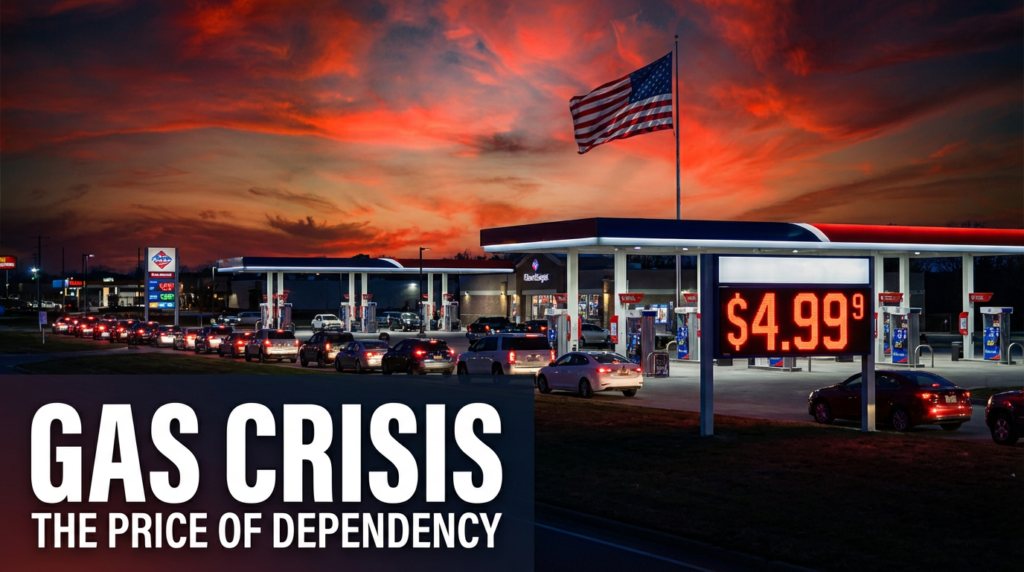
Every time Americans pull up to the pump, they get a front-row seat to the consequences of decades of energy policy failures, foreign entanglements, and a stubborn refusal to fully unleash the most energy-rich nation on earth. As of March 8, 2026, the national average for a gallon of regular gasoline has surged to $3.45 — up a staggering 16% in a single week — and analysts warn it could breach $5.00 per gallon by the end of the month. In California, drivers are already paying over $5.15 per gallon, with some projections putting that figure above $7.50 if current trends hold.
This is not a weather event. This is not an act of God. This is the predictable consequence of a fragile global energy order — and a reminder that when America allows itself to be tethered to the volatility of the Middle East, it is ordinary working families, not Washington bureaucrats, who pay the price.
The Trigger: Iran and the Strait of Hormuz
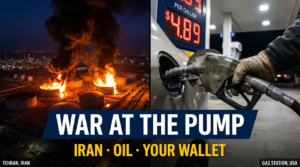
The immediate cause of this price explosion is the escalating U.S.-Israeli military conflict with Iran, known as Operation Epic Fury. Iran, a nation whose hostility toward the West has never been ambiguous, is now threatening to shut down the Strait of Hormuz — the narrow waterway through which approximately 20% of the world’s crude oil and natural gas passes. That single chokepoint is the economic jugular vein of the global energy supply chain.
Support Independent Local Journalism
TheTownHall.News is reader-supported journalism. Just $5 helps us hire local reporters, investigate important issues, and hold public officials accountable across Alameda County. If you believe our community deserves strong, independent journalism, please consider donating $5 today to support our work.If that strait closes — even temporarily — the ripple effects would be catastrophic. Nations dependent on Gulf oil, including some of America’s closest allies, would face severe supply shortfalls. Qatar’s Minister of Energy, Saad Sherida al-Kaabi, warned bluntly that a prolonged conflict “threatens to bring down the economies of the world,” adding that it would trigger “a chain reaction of factories that cannot supply.” This is not alarmism. This is basic economic reality.
The price of West Texas Intermediate crude has already jumped from $66 per barrel on February 20th to over $90 per barrel today. Oil ETFs tell the same story: the United States Oil Fund (USO) is up 57% year-to-date. Prediction markets now assign a 63% probability that national average gas prices will exceed $4.50 by the end of March, with a 34% chance of hitting $5.00 — which would approach the all-time record of $5.016/gallon set in June 2022.
What Washington Owes the American People: Honesty
President Trump, to his credit, has not buried the reality. When asked about rising prices, he stated plainly: “They’ll drop very rapidly when this is over, and if they rise, they rise — but this is far more important than having gasoline prices go up a little bit.” Energy Secretary Chris Wright echoed that confidence, predicting the spike would last “weeks, not months.”
That optimism may prove correct. Economist Wayne Winegarden of the Pacific Research Institute has noted that a resolution of tensions and a reopening of the Strait of Hormuz would likely bring prices back down. But he was equally honest about the short-term human cost: “Even a short-term increase in prices will still significantly squeeze people’s budgets.”
This is the part that deserves more attention. Working-class Americans — the truck driver in Ohio, the nurse commuting in Texas, the small business owner in Florida — do not have the luxury of absorbing a 16% jump in fuel costs in a single week. These are real people, operating on real budgets, with no ability to simply absorb Washington’s foreign policy decisions into their monthly expenses. Fiscal accountability must mean more than balancing ledgers in Washington — it must mean protecting the financial stability of everyday Americans.
America’s Strength: We Have the Resources — Now Let’s Use Them
Here is the fact that too rarely makes headlines: the United States is the world’s largest energy producer. Today, America produces approximately 22.8 million barrels of oil per day — accounting for 20% of global supply and more than double the output of Saudi Arabia. This is a remarkable achievement, driven largely by the shale revolution and the principle that free markets and private enterprise, not government mandates, are the engines of energy abundance.
Compare that to 2007, when the U.S. was producing only about 5 million barrels per day and was far more dependent on OPEC goodwill. America has come an extraordinary distance. And yet, here we are — still rattled by events in the Strait of Hormuz. Why?
Because energy production alone is not the same as energy independence. Independence requires infrastructure, refining capacity, export terminals, regulatory freedom, and a government that stops treating domestic energy producers as adversaries. For too long, federal permitting processes, environmental litigation, and anti-pipeline activism have acted as a slow tourniquet on America’s energy potential — not protecting the planet, but simply exporting the problem overseas while making our own citizens more vulnerable.
The answer is not more government control over energy markets. The answer is less. Get Washington out of the way, let American producers compete, and trust the market to deliver affordable energy to American families. That is the conservative principle — and it works.
The Strategic Petroleum Reserve: A Limited Band-Aid
Senator Chuck Schumer has already called on the Trump administration to tap the Strategic Petroleum Reserve (SPR) to ease the price surge. It is a politically predictable move — and an economically short-sighted one. The SPR exists for genuine national emergencies and supply disruptions of critical severity. Using it as a pressure valve every time geopolitical tensions spike depletes a vital national security asset and does nothing to address the structural vulnerabilities that caused the problem in the first place.
Americans deserve long-term solutions, not election-cycle band-aids. Fiscal responsibility means building durable energy infrastructure, not raiding emergency reserves to mask the consequences of avoidable dependency.
The Bigger Picture: Energy Is a Values Issue
For conservatives, affordable energy is not just an economic issue — it is a values issue. It is about personal responsibility: the ability of a family to plan their budget without fear that a foreign regime’s actions will make their daily commute unaffordable. It is about limited government: removing the bureaucratic obstacles that prevent American producers from meeting American demand. It is about national sovereignty: ensuring that the United States is never held hostage by adversaries who control critical energy chokepoints.
It is also, frankly, about law and order on the world stage. Iran’s decades-long campaign of terror, proxy warfare, and nuclear brinkmanship have come at an enormous cost — to regional stability, to American military readiness, and now, directly, to the pocketbook of every American who drives a car. The current military operation, whatever one’s views on its scope and execution, is a response to a long record of Iranian aggression that the international community failed to deter through diplomacy alone.
Strength — not appeasement — is ultimately the most cost-effective foreign policy. Every gallon of gas that spikes because of a hostile regime is a reminder of what strategic weakness costs.
What Comes Next
Energy Secretary Wright’s prediction of a quick resolution may well come true. Markets are forward-looking, and if the Strait of Hormuz reopens and tensions de-escalate, prices should retreat. But Americans should not simply wait for the next crisis to have this conversation again. The structural lesson must be absorbed now.
The United States has everything it needs — the resources, the technology, the workforce, and the innovative spirit — to achieve genuine, durable energy independence. What it has lacked, at times, is the political will to pursue it. That will must be demanded by citizens, at the ballot box and in public discourse.
Because in the end, the best insurance against $5 gas is an America that produces, refines, and distributes its own energy freely and efficiently — not one that hedges its family budgets on the behavior of foreign regimes.
Call to Action
The gas prices you’re paying today are not inevitable — they are the result of policy choices, geopolitical miscalculations, and decades of energy complacency. Stay informed. Know the facts. Share this article with friends, family, and neighbors who are feeling the squeeze at the pump. Demand that your elected representatives prioritize America’s long-term energy independence — not just temporary relief. And hold both parties accountable for building an energy policy worthy of the most powerful and resource-rich nation on earth.
The pump doesn’t lie. It’s time our policies stopped.