The Strait of Hormuz Crisis: Why American Strength Is the Only Answer
A Chokepoint the World Cannot Afford to Lose
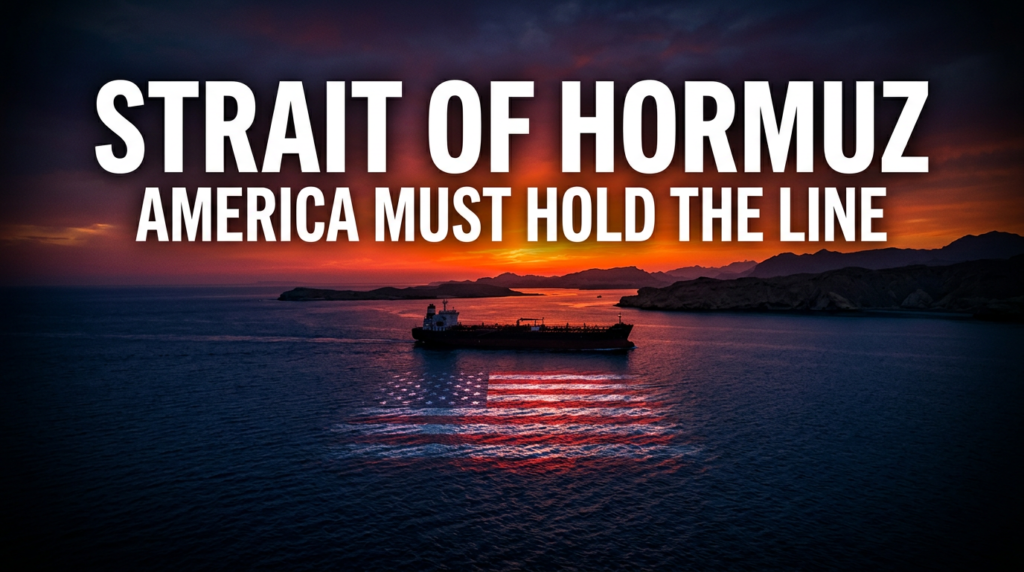
On the morning of March 1, 2026, the world woke up to a new reality. Tanker traffic through the Strait of Hormuz — the narrow, 21-mile-wide waterway connecting the Persian Gulf to the global energy market — had dropped to near zero. A waterway that normally handles over 153 vessel transits daily, carrying roughly 20% of the world’s oil and liquefied natural gas, had been effectively shut down by Iran’s Islamic Revolutionary Guard Corps. Oil prices surged 16%. Global shipping costs spiked to record highs. American consumers braced for consequences at the pump and in grocery aisles.
This is not a distant geopolitical abstraction. It is the direct result of strategic miscalculation, hollow diplomacy, and a failure to project American power with conviction. The Hormuz crisis is a wake-up call — and the response demands clarity, resolve, and a return to the conservative principles that have always kept America strong.
What Actually Happened — The Facts
On February 28, 2026, the United States and Israel launched coordinated airstrikes on Iran, killing Supreme Leader Ali Khamenei and dismantling key nodes of the Iranian military. Within hours, Iran’s remaining leadership declared the Strait of Hormuz closed to all traffic. On March 2, the IRGC announced that any vessel attempting to pass would be attacked — and within 24 hours, at least five commercial ships were struck by Iranian drones and missiles.
Support Independent Local Journalism
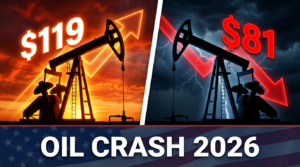
TheTownHall.News is a non-profit reader-supported journalism. Just $5 helps us hire local reporters, investigate important issues, and hold public officials accountable across Alameda County. If you believe our community deserves strong, independent journalism, please consider donating $5 today to support our work.By March 4, daily tanker transits had fallen from 37 to zero. Brent crude was trading around $87 per barrel by March 6, on an upward trajectory. Goldman Sachs analysts estimated a prolonged closure could lift prices $10–$15 above pre-conflict levels. The first two days of the war cost an estimated $5.6 billion, according to the Trump administration.
On March 10, President Trump announced that U.S. forces had destroyed Iranian mine-laying vessels threatening the strait and warned of far harder strikes if Iran continued its aggression. Despite earlier suggestions of Navy escorts for tankers, the U.S. Navy acknowledged that formal escort operations were not feasible for the moment — underscoring just how consequential the disruption has become.
These are the facts. And they demand a serious, principle-driven response.
The Cost of Weakness: A Lesson in Fiscal Accountability
For conservatives who believe in protecting the American taxpayer, the Hormuz crisis is a masterclass in what happens when strategic deterrence is allowed to erode. Every dollar spike in oil prices ripples through the entire economy — from filling up your truck to the cost of shipping goods nationwide. American families, already navigating inflationary pressures, now face another energy shock driven by instability that could have been preempted.
The lesson is straightforward: a strong America is a fiscally responsible America. The cost of maintaining credible deterrence — robust military readiness, a forward-deployed Navy, and the political will to act — is far lower than the cost of crisis management after deterrence collapses. Every aircraft carrier kept at full readiness is an investment that pays dividends in stability. When America retreats, adversaries fill the void, and ordinary citizens pay the bill.
Defense is one of the few constitutionally mandated federal responsibilities. It is precisely the kind of core government function that should be funded without hesitation or apology.
Energy Independence: The Conservative Imperative
The Hormuz crisis exposes, once again, why American energy independence is not merely an economic goal — it is a national security necessity. When a hostile regime can threaten to close the strait carrying 20% of the world’s oil and gas, the global economy is held hostage. Major Asian economies — China, India, Japan, and South Korea — import over 80% of their oil and LNG through Hormuz. America’s exposure is more indirect, but the global price shock is real and immediate.
The conservative answer has always been clear: drill, produce, refine, and export. A fully unleashed American energy sector — freed from regulatory overreach, permitting delays, and ideologically driven restrictions on domestic production — is the most powerful hedge against foreign energy crises. When America produces at full capacity, its allies have alternatives, adversaries lose leverage, and consumers are shielded from the worst of global disruptions.
The events of these past ten days should settle any remaining debate: transitioning away from domestic fossil fuel production does not make America safer. It makes America vulnerable. Energy security is national security.
Support Independent Local Journalism
TheTownHall.News is a non-profit reader-supported journalism. Just $5 helps us hire local reporters, investigate important issues, and hold public officials accountable across Alameda County. If you believe our community deserves strong, independent journalism, please consider donating $5 today to support our work.The Iran Problem: Strength, Not Sympathy
There are those who will argue that military action against Iran was reckless and that diplomacy was the better path. It is worth asking: how many rounds of diplomacy did the world try with Tehran? How many agreements were signed, how many sanctions were lifted in good faith — only to be met with nuclear advancement, proxy warfare, and direct threats to global shipping lanes?
Iran’s IRGC did not wait for negotiations before striking commercial vessels. They acted from perceived impunity — the product of years of inconsistent Western responses to Iranian aggression.
President Trump’s decision to issue stark warnings and follow through with action against mine-laying vessels reflects a core conservative principle: law and order must be enforced, whether at home or abroad. International shipping lanes — the arteries of the global economy — must be kept open, and that requires a credible willingness to defend them. Strength, clearly communicated and credibly backed, is the most effective deterrent to tyranny. That is not warmongering. That is history.
The Broader Stakes: Food, Families, and the Global Order
Beyond oil, the Hormuz closure carries consequences that strike at something more fundamental: food security. Roughly 70% of all food imports to Gulf Cooperation Council countries pass through the strait. For conservatives who believe in the dignity of the family and the responsibility of government to protect citizens from genuine threats — this matters. Parents trying to feed their families should not be at the mercy of a theocratic regime holding global commerce hostage.
The traditional values of stability, security, and self-determination are inseparable from the ability to project power in defense of open, rules-based international systems. Abandoning that responsibility doesn’t make the world more peaceful. It makes it more dangerous.
What Comes Next — And What Americans Must Demand
Some analysts are cautiously optimistic. CNBC strategist David Roche suggested the strait could partially reopen within two to three weeks if military operations decrease in intensity. That is encouraging — but hope is not a strategy.
What Americans must demand from their elected officials and military leadership is accountability, transparency, and a clear long-term plan. Not just for Hormuz, but for the broader question of how America secures its interests, protects its allies, and ensures no hostile power can hold the global economy hostage again. That means sustained investment in naval power, pressing forward on domestic energy production, and honest conversations with the American people about the real costs — managed with fiscal discipline.
The Conservative Case Is Clear
The Strait of Hormuz crisis is not just a foreign policy story. It is a story about what happens when deterrence erodes, when energy dependence replaces independence, and when bad actors conclude that aggression carries no real cost.
The conservative principles of personal responsibility, limited but effective government, fiscal accountability, law and order, and strength-through-clarity are not relics of the past. They are the most practical, proven tools for navigating a world that remains defined by power.
America is responding. The question is whether it will do so with enough resolve and conviction to make this crisis a turning point — not a template.