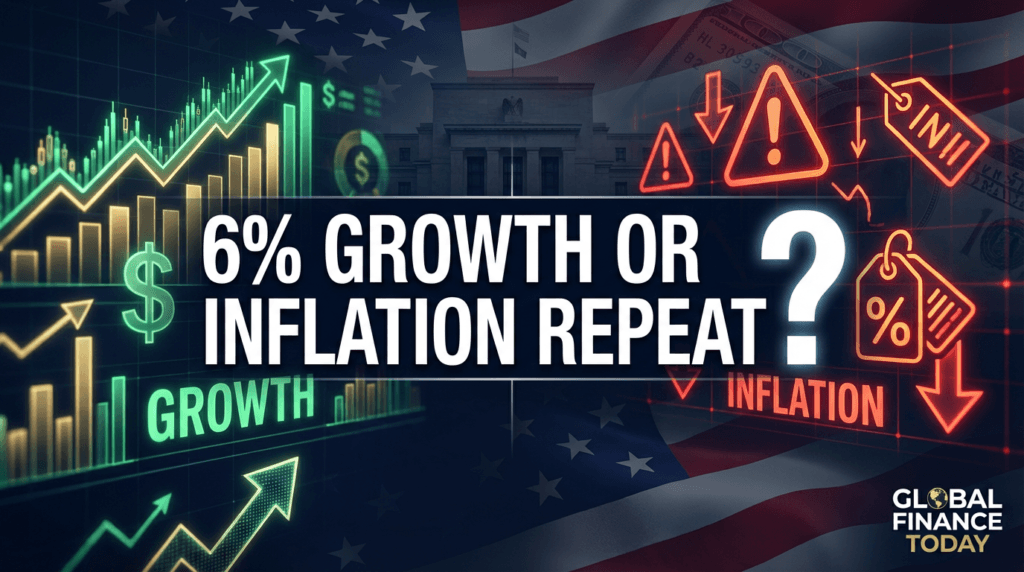
The Trump Economic Boom: Can America Grow at 6% Without Repeating Biden’s Inflation Disaster?
The Return of Economic Optimism
Commerce Secretary Howard Lutnick stood before cameras at the World Economic Forum in Davos and made a declaration that turned heads across global financial markets: America’s economy will grow at 5% in the first quarter of 2026, accelerating to 6% by year’s end.
If realized, this would represent the fastest sustained economic growth since the post-pandemic reopening of 2021—a period that also unleashed the worst inflation in four decades.
The Trump administration’s economic strategy is clear and aggressive: pump money into consumers’ pockets through historically large tax refunds, pressure the Federal Reserve to cut interest rates, and unleash what Treasury Secretary Scott Bessent calls an economy that is “likely accelerating.” The goal is ambitious—to deliver the kind of robust growth that makes Americans feel prosperous again after years of inflation-driven economic anxiety.
Support Independent Local Journalism
TheTownHall.News is a non-profit reader-supported journalism. Just $5 helps us hire local reporters, investigate important issues, and hold public officials accountable across Alameda County. If you believe our community deserves strong, independent journalism, please consider donating $5 today to support our work.But here’s the question that should concern every fiscal conservative: Can we achieve this growth without repeating the mistakes that led to 40-year-high inflation under President Biden? And more fundamentally, is government-driven stimulus the right path to sustainable prosperity, or are we setting up another boom-bust cycle that will ultimately harm the working families we’re trying to help?
The answers matter, because getting economic policy wrong doesn’t just affect stock portfolios—it determines whether ordinary Americans can afford groceries, housing, and the basic cost of living.
The Administration’s Growth Strategy: Tax Refunds and Easy Money
The Trump administration’s economic optimism rests on two primary pillars: massive tax refunds under the recently passed “big, beautiful bill,” and anticipated Federal Reserve interest rate cuts.
According to White House projections, American taxpayers could see refunds up to 30% larger than previous years—potentially adding $1,000 or more to household budgets during tax season. This represents one of the largest one-time fiscal injections into consumer spending in recent history. The administration is even discussing a $2,000 “tariff dividend” payment later in 2026, funded by revenue from new tariffs, though President Trump has indicated this would likely come “toward the end of the year.”

Meanwhile, there are clear signals that the administration wants the Federal Reserve to lower interest rates more aggressively. While Fed Chair Jerome Powell has maintained the central bank’s independence, Commerce Secretary Lutnick’s growth projections explicitly assume rate cuts as a catalyst for expansion.
The theory is straightforward: put more money in Americans’ pockets and make borrowing cheaper, and the economy will naturally accelerate. Consumer spending drives roughly 70% of U.S. economic activity, so boosting household finances should translate directly into growth.
On paper, it’s an appealing strategy. In practice, it raises serious questions about fiscal responsibility and long-term economic sustainability.
The Fiscal Conservative’s Dilemma: Growth vs. Discipline
Conservatives have spent decades arguing for fiscal discipline, limited government intervention in markets, and sound money policies. We’ve criticized Democrats for “tax and spend” policies and warned about the dangers of government trying to manage economic outcomes through fiscal manipulation.
Yet here we find ourselves with a Republican administration pursuing what is essentially a massive fiscal stimulus program—injecting hundreds of billions of dollars into the economy through tax refunds while simultaneously pressuring for easier monetary policy.
Support Independent Local Journalism
TheTownHall.News is a non-profit reader-supported journalism. Just $5 helps us hire local reporters, investigate important issues, and hold public officials accountable across Alameda County. If you believe our community deserves strong, independent journalism, please consider donating $5 today to support our work.This creates an uncomfortable tension between short-term political objectives and long-term conservative principles.
There’s no question that Americans want to feel economically secure again. After three years of elevated inflation that eroded purchasing power and made everyday expenses painful, voters sent a clear message in the 2024 election: fix the economy. The Trump administration heard that message and is acting decisively.
But fiscal conservatism has never been just about making people feel good in the moment—it’s about creating sustainable prosperity that doesn’t come with devastating consequences down the road. The question isn’t whether we want economic growth. The question is whether government-driven stimulus is the right way to achieve it, and whether we’re willing to accept the potential costs.
The Inflation Risk: Are We Repeating 2021’s Mistakes?
The most immediate concern with the administration’s growth strategy is inflation. We don’t need to speculate about what happens when you combine massive fiscal stimulus with easy monetary policy—we lived through it just three years ago.
In 2021, the Biden administration and Democratic Congress passed the $1.9 trillion American Rescue Plan, pumping money into an economy that was already recovering from pandemic shutdowns. The Federal Reserve kept interest rates at historic lows. The result was predictable: inflation surged to 9.1% by June 2022, the highest rate since 1981.
Groceries became unaffordable. Gas prices hit record highs. Rent skyrocketed. The inflation pain was real, widespread, and politically devastating for Democrats.
Now, in January 2026, inflation still hasn’t returned to the Federal Reserve’s 2% target. The December 2025 Consumer Price Index showed prices rising at a 2.7% annual rate. Food prices are climbing at 3.1% annually, with staples like beef and coffee seeing sharp increases. Housing costs remain elevated across most markets.
Into this environment, the Trump administration wants to inject massive tax refunds and encourage lower interest rates. As economists at Truist and Groundworks have noted, this creates a classic “too many dollars chasing too few goods” scenario—the textbook definition of what causes inflation.
Liz Pancotti, managing director at Groundworks, put it bluntly: “What the secretary was intimating earlier today, to me, that doesn’t unlock a bunch of growth—it unlocks a bunch of inflation.”
Even if you dismiss Groundworks as a “liberal-leaning think tank,” the concern is shared by mainstream Wall Street economists. Most project 2026 growth at 2-2.5%—less than half of what Lutnick is forecasting—precisely because they see inflation constraints limiting how fast the economy can safely expand.
The Reality Check: What Wall Street Actually Thinks
While Commerce Secretary Lutnick predicts 6% annual growth, the consensus among private sector economists tells a very different story.
Truist forecasts 2.3% growth for 2026. Other major Wall Street firms project between 2-2.5%. These aren’t partisan political estimates—they’re projections from analysts whose careers depend on accurately reading economic data.
Mike Skordeles, head of U.S. economics at Truist, acknowledged that hitting 5% growth “on a one-off basis” in a single quarter is possible, but called sustained 6% annual growth “a really tough hill to climb.” His reasoning is straightforward: economic headwinds including trade tensions from tariffs and business uncertainty about shifting policies will blunt any stimulus effects.
The Atlanta Federal Reserve’s GDPNow tool, which the administration has cited to support its optimism, does project strong fourth-quarter 2025 growth at 5.4%. But a single strong quarter doesn’t translate into sustained annual growth, especially when the factors driving that quarter—including the anticipation of tax refunds—may not be repeatable.
Historical context matters here. Outside of the statistical anomalies of the pandemic recovery period, the U.S. economy has grown at 2-3% annually for decades. Sustained 6% growth would be extraordinary—and would likely require either a massive productivity breakthrough (like the tech boom of the late 1990s) or unsustainable stimulus that ends in inflation or recession.
The smart money isn’t betting on 6% growth. That should give us pause.
The Tariff Complication: Adding Uncertainty to the Mix
The administration’s economic strategy includes another variable that complicates the growth picture: aggressive use of tariffs.
President Trump has implemented or threatened tariffs on multiple trading partners, justified as tools to protect American industries and generate revenue. The proposed $2,000 “tariff dividend” would be funded by this tariff revenue, creating a direct link between trade policy and fiscal stimulus.
But tariffs are, economically speaking, taxes on imports that raise costs for American businesses and consumers. When tariffs increase the cost of imported materials and goods, those costs typically get passed along the supply chain, ultimately showing up as higher prices at the checkout counter.
This creates a policy tension: the administration wants to stimulate growth through tax refunds while simultaneously implementing tariffs that function as tax increases on consumption. The net effect on household finances depends on whether the refund checks are larger than the increased costs from tariffs—a calculation that will vary significantly by income level and consumption patterns.
More broadly, tariff policy creates business uncertainty. Companies making decisions about investments, hiring, and expansion need to understand their cost structure. When tariff policy shifts unpredictably, businesses become cautious—exactly the opposite of what you want when trying to accelerate economic growth.
As Skordeles noted, “One of those reasons why we’re not growing faster is uncertainty.” Trade policy uncertainty is a significant contributor to that caution.
The Workers’ Dilemma: Growth Without Prosperity
Even if the administration achieves its growth targets, there’s a deeper question about who benefits.
Recent economic data reveals a troubling trend: labor’s share of GDP—the portion of economic output that goes to workers rather than capital—fell to 53.8% in the third quarter of 2025, the lowest level since 1947 when this data series began.
This means that even as the economy grows, workers are taking home a smaller slice of the pie. Corporate profits and returns to capital are capturing an increasingly large share of economic gains, while wage growth lags behind.
For working-class and middle-class Americans, this creates a disconnect between headline economic statistics and lived experience. GDP might be growing at 4% or 5%, but if your wages are growing at 2% while inflation runs at 3%, you’re actually losing ground.
This phenomenon isn’t new—it characterized much of the post-2008 recovery, when strong GDP growth coexisted with wage stagnation for most workers. It’s also what happened during parts of the Biden administration, when robust economic statistics failed to translate into positive feelings about the economy among voters.
PNC Economics Research noted in a recent report that “lower-income households have experienced weaker wage growth in 2025, while inflation has steadily eroded their checking and savings balances.”
This is the real test of economic policy: not whether we can generate impressive GDP numbers, but whether ordinary Americans can afford groceries, pay rent, and build savings. Growth that doesn’t translate into broadly shared prosperity isn’t conservative economic success—it’s a statistical illusion that masks ongoing struggles.
The Conservative Alternative: Supply-Side Growth, Not Demand-Side Stimulus
If the administration’s demand-side stimulus strategy carries significant risks, what’s the conservative alternative?
Traditional supply-side economics offers a different path: focus on removing barriers to productive economic activity rather than artificially stimulating demand through government spending.
This means:
Regulatory reform that eliminates unnecessary red tape choking business formation and expansion. The Trump administration has made progress here, but there’s much more that could be done, particularly at the state and local levels where many of the most burdensome regulations exist.
Energy policy that unleashes American energy production, lowering costs for manufacturers and consumers while creating high-paying jobs. Affordable energy is the foundation of a competitive economy.
Labor market reforms that make it easier for businesses to hire and for workers to move between jobs, including occupational licensing reform that removes artificial barriers to employment.
Tax reform focused on investment and production, not just consumption. Lower taxes on capital investment encourage businesses to expand capacity, which increases productivity and ultimately raises wages.
Spending restraint that prevents government borrowing from crowding out private investment and keeps deficits from becoming unsustainable.
Sound money policy that maintains the dollar’s purchasing power rather than pursuing easy money policies that risk inflation.
This supply-side approach takes longer to show results than stimulus checks, which is why it’s politically challenging. But it produces sustainable growth based on genuine increases in productive capacity, not artificial demand stimulus that risks inflation and boom-bust cycles.
The Federal Reserve Independence Question
One of the more concerning aspects of the administration’s economic strategy is the implicit—and sometimes explicit—pressure on the Federal Reserve to lower interest rates.
Federal Reserve independence is not a partisan issue. It’s a structural feature that protects the economy from short-term political pressures that could lead to disastrous long-term consequences.
When politicians control monetary policy directly, the temptation is always to pursue easy money policies that feel good in the moment but create inflation and instability over time. This is why Congress created the Federal Reserve as an independent institution in 1913, and why that independence has been jealously guarded by both parties for over a century.
President Trump has been openly critical of Fed Chair Jerome Powell—whom he appointed—for not cutting rates more aggressively. Commerce Secretary Lutnick’s growth projections explicitly assume a more accommodative Fed policy, potentially under new leadership if Trump replaces Powell when his term expires.
Conservatives should be deeply uncomfortable with this pressure. We’ve spent decades arguing that government shouldn’t manipulate markets and that independent institutions should be insulated from political pressure. The Federal Reserve’s independence falls squarely within these principles.
If inflation remains above target and the Fed believes rate cuts would be premature, the correct conservative position is to respect that judgment—even if it means slower short-term growth. The alternative is to politicize monetary policy in ways that could haunt us for decades.
The Political Reality: Perception vs. Economics
There’s an uncomfortable truth that conservatives need to confront: economic statistics don’t always translate into political success.
President Biden oversaw strong GDP growth, low unemployment, and rising wages—yet voters punished Democrats at the ballot box because inflation made people feel economically insecure. The Trump administration clearly learned this lesson: people vote based on how they feel about their personal finances, not on what economists say about aggregate statistics.
This creates pressure to pursue policies that make people feel immediately better, even if those policies risk longer-term problems. Tax refund checks arriving in mailboxes create an immediate positive feeling. The potential inflation consequences won’t show up for months or quarters.
But governing based on short-term political incentives rather than sound economic principles is exactly what conservatives have criticized progressives for doing. If we abandon fiscal discipline when it’s politically convenient, we forfeit the moral authority to demand it from others.
The challenge for conservative leaders is to pursue policies that help Americans feel prosperous without sacrificing the principles that create sustainable, long-term economic health.
Conclusion: Bold Vision Requires Honest Assessment
There’s much to admire in the Trump administration’s economic ambition. After years of economic anxiety, Americans deserve leaders who believe in growth and prosperity rather than managed decline.
The question isn’t whether we should pursue economic growth—of course we should. The question is how we achieve it, and whether we’re willing to honestly assess the risks and trade-offs involved in different approaches.
Massive tax refunds and pressure for lower interest rates might deliver short-term growth and positive feelings. But if that stimulus reignites inflation, erodes purchasing power, and leads to an eventual recession, we’ll have traded short-term political gains for long-term economic pain.
Fiscal conservatism isn’t about pessimism or austerity for its own sake. It’s about recognizing that sustainable prosperity comes from productive capacity, not government stimulus. It’s about understanding that there are no free lunches in economics—every policy choice involves trade-offs.
The Trump administration’s 6% growth prediction may prove accurate, though most serious economists are skeptical. But even if achieved, we need to ask: At what cost? Through what mechanisms? With what long-term consequences?
These aren’t partisan questions—they’re the questions that anyone serious about economic policy should be asking. Conservative principles demand that we pursue growth through supply-side reforms that increase productive capacity, not demand-side stimulus that risks inflation. They demand respect for independent institutions like the Federal Reserve, even when their decisions are politically inconvenient. And they demand fiscal discipline even when spending money would be popular.
The test of conservative economic policy isn’t whether it can generate impressive short-term statistics. It’s whether it creates broadly shared, sustainable prosperity that allows ordinary Americans to build better lives without the government having to constantly intervene to prop up demand.
That’s the standard by which the Trump economic boom should be judged.
Call to Action
Economic policy affects every American’s daily life—from grocery bills to job opportunities to retirement security. Don’t rely on political spin from either party to understand what’s really happening. Share this analysis with friends and family who care about fiscal responsibility and sustainable growth. Contact your representatives in Congress and demand they prioritize supply-side reforms over short-term stimulus gimmicks. Stay informed about inflation data, Fed policy decisions, and how proposed tax and spending policies will actually affect your household finances. And most importantly, hold leaders accountable when political convenience conflicts with sound economic principles. Conservative economics works when we have the courage to stick with it, even when easier paths are available.