They Answered the Call: Honoring the Six Americans Who Died in Kuwait So We Don’t Have To
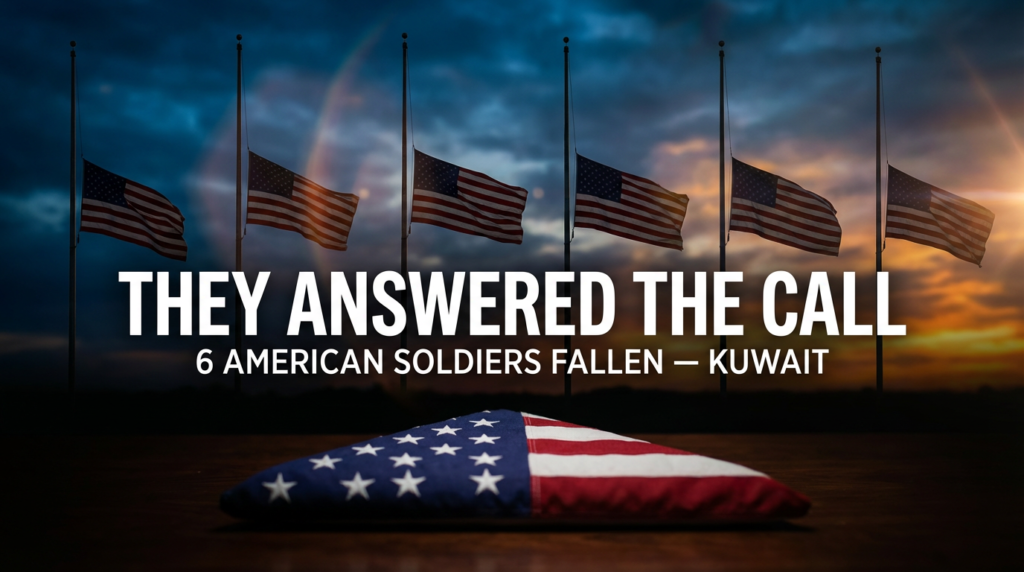
When the Flag Comes Home Folded
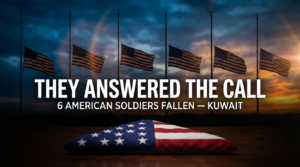
On Sunday, March 1, 2026, an Iranian drone punched through the air defenses over Port Shuaiba, Kuwait, and struck a tactical operations center where six American soldiers were working. They were not front-line commandos. They were Army Reserve logistics specialists — men and women who kept food on the table, fuel in the tanks, and ammunition in the hands of the warfighters. They were, in the truest sense, the backbone of American military power.
By Tuesday, March 3, the Pentagon had named four of them: Capt. Cody Khork, 35, of Winter Haven, Florida; Sgt. 1st Class Noah Tietjens, 42, of Bellevue, Nebraska; Sgt. 1st Class Nicole Amor, 39, of White Bear Lake, Minnesota; and Sgt. Declan Coady, 20, of West Des Moines, Iowa — posthumously promoted from specialist. Two others remain unidentified, their families still living with grief that has no public name attached to it yet.
These were not faceless statistics. They were our neighbors, our parents, our children. And the way this nation responds to their deaths says everything about who we are.
Who They Were: Real People, Real Sacrifice
Declan Coady was 20 years old. He was an Eagle Scout who once built 12 Adirondack chairs for an Iowa organization serving homeless children. He was studying cybersecurity at Drake University while taking online classes from Kuwait because he wanted to become an officer. His father Andrew said he had just been recommended for a promotion the week before. His sister Keira could barely process it: “I still don’t fully think it’s real. I just remember all of our conversations about what he was going to do when he came back.”
Nicole Amor was days away from coming home. She tended a garden, made salsa from homegrown peppers and tomatoes with her son, and rollerbladed with her fourth-grade daughter. The last message she sent her husband was about tripping and falling the night before. “She just never responded in the morning,” Joey Amor said. She was 39. She was almost home.
Cody Khork was deeply patriotic from a young age, earned a degree in political science, and joined ROTC at Florida Southern College. His family called him “the life of the party, known for his infectious spirit, generous heart, and deep care for those who served alongside him.” His best friend of 16 years, Abbas Jaffer, wrote on social media: “My best friend, best man, and brother gave his life defending our country overseas.” He was 35.
Noah Tietjens, 42, was a husband and father, a martial arts instructor who earned a black belt in Philippine Combatives and Taekwondo. The Philippine Martial Arts Alliance honored him, saying “he carried the same values: honor, discipline, service, and commitment to others.” Nebraska Governor Pillen wrote: “Noah stepped up to serve and defend the American people from foreign enemies around the world — a sacrifice we must never forget.”
These four — along with two soldiers whose names have not yet been released — represent the finest tradition of American service: ordinary citizens who raise their right hands, pull on a uniform, and put their lives on the line so the rest of us can live freely.
The Hard Questions of Accountability
Honoring the fallen is not enough. A nation that truly respects its military asks hard questions — not to score political points, but because these men and women deserve answers.
Satellite imagery reviewed by the Associated Press revealed that the operations center at Port Shuaiba was not on the heavily fortified Camp Arifjan, located more than 10 miles away. It was a shipping container-style structure in the middle of a civilian port, surrounded by oil storage tanks, refineries, and a power plant — with no dedicated air defenses of its own. Joey Amor confirmed that his wife Nicole was moved to this location just one week before the strike. Military personnel had been dispersed because commanders feared the main base would be targeted. Instead, the dispersed location became the target.
The Pentagon spokesman stated the facility was “fortified with 6-foot walls.” With respect — walls do not stop drones. The military is investigating, as it should. But the American public deserves full transparency about how six reservists came to be operating out of an undefended position at the outset of a major military campaign. Accountability is not the enemy of the military. It is its guardian.
Volunteers, Not Conscripts: The Honor of the All-Volunteer Force
Every single one of these soldiers volunteered. In an era when fewer than 1% of Americans serve in uniform, that choice is extraordinary. Declan Coady didn’t have to join the Army Reserve while attending college. Nicole Amor didn’t have to put on a uniform as a mother of two. Cody Khork didn’t have to go to ROTC. Noah Tietjens didn’t have to serve at 42 with a family at home. They chose to.
This is the living embodiment of personal responsibility and patriotic duty — values that form the bedrock of a free society. The conservative vision of America has always rested on the understanding that freedom is not free; that it is purchased and preserved by those willing to pay the price. These six soldiers paid that price in full.
The all-volunteer military is one of America’s greatest institutional achievements. It reflects the belief that service should flow from conviction, not compulsion — from love of country, not fear of government. When we lose soldiers like these, we are not losing government assets. We are losing the best of us.
What Strength Looks Like
President Trump warned the nation that more casualties are likely. “Sadly, there will likely be more, before it ends. That’s the way it is,” he said. It was a somber, honest acknowledgment of the cost of war — there is no sugarcoating what it means to send Americans into combat with a determined adversary.
But strength is not just measured in airstrikes and destroyed targets. It is measured in the seriousness with which a government treats the lives of the people it sends into harm’s way. Strength means ensuring that those who serve are properly protected. It means demanding full accountability when a preventable loss occurs. It means a dignified transfer ceremony that the Commander-in-Chief attends personally — as President Trump has pledged to do — so that a grieving family knows their loved one was not forgotten by the country they died defending.
The Senate voted down a war powers resolution, backing the administration’s campaign. That is a legitimate exercise of congressional authority. But oversight is not opposition — it is the constitutional responsibility of a co-equal branch of government to ensure that military force is used wisely, lawfully, and with every possible protection for the Americans in uniform.
A Nation That Must Never Forget
The names Cody Khork, Noah Tietjens, Nicole Amor, and Declan Coady should not fade into a news cycle. They should be spoken at town halls, remembered on Memorial Day, and etched permanently into the consciousness of a nation that benefits daily from the sacrifice of people like them.
Traditional values — faith, duty, family, honor — are not abstract concepts. They are the things these soldiers lived by. Declan Coady built chairs for homeless children as an Eagle Scout. Nicole Amor made salsa with her son and rollerbladed with her daughter. Cody Khork was the best man at his best friend’s wedding. Noah Tietjens taught martial arts and passed on discipline to the next generation. These were people of deep character, and their character was forged in the same tradition of service and sacrifice that has always made America worth defending.
Conclusion: Honor Demands More Than Silence
America is at war. Americans are dying. And the response of a serious, principled nation is not to look away or reduce this to a partisan talking point, but to do three things: honor the fallen with full sincerity, demand accountability for every avoidable loss, and ensure that those still in uniform have every resource, protection, and support they need to come home alive.
Cody Khork, Noah Tietjens, Nicole Amor, Declan Coady, and two soldiers yet unnamed did not die for a political agenda. They died for a flag, for a principle, and for each of us. The least we can do is remember their names — and insist that their country is worthy of the price they paid.
📢 Share This. Stay Informed. Get Involved.
These heroes deserve more than a moment of silence — they deserve a nation that stays engaged. Share this article to make sure their names are not forgotten. Stay informed about the ongoing conflict in the Middle East and hold your elected officials accountable for both the conduct of this war and the welfare of those who fight it. And if you know a military family, reach out to them today. They are carrying a weight the rest of us can barely imagine.
Freedom is not free. Never let anyone forget who pays the bill.