
Tooth Enamel Regeneration Gel Is Real. Here’s Why Bureaucrats Might Kill It Before You Can Use It
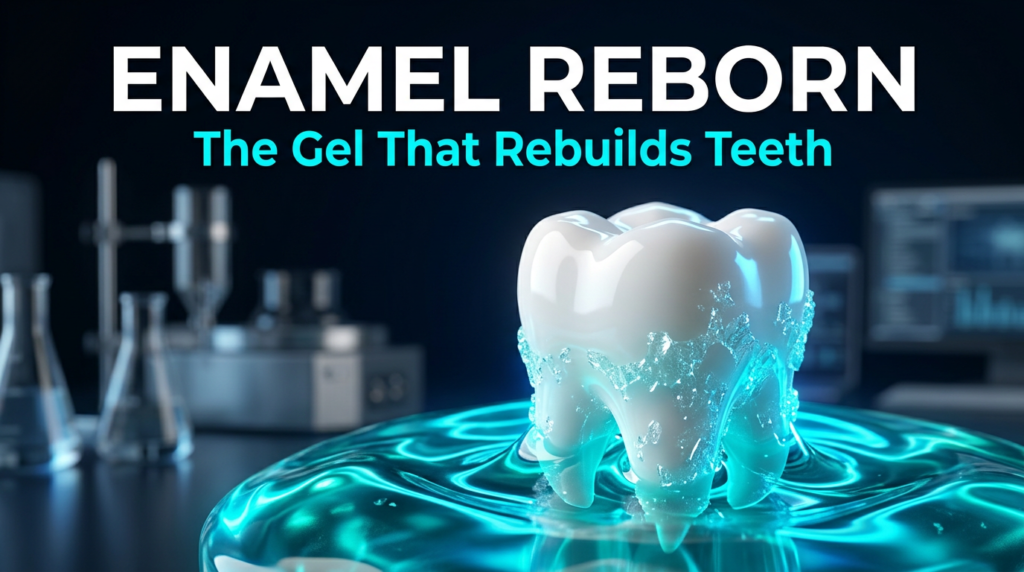
A fluoride-free protein gel from the University of Nottingham can rebuild tooth enamel. The science is real — but will regulators let it reach patients in time?
For as long as most of us can remember, a cavity has meant one thing: a drill, a needle, and a bill. We were told enamel — the hardest substance the human body produces — cannot repair itself once gone. Dentistry, for all its technological advances, had no answer for that. You could slow the damage with fluoride. You could fill the hole with composite resin. But regrow what was lost? Impossible.
Until now.
Support Independent Local Journalism
TheTownHall.News is a non-profit reader-supported journalism. Just $5 helps us hire local reporters, investigate important issues, and hold public officials accountable across Alameda County. If you believe our community deserves strong, independent journalism, please consider donating $5 today to support our work.Researchers at the University of Nottingham, publishing in the prestigious journal Nature Communications in November 2025, have developed a protein-based gel that doesn’t just coat damaged enamel — it rebuilds it. Real crystal structure. Real mineralization. Integrated into existing enamel architecture, not pasted on top of it. The peer-reviewed science is solid, the electron microscopy images are striking, and clinical trials are scheduled to begin in 2026 through their spin-off company, Mintech-Bio.
This is not hype. This is one of the most genuinely exciting developments in preventive dentistry in a generation. And precisely because it is real, it is worth asking a harder question: will the patients who need it most actually get access to it — or will regulatory inertia, institutional gatekeeping, and bureaucratic delay stand between this breakthrough and the 2.3 billion people worldwide suffering from untreated dental decay?
The Science: What the Gel Actually Does
The mechanism is elegant. The gel is made from engineered proteins called elastin-like recombinamers, designed to mimic the molecules the body uses to build enamel during infancy. Applied like a standard fluoride varnish, it seeps into microscopic cracks and erosion sites on the tooth surface. Once in place, it draws calcium and phosphate ions directly from the patient’s own saliva, directing their growth in precise alignment with the existing enamel crystal structure — a process known as epitaxial mineralization.
“When our material is applied to demineralized or eroded enamel, it promotes crystal growth in an integrated and organized manner, recovering the architecture of natural healthy enamel.” — Dr. Abshar Hasan, Lead Author, University of Nottingham
Lab results on extracted molars showed measurable repair beginning within a week, and regenerated layers that withstood brushing, acid exposure, and chewing forces for weeks in controlled testing. It is fluoride-free, works with the body’s own chemistry, and requires no drilling, no anesthesia, and no filling material.

✔ Fact-Check Summary
- Published in Nature Communications, November 2025 — peer-reviewed, not a press release.
- All current results are from extracted teeth in lab conditions — no human trials yet as of March 2026.
- Regenerated layer is approximately 10 micrometers; natural enamel runs up to 2,000 micrometers on biting surfaces.
- Mintech-Bio, the commercializing spin-off, is active and recruiting. Clinical trials scheduled for early 2026.
- A separate November 2025 study found keratin protein also repairs enamel — two independent approaches converging simultaneously.
Personal Responsibility Begins With Access to Real Solutions
Conservatives have long championed personal responsibility in healthcare. Take care of your body. Don’t rely on the state. Make smart choices. That is a sound philosophy — but it only works when individuals have access to the tools that actually make a difference. For decades, the best tool dentistry could offer was a drill and a chemical patch. Americans were told to brush, floss, and show up for cleanings — and then handed a $3,000 bill when the enamel eroded anyway.
A gel that rebuilds enamel early, affordably, and without a surgical procedure fundamentally changes the equation. It shifts power back to the individual and the family. Catch the early signs of erosion, apply the treatment at a routine dental visit — or eventually, at home — and prevent the cavity before it ever becomes a procedure. That is preventive healthcare in its truest form: empowering people to act before a problem becomes a crisis, rather than waiting for the crisis and billing them for the repair.
For the 26% of American adults currently living with untreated tooth decay — disproportionately in working-class and rural communities where dental insurance is a luxury, not a given — this is not an abstract policy discussion. It is a practical lifeline.
Fiscal Accountability: The Cost of Doing Nothing
The United States spends over $150 billion annually on dental care. A significant share of that cost flows directly from the failure to stop early enamel erosion before it becomes a cavity, and a cavity before it becomes a root canal. The downstream cost of untreated decay — emergency room visits, lost work hours, childhood developmental impacts — runs into the tens of billions more.
Support Independent Local Journalism
TheTownHall.News is a non-profit reader-supported journalism. Just $5 helps us hire local reporters, investigate important issues, and hold public officials accountable across Alameda County. If you believe our community deserves strong, independent journalism, please consider donating $5 today to support our work.A proven enamel-regeneration treatment does not just improve individual outcomes. It restructures the cost curve of preventive dentistry at a population level. Fiscal conservatives who rightly scrutinize healthcare spending should be among the loudest advocates for fast-tracking innovations like this one. The most expensive procedure is almost always the one that could have been prevented. Government programs that cover dental care — Medicaid, the Children’s Health Insurance Program, Veterans Affairs dental benefits — would see meaningful long-term cost reductions if an accessible, affordable enamel-repair product reached the market.
The Fluoride Debate: A Timely Complication
The timing of this breakthrough carries an unavoidable political dimension. In early 2026, Robert F. Kennedy Jr., now leading the Department of Health and Human Services, has pushed for the removal of fluoride from U.S. drinking water. Whatever one’s position on that debate, the dental establishment finds itself in an uncomfortable defensive posture — and the Nottingham gel lands squarely in that crossfire.
Here is what matters: the gel is fluoride-free by design. Not as a political statement, but because the protein-based mechanism doesn’t require it. This means that regardless of where the fluoride policy debate lands, patients would have a scientifically validated alternative for enamel protection. That is a win for patient choice and for the principle that individuals — not government mandates — should decide what enters their bodies.
Limited Government Means Getting Out of the Way
The greatest risk to this breakthrough is not scientific. The gel works in the lab. The researchers are credible. The commercialization path through Mintech-Bio is underway. The risk is regulatory: the multi-year, multi-million-dollar approval process that routinely delays promising innovations from reaching patients for five to ten years after the science is proven.
This is not an argument for abandoning safety standards. Human trials must proceed rigorously, and the data must be scrutinized. The current 10-micrometer regeneration layer, while scientifically meaningful, is a fraction of full enamel thickness — and clinical trials must answer real questions about efficacy in living mouths, optimal application protocols, and long-term durability. That diligence is appropriate and necessary.
But there is a meaningful difference between rigorous science and regulatory obstruction. The FDA’s track record of extended delays on low-risk preventive dental products — treatments applied topically, using proteins already found in the human body, with no systemic absorption — deserves scrutiny. A framework that treats a biomimetic protein gel with the same approval timeline as a novel pharmaceutical is not protecting patients. It is failing them.
If clinical trials in 2026 validate what the lab has shown, the regulatory pathway should be clear and expedited. Conservative leadership in Congress and at HHS should be pressing for exactly that.
What 2026 Will — and Won’t — Tell Us
Intellectual honesty requires acknowledging what remains unknown. All existing data comes from extracted teeth under controlled conditions. A real mouth is a different environment: bacterial load, dietary variation, pH fluctuations, patient compliance. Whether the gel performs as well in vivo as it does in the lab is the central question the 2026 trials must answer.
The 10-micrometer regeneration layer, while a genuine structural achievement, represents less than 1% of full enamel depth on a molar’s biting surface. This is a treatment for early erosion and early cavity formation — not a replacement for restorative dentistry in cases of advanced decay. Managing public expectations accurately is part of responsible science communication.
What we can say with confidence is this: the science is real, the mechanism is sound, the researchers are credible, and the commercial infrastructure to bring this to market is already in motion. This is not speculative. It is a serious clinical development that deserves serious attention — from patients, from policymakers, and from the conservative movement that has always understood the value of genuine innovation over government dependency.
Stay Informed. Stay Ahead.
This breakthrough is just getting started — the clinical trial results in 2026 will be the real story. Don’t miss it. Share this article with someone who deserves to know, subscribe to The TownHall News for updates as the science develops, and contact your representatives to demand a clear, expedited regulatory pathway for proven preventive treatments.
The drill had a 150-year run. It may be time to retire it.
Sources: Nature Communications (Nov. 2025) · University of Nottingham Official Release · BBC News · ScienceDaily · Futura-Sciences (Feb. 2026) · Mintech-Bio · WHO Global Oral Health Data