Trump’s $2,000 Tariff Dividend Check: What’s Real, What’s Blocked, and What Comes Next
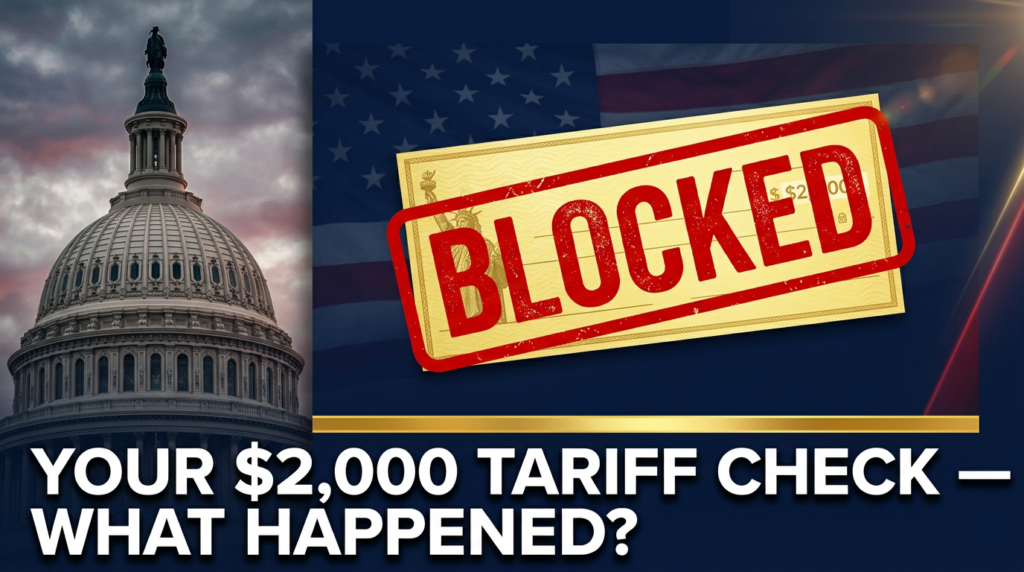
The president promised every middle-class American a $2,000 payout from tariff revenues — no Congressional approval needed. Here’s where that promise stands today, and why the fight over it matters far beyond the dollar amount.
A president promising Americans direct relief funded by trade revenues — not new taxes, not borrowed money, but revenue collected from foreign goods entering U.S. markets. It sounds straightforward. But in Washington, even the most popular ideas collide with legal walls, bureaucratic resistance, and partisan obstruction.
That’s exactly what has happened to President Trump’s proposed $2,000 tariff dividend — a direct cash payment to middle- and lower-income Americans funded by the billions collected from his sweeping tariff agenda. After months of promises, legal battles, and one bruising Supreme Court ruling, the fate of those checks hangs in the balance. How this plays out will say something important about whether any president can make good on economic promises to working Americans without the D.C. establishment’s permission.
Support Independent Local Journalism
TheTownHall.News is a non-profit reader-supported journalism. Just $5 helps us hire local reporters, investigate important issues, and hold public officials accountable across Alameda County. If you believe our community deserves strong, independent journalism, please consider donating $5 today to support our work.Where the $2,000 Tariff Dividend Idea Came From
The proposal first surfaced in July 2025, when Trump and Sen. Josh Hawley (R-MO) floated the idea of redirecting tariff revenue directly to American households. Hawley introduced the American Worker Rebate Act of 2025, which outlined a mechanism for stimulus-style checks funded entirely by import duties — not deficit spending.
By November 2025, Trump made it official on Truth Social: “A dividend of at least $2,000 a person (not including high income people!) will be paid to everyone.” The message was direct, the math seemed viable — the administration claimed tariffs had generated $289 billion in revenue during 2025 — and the political appeal was undeniable.
In December 2025, Trump doubled down at a cabinet meeting, saying the U.S. was collecting “trillions of dollars” in tariff revenue and that dividend checks were coming in 2026. The proposal was concrete: set an income limit, issue payments to working and middle-class families, and use surplus tariff revenue to simultaneously pay down national debt.
Trump’s Bold Claim: We Don’t Need Congress
The most striking element of the proposal came in January 2026, when Trump told reporters he believed the dividend could be issued without Congressional approval. “I don’t think we would have to go the Congress route,” he said. “I believe we can do that without Congress.”

This was an extraordinary claim — and a politically significant one. For years, conservatives have rightly criticized executive overreach when administrations bypassed the legislative process to spend money without authorization. Here, Trump was arguing differently: revenue already collected under his emergency trade authority could be returned directly to Americans as a rebate.
“If true, it would represent one of the most direct ‘government working for the taxpayer’ moments in recent memory — money collected from trade policy, returned to the working Americans who bore its costs.”
The legal vehicle he was relying on: the International Emergency Economic Powers Act (IEEPA), under which most of his tariffs had been imposed.
The Supreme Court Ruling That Changed Everything
In February 2026, the Supreme Court dealt a significant blow. In a 6-3 ruling, the justices struck down a core portion of Trump’s tariff agenda, finding he had wrongfully invoked IEEPA to implement large-scale, broad-based tariffs. The decision didn’t eliminate all tariffs, but it gutted the primary legal framework Trump had used — and with it, a major funding source for the dividend.
Trump moved quickly. He signed an executive order imposing a new 15% global tariff under Section 122 of the Trade Act of 1974 — a different legal authority granting the president temporary tariff power for up to 150 days. Treasury Secretary Scott Bessent publicly stated that tariff revenue “will be little changed” under the new framework, and the White House reaffirmed its commitment to “putting that revenue to good use for the American people.”
But the ruling had knocked the wind out of the dividend’s momentum. Financial analyst Stephen Kates of Bankrate put it starkly: “The odds of this policy moving forward is now effectively zero.” Columbia economist Brett House added that the widening federal deficit makes anyone skeptical the checks will “ever be in the mail.”
Support Independent Local Journalism
TheTownHall.News is a non-profit reader-supported journalism. Just $5 helps us hire local reporters, investigate important issues, and hold public officials accountable across Alameda County. If you believe our community deserves strong, independent journalism, please consider donating $5 today to support our work.What Critics Get Wrong
Opponents of the dividend checks fall into two camps: those who argue the checks are fiscally irresponsible, and those who insist the president doesn’t have the authority to issue them without Congress.
On the fiscal argument: the proposal was explicitly designed to be revenue-neutral — spending only what had already been collected, not borrowing. The Committee for a Responsible Federal Budget estimated that a universal $2,000-per-person dividend could cost up to $600 billion annually. But the income limit Trump specified would significantly reduce that figure, targeting middle- and lower-income households. This is, in practice, more fiscally disciplined than the COVID-era stimulus checks, which were funded entirely by debt.
On the legal argument: critics are on firmer ground. Presidential authority to issue broad-based direct payments outside of Congressional appropriation is genuinely contested. Even Trump’s own team has been split — NEC Director Kevin Hassett and Treasury Secretary Bessent both previously stated that Congressional legislation would be required.
The honest assessment? The “without Congress” route was always a legal stretch. But that doesn’t make the underlying policy wrong — it means it needs a Congressional vehicle.
The Legislative Path Still Exists
Here’s what hasn’t been widely reported: a new legislative effort is quietly advancing. Sen. Hawley’s American Worker Rebate Act remains in the Senate Finance Committee, and as of March 2026, the Tariff Refund Act of 2026 has been introduced to create a structured tax-rebate program prioritizing small businesses and direct consumer relief.
These bills reflect a straightforward conservative principle: when the government collects money, it should be accountable for how it’s spent. Returning it to the workers who bore the cost is far more defensible than cycling it through new bureaucratic programs. The political will is there. What’s missing is urgency from Republican leadership.
The Real Stakes: Midterms and the Working-Class Promise
Make no mistake — this issue is politically supercharged heading into the 2026 midterms. Trump’s tariff agenda has carried real costs: higher consumer prices, supply chain disruptions, and business uncertainty. A direct payment to working families would serve as both economic relief and political validation.
“Working Americans don’t want government programs. They want their money back. A tariff dividend is exactly that.”
The window is narrowing fast. Section 122 tariffs expire after 150 days unless Congress acts. If the dividend isn’t codified legislatively within that window, the revenue base collapses — and with it, any near-term prospect of checks reaching American households.
The Bottom Line: A Real Promise Facing Real Obstacles
Trump’s $2,000 tariff dividend was never a sure thing — but it’s not dead yet. The administration retains tariff-collection authority under Section 122, new legislative vehicles exist, and the political demand is real. What’s missing is the final push: a Congressional vote, a signed bill, and a clear distribution mechanism.
Fiscal accountability means government should be transparent about the money it collects. If $289 billion-plus in tariff revenue was generated, the working families who absorbed higher prices have a legitimate claim to see some of that money returned — not absorbed into Washington’s baseline spending or lost in legal limbo.
The question now isn’t whether the idea is popular. It is. The question is whether Washington has the discipline to act before the opportunity closes.
📌 Key Takeaways
- Trump proposed the $2,000 dividend in Nov. 2025, funded by $289B+ in tariff revenue
- The Supreme Court struck down IEEPA-based tariffs 6-3 in Feb. 2026
- Trump pivoted to Section 122 authority — 15% tariff, valid 150 days
- Hawley’s American Worker Rebate Act and the Tariff Refund Act of 2026 are active in Congress
- Experts say odds are “effectively zero” short-term; White House disagrees
- This is a live 2026 midterm issue — expect it to dominate campaign messaging
Democracy works when citizens stay informed. Share this article. Subscribe to The Town Hall News. Make your voice heard.