Trump Mail-In Voting Executive Order: What It Does, Why It Matters, and What Comes Next
President Trump’s sweeping new executive order finally puts verification, tracking, and accountability at the center of mail-in voting — and the political establishment that profits from the status quo is furious about it.
For decades, Americans have been asked to trust a mail-in voting system built largely on the honor system. No barcode. No confirmed delivery chain. In many states, no hard verification that the person receiving a ballot is who they say they are. Now, for the first time, a president is attempting to bring the same level of accountability to mail ballots that most Americans already expect from their bank, their pharmacist, and their Amazon delivery.
On March 31, 2026, President Trump signed an executive order titled “Ensuring Citizenship Verification and Integrity in Federal Elections.” The reaction from Democratic state officials was immediate — and revealing. Within hours, attorneys general in Arizona, Colorado, and several other states threatened to sue. Prominent Democratic election lawyer Marc Elias announced he would challenge the order in court. The speed of the pushback raises a fair question: if the system is already secure, why is accountability such a threat?
Support Independent Local Journalism
TheTownHall.News is a non-profit reader-supported journalism. Just $5 helps us hire local reporters, investigate important issues, and hold public officials accountable across Alameda County. If you believe our community deserves strong, independent journalism, please consider donating $5 today to support our work.What the Executive Order Actually Requires
Strip away the partisan noise and the order does three concrete things.
First, it directs the Department of Homeland Security, working in conjunction with the Social Security Administration, to compile a verified list of adult U.S. citizens on a state-by-state basis. That list is then made available to chief state election officials to cross-reference against their voter rolls. This is not a voter suppression tool — it’s a data reconciliation measure using federal records that the government already maintains.
Second, the order instructs the U.S. Postal Service to transmit mail-in ballots only to voters whose names appear on a pre-approved list submitted by states at least 60 days before a federal election. States that want to use the Postal Service as a ballot delivery channel must meet this requirement. Those that don’t comply risk losing federal funding.
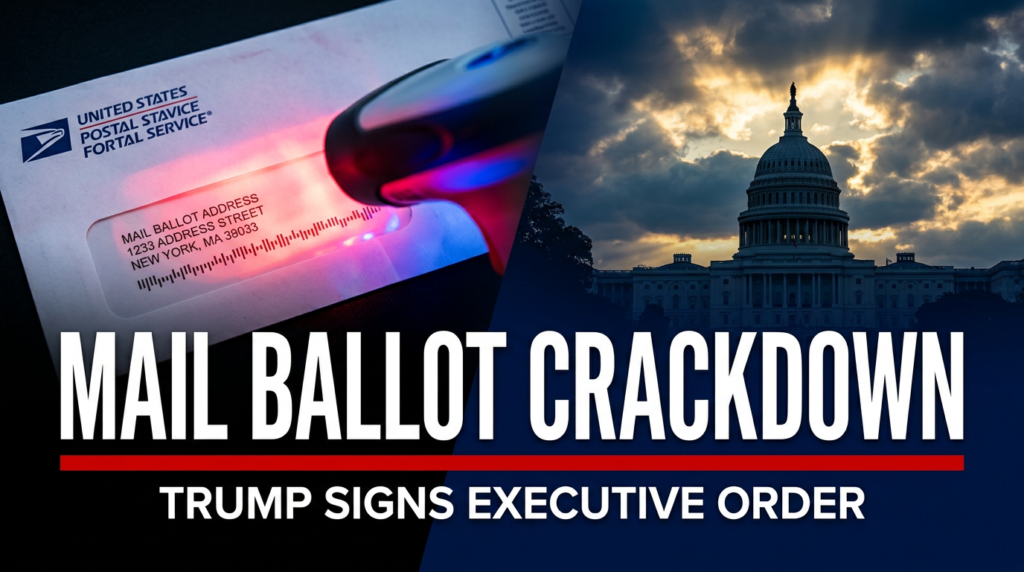
Third, and perhaps most visibly, the order mandates that all official mail ballot envelopes carry a USPS Intelligent Mail barcode — a unique identifier that allows individual ballot envelopes to be tracked through the postal system. As Commerce Secretary Howard Lutnick explained at the signing ceremony: “One envelope per vote.” That’s not a radical concept. It’s basic chain-of-custody logic.

Why This Issue Matters Now
The timing is not accidental. November 2026 midterm elections will determine control of Congress, and both parties know it. Republicans have long argued that the expansion of mail-in voting — accelerated dramatically during the COVID-19 pandemic — outpaced the security infrastructure designed to support it. The SAVE America Act, which would require documentary proof of citizenship to register to vote, has already passed the House but stalled in the Senate. This executive order represents Trump’s effort to advance election security measures without waiting for legislative consensus.
The stakes are real. Mail-in voting has expanded significantly in recent election cycles. In Arizona alone, roughly 80% of voters cast ballots by mail. When a system handles that volume of votes, even small vulnerabilities have outsized consequences. A tracking barcode and a verified recipient list are not burdens — they are basic safeguards that every responsible system at scale should have.
If your ballot can get lost in the mail with no record of what happened to it, that’s not democracy. That’s a suggestion box.
What Critics Get Wrong
The loudest objection from opponents is constitutional: they argue that under Article I, Section 4 of the Constitution, the power to govern elections rests with the states and Congress — not the president acting alone. That argument has legal merit and is worth taking seriously. Courts blocked Trump’s first election-related executive order in 2025 on similar grounds, and several legal experts believe this one faces the same fate.
But critics are conflating a legal process question — who has the authority to implement this — with a policy question — whether this should be done at all. Even scholars who oppose the executive order have not seriously argued that citizenship verification or ballot tracking are bad ideas. They’re arguing about the mechanism, not the principle. If Congress passes the SAVE America Act, virtually every provision in this order gets statutory backing. That debate belongs in the legislature — and Republicans should push it there.
Support Independent Local Journalism
TheTownHall.News is a non-profit reader-supported journalism. Just $5 helps us hire local reporters, investigate important issues, and hold public officials accountable across Alameda County. If you believe our community deserves strong, independent journalism, please consider donating $5 today to support our work.The claim that these measures would disenfranchise eligible voters also deserves scrutiny. The order does not ban mail-in voting. It does not require voters to appear in person. It asks states to submit voter lists 60 days before an election — a reasonable administrative timeline that most well-run election offices should be able to meet.
The Real Cost of the Status Quo
Defenders of the current system rarely acknowledge its documented weaknesses. Voter rolls across the country contain outdated records — addresses of people who have moved, died, or become ineligible. The Heritage Foundation’s Election Fraud Database has tracked hundreds of proven instances of mail-in ballot fraud, from individual cases of ballot harvesting to organized schemes.
The USPS barcode requirement, in particular, is a straightforward upgrade. The postal service already uses Intelligent Mail barcodes for package tracking. Applying the same technology to ballot envelopes adds zero cost to the voter, requires no new ID, and creates a verifiable audit trail from sender to recipient. The argument that this constitutes an undue burden is difficult to sustain.
The deeper issue is this: when citizens lose confidence in the integrity of their elections, they lose confidence in their government. That erosion of civic trust is not a partisan talking point — it is a documented reality. Polling consistently shows that tens of millions of Americans, across party lines, harbor doubts about mail-in ballot security. A verified, trackable, accountable system does not weaken democracy. It strengthens it.
The Federalism Question — A Fair Challenge
It would be intellectually dishonest to ignore the strongest counterargument. The Constitution does reserve broad election authority to the states, and Trump’s previous election executive order was struck down by multiple courts precisely because it attempted to override state prerogatives without congressional authorization. Colorado Secretary of State Jena Griswold and Arizona Attorney General Kris Mayes are not wrong to note that this order raises legitimate federalism concerns.
The appropriate response, however, is not to abandon the policy goals — it is to pursue them through proper legislative channels. The SAVE America Act is the right vehicle. If Senate Republicans lack the votes to pass it, that is a political problem to solve, not a reason to accept a status quo that millions of Americans find untrustworthy. The executive order, even if courts ultimately limit its scope, forces that conversation into the open.
What Comes Next
Legal challenges are already being drafted. Marc Elias has pledged to sue. Attorneys general in at least six states — Arizona, Colorado, Nevada, Minnesota, Oregon, and Virginia — have signaled opposition. Federal judges could issue a preliminary injunction within weeks of the first filing.
Even if the order is partially or fully blocked, it accomplishes something important: it puts election accountability on the national agenda in a midterm year. Americans who believe their vote should count — and only their vote — are paying attention.
This is not about making it harder to vote. It’s about making it harder to cheat.
Key Takeaway
President Trump’s executive order mandates citizenship verification, a pre-approved mail voter list, and USPS barcode tracking on all mail ballots. Legal challenges are coming, but the core principle — that every legitimate vote deserves a verifiable chain of custody — is one that most Americans can support regardless of party. If courts block the order, Congress should act. The integrity of American elections is not the foundation of one party’s power. It’s the foundation of self-governance.
Stay informed. Share this article with someone who cares about the integrity of American elections. Civic engagement starts with an informed public — and that starts with you.