Trump Paid $928 Million to Kill Biden’s Wind Farms — But Who’s Paying to Clean Up the Ocean?
The deal is done. The leases are gone. The question Washington isn’t asking — but should be — is who’s left holding the mop.
When the Trump administration announced its landmark $928 million deal with French energy giant TotalEnergies this week, the headlines focused on what was gained: two cancelled offshore wind projects, a pivot to American oil, gas, and LNG investment, and a symbolic victory over Biden-era energy ideology. The administration called it a win for national security. TotalEnergies called it a more efficient use of capital. Conservative commentators called it a long-overdue course correction.
They’re not wrong. But in the rush to celebrate, a critical question has gone entirely unanswered — one that every American taxpayer and every coastal community from New York to North Carolina has a right to ask:
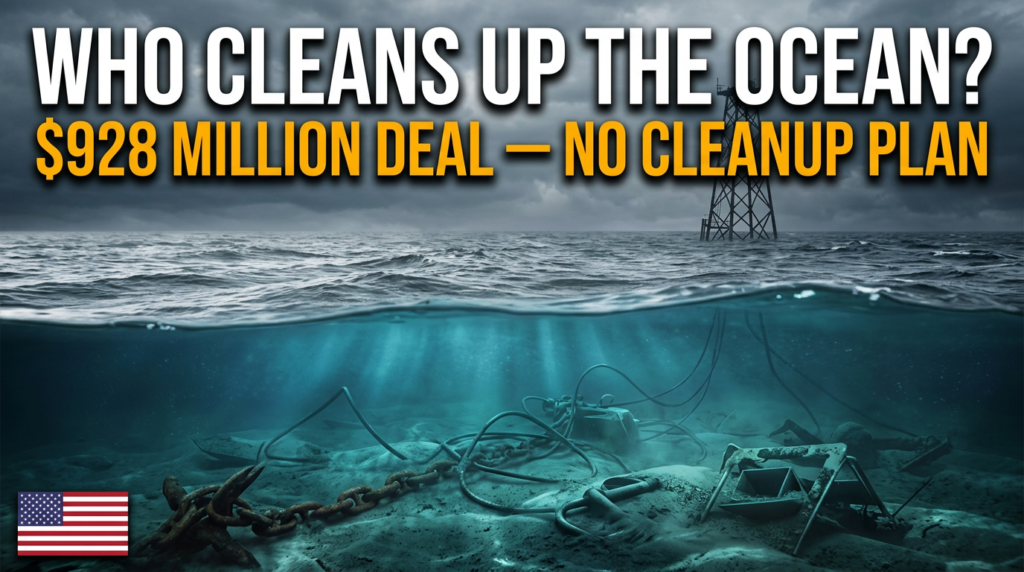
Who is responsible for cleaning up the ocean?
Support Independent Local Journalism
TheTownHall.News is a non-profit reader-supported journalism. Just $5 helps us hire local reporters, investigate important issues, and hold public officials accountable across Alameda County. If you believe our community deserves strong, independent journalism, please consider donating $5 today to support our work.It is not a small question. And right now, no one in Washington is giving a straight answer.
What the Deal Actually Covers — and What It Doesn’t
The terms of the TotalEnergies settlement are straightforward on paper. The federal government reimburses the company up to $928 million — dollar for dollar — matching what TotalEnergies paid for two offshore wind leases under Biden:
- Lease OCS-A 0535 (Carolina Long Bay, NC): $133.3 million, purchased June 2022
- Lease OCS-A 0538 (New York Bight, NY): $795 million, purchased May 2022
In return, TotalEnergies surrenders the leases, reinvests the reimbursed funds into U.S. fossil fuel development, and pledges no new offshore wind projects on American waters.
Critically, construction had not yet begun on either project. No turbines were installed. No foundations were sunk. So the cleanup question is not about dismantling a forest of steel towers rising from the Atlantic — at least not yet. But that does not mean the seabed was untouched. Site surveys, geotechnical investigations, cable route assessments, and preparatory environmental studies disturb ocean floor ecosystems in ways that are real, if less visible than a physical structure. And the broader legal and regulatory framework governing what happens when an offshore wind lease is simply walked away from is, to put it plainly, deeply incomplete.

The Legal Framework: What Federal Law Actually Requires
Under federal law, the obligations for offshore energy decommissioning are clear — in principle. The Bureau of Ocean Energy Management (BOEM) and the Bureau of Safety and Environmental Enforcement (BSEE) govern offshore development on the Outer Continental Shelf. Their rules state that within one year of lease termination, lessees must permanently plug any wells, remove all platforms and facilities, decommission pipelines, and clear the seafloor of obstructions.
For offshore wind specifically, BOEM requires leaseholders to submit conceptual decommissioning plans at the project proposal stage and detailed plans closer to the end of the lease term. Financial assurance — in the form of bonds or security deposits — is supposed to be posted to ensure companies can cover the cost of cleanup even if they go bankrupt or walk away.
Here is where the story gets uncomfortable: in practice, those protections have significant gaps. Several offshore wind developers — including Revolution Wind, Sunrise Wind, Southcoast Wind, and Vineyard Wind — had their decommissioning bond requirements waived by BOEM under the Biden administration, with insurance policies cited as alternative coverage. And in 2026, the Trump administration moved to ease financial assurance rules further for offshore energy firms, rolling back a 2024 regulation that had tightened bonding requirements.
In other words: both administrations, in different ways, have loosened the financial safety net that is supposed to guarantee cleanup happens. The TotalEnergies deal is silent on what specific restoration obligations, if any, accompany the lease surrender.
America Has Seen This Movie Before — and It Didn’t End Well
Anyone who thinks this is a hypothetical concern has not been paying attention to the history of offshore energy abandonment in this country.
Support Independent Local Journalism
TheTownHall.News is a non-profit reader-supported journalism. Just $5 helps us hire local reporters, investigate important issues, and hold public officials accountable across Alameda County. If you believe our community deserves strong, independent journalism, please consider donating $5 today to support our work.The numbers are staggering. According to federal data, there are an estimated 2.3 to 3 million abandoned onshore oil and gas wells across the United States. In the Gulf of Mexico alone, approximately 14,000 wells remain unplugged, with roughly 2,700 abandoned wells and 500 platforms overdue for decommissioning. Since the 1960s, some 18,000 miles of pipeline — approximately 97% of the total pipeline length ever laid in the Gulf — has simply been left on the seafloor.
The price tag for that neglect? Estimates suggest it would cost over $151 billion to plug and remediate abandoned oil and gas wells nationwide. The offshore platform Holly off the California coast cost the state $65 million to clean up after its operator went bankrupt. The Rincon Pier cleanup required approximately $51 million in state appropriations.
When companies are allowed to walk away — whether through bankruptcy, policy change, or a government-brokered deal — the costs don’t disappear. They transfer. To states. To federal agencies. To taxpayers. To the ocean ecosystems and fishing communities left behind.
The principle of personal responsibility — one of the bedrock values of conservative governance — demands that the entity that disturbs a resource be the entity that restores it. That principle does not stop at the shoreline.
The Unanswered Question: What Did TotalEnergies Leave Behind?
To be precise about what TotalEnergies actually did to the seafloor in the Carolina Long Bay and New York Bight lease areas requires transparency that the current deal documents do not provide. What site characterization work was conducted? What cables or anchors, if any, were deployed for survey operations? What environmental baseline was established — and what departures from that baseline occurred?
These are not gotcha questions. They are the basic inquiries that any responsible stewardship of public ocean resources demands. The Atlantic Ocean floor is not TotalEnergies’ property. It belongs to the American people. A lease granted the company the right to develop it — it did not grant the company the right to leave it in any condition other than the one it was found in.
The deal as publicly announced makes no specific mention of environmental remediation obligations tied to the lease surrender. The Department of Interior’s press release focuses entirely on the energy investment commitments. That silence is not reassuring.
Fiscal Accountability Cuts Both Ways
Conservatives rightly celebrated this deal as a rebuke of Biden’s subsidy-driven wind agenda. Interior Secretary Doug Burgum called offshore wind a “subsidy-driven scheme” delivering unreliable and expensive electricity. That critique is well-founded, and the broader pivot toward LNG, Gulf oil, and shale gas investment represents a genuine improvement in American energy policy.
But fiscal accountability is not a selective principle. It cannot be applied only to green energy boondoggles while ignoring the open-ended environmental liabilities that come with walking away from ocean leases without clearly defined cleanup requirements.
If the deal required TotalEnergies to fully document the condition of both lease sites, post decommissioning bonds covering any restoration work needed, and certify that the seafloor was returned to pre-lease condition — that would be a fiscally and environmentally complete agreement. If it didn’t, then the celebration may be premature.
The American people paid $928 million to cancel this wind deal. They should not also be on the hook to clean up after it.
What Responsible Governance Looks Like
There is a straightforward path forward that honors both the energy policy correction this deal represents and the accountability that ocean stewardship demands:
- Full disclosure of all site characterization and survey activities conducted under both leases
- Independent environmental assessment of the Carolina Long Bay and New York Bight lease areas, conducted before the lease terminations are finalized
- Explicit cleanup certification by TotalEnergies, confirming the seafloor has been restored to pre-lease condition or that no disturbance occurred
- Financial assurance posted and held for a defined period post-surrender, in case delayed environmental impacts emerge
- Congressional oversight of the broader pattern of decommissioning bond waivers for offshore wind developers, regardless of political affiliation
None of this is anti-business. None of it undermines the energy policy goals this deal advances. It is simply what responsible governance of public resources looks like — a principle that should be non-negotiable across administrations of either party.
Conclusion: A Win That Deserves a Complete Audit
The TotalEnergies deal is a legitimate policy victory. Redirecting nearly $1 billion from unviable offshore wind into American LNG, Gulf oil, and shale gas is good for jobs, good for energy security, and good for American geopolitical influence. The Trump administration deserves credit for unwinding a Biden-era policy that was built on ideology more than economics.
But a complete victory requires complete accountability. The American coastline — from the Outer Banks of North Carolina to the waters off New York — is a national treasure. The fishing communities, marine ecosystems, and coastal economies that depend on a healthy Atlantic deserve to know, on the record, that the ocean floor was not compromised by years of lease activity that is now being quietly terminated with a government check.
Winning on energy policy and protecting the ocean are not competing goals. They are both expressions of the same conservative principle: responsible stewardship of American resources, for American people, with accountability attached to every dollar and every acre — including the ones underwater.
The deal is done. Now let’s see the cleanup plan.
📣 Call to Action
Don’t let this question get buried. Share this article, contact your congressional representatives, and demand that the Department of Interior release the full environmental terms of the TotalEnergies lease surrender. America’s oceans are public property — and the public deserves a full accounting. Subscribe for ongoing coverage of energy policy, fiscal accountability, and the stories Washington hopes you’ll miss.