Trump Tariffs Bring American Manufacturing Back: South Carolina Aluminum Plant Returns to Full Production
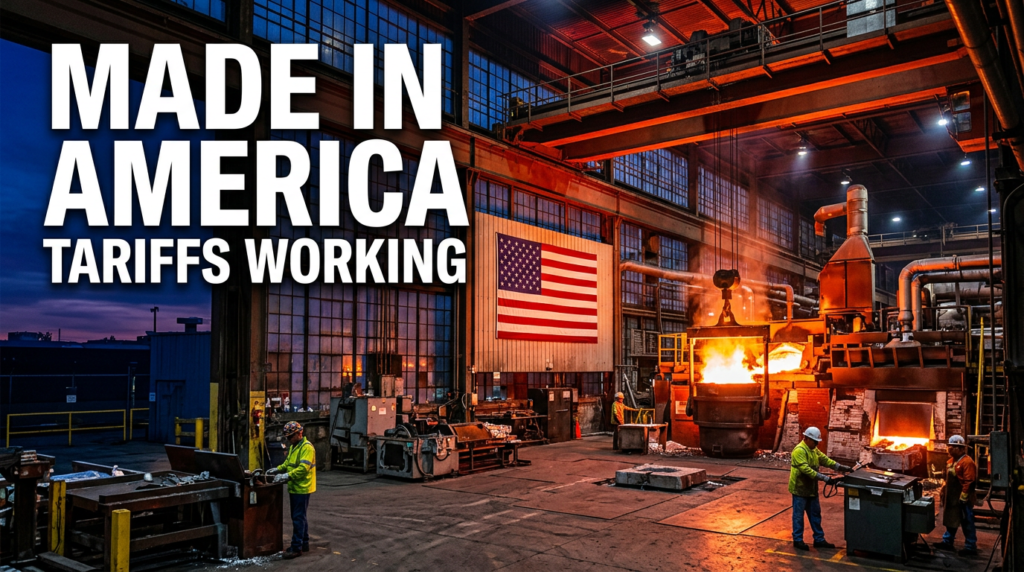
A South Carolina aluminum plant is returning to full production for the first time since 2015, creating over 100 good-paying jobs — and the CEO says it wouldn’t have happened without President Trump’s tariffs. This is what an America First industrial policy looks like in practice.
For years, critics of trade protectionism argued that tariffs were economic poison — a tax on consumers that would do nothing to revive American manufacturing. Then Century Aluminum’s CEO Jesse Gary stepped in front of cameras at his Goose Creek, South Carolina facility and said two words the skeptics didn’t want to hear: they’re working.
The Mt. Holly aluminum smelter — idle or operating at reduced capacity for nearly a decade — is being brought back to 100% production for the first time since 2015. More than 100 new jobs are being created, paying an average wage of approximately $100,000 per year. The company is investing $50 million in the restart. And it is happening, directly and explicitly, because of President Trump’s Section 232 aluminum tariffs. When the results are this concrete, it’s time to retire the talking points and look at the evidence.
Support Independent Local Journalism
TheTownHall.News is a non-profit reader-supported journalism. Just $5 helps us hire local reporters, investigate important issues, and hold public officials accountable across Alameda County. If you believe our community deserves strong, independent journalism, please consider donating $5 today to support our work.What Actually Happened at Mt. Holly
Century Aluminum, the largest domestic producer of primary aluminum in the United States, announced the Mt. Holly restart in August 2025. The plant, located in Berkeley County outside Charleston, had been running at just 75% of its output capacity. Under the restart plan, the smelter is expected to reach full production by June 30, 2026 — and the company is putting real money on the table to get there.
The $50 million investment isn’t a government handout. It’s a private sector commitment made possible by a stable trade policy that levels the playing field against heavily subsidized foreign competitors. Century also secured a power agreement extension with South Carolina’s Santee Cooper utility through 2031 — a sign that this isn’t a short-term political stunt, but a long-term industrial commitment.
The numbers behind the plant are staggering. According to a University of South Carolina economic study released in 2024, the Mt. Holly smelter at full capacity generates over $890 million annually in economic impact for South Carolina alone. That is what domestic manufacturing does for a community — and for a country.
The Tariff Policy That Made It Possible
The Section 232 tariffs on aluminum imports — initially imposed at 25% during Trump’s first term — were raised to 50% in 2025, with no exceptions and no exemptions. This was the trigger. For years, foreign competitors — particularly state-subsidized producers in China and the Middle East — had been undercutting American aluminum manufacturers by flooding the market with artificially cheap metal. The result was predictable: U.S. smelters went dark, American workers lost jobs, and the country became dangerously dependent on foreign sources for a metal critical to aerospace, defense, and infrastructure.

Then, on April 2, 2025, President Trump went even further — signing an executive order that closed valuation loopholes that importers were exploiting to reduce the effective tariff rate. Century Aluminum publicly praised the action, noting that these loopholes had been quietly draining the policy’s intended effect.
The message to the market was unmistakable: the United States is serious about protecting its aluminum industry. And the market responded.
“Today’s announcement was made possible by President Trump’s commitment to onshoring manufacturing of critical metals, protecting America’s national security, and to protecting American workers.” — CEO Jesse Gary, Century Aluminum
Why This Isn’t Just About Aluminum
The critics who reflexively dismiss tariffs as protectionism miss the bigger picture. This is about national security as much as economics. Aluminum is not a commodity like soybeans or sneakers. It is a foundational material in fighter jets, naval vessels, communications infrastructure, and transportation systems. A nation that cannot produce its own aluminum is a nation dependent on its strategic rivals for the materials of its own defense.
For decades, the conventional wisdom in Washington — from both parties — was that the free market would sort this out. It didn’t. What it sorted out instead was the offshoring of tens of thousands of middle-class manufacturing jobs, the gutting of industrial communities across the Midwest and South, and the quiet dismantling of supply chains that took generations to build.
The personal responsibility and limited-government values that define common-sense conservatism do not require the U.S. to be naive about how other governments play the game. When Beijing subsidizes its aluminum industry to the tune of billions of dollars, American companies aren’t competing on a free market — they’re competing against the Chinese state. Tariffs don’t distort the market; they correct a distortion that already exists.
Support Independent Local Journalism
TheTownHall.News is a non-profit reader-supported journalism. Just $5 helps us hire local reporters, investigate important issues, and hold public officials accountable across Alameda County. If you believe our community deserves strong, independent journalism, please consider donating $5 today to support our work.What Critics Get Wrong
The most common counterargument is that tariffs raise costs for downstream industries — automakers, beverage companies, and construction firms — that use aluminum as an input. This is a legitimate concern, and it deserves a straight answer.
Yes, aluminum tariffs increase input costs for some manufacturers. That is a real trade-off. But the alternative — allowing the complete collapse of domestic primary aluminum production — carries far greater long-term costs. If the United States loses the capacity to produce primary aluminum at industrial scale, no trade policy reversal will quickly rebuild it. Smelters take years and hundreds of millions of dollars to restart. Workers with specialized skills disperse and don’t return. The infrastructure atrophies. You don’t just flip a switch.
The question is not whether tariffs are cost-free. They are not. The question is whether the long-term strategic and economic cost of deindustrialization exceeds the short-term cost of protection. At Mt. Holly, the answer appears to be yes — and private capital is voting accordingly with a $50 million commitment.
Furthermore, it’s worth noting that the U.S. Supreme Court upheld the legal basis for the IEEPA tariff framework in 2026, removing significant legal uncertainty that had hung over the broader trade strategy. That ruling matters — it gives American manufacturers the policy stability they need to make long-term investment decisions with confidence.
How This Affects American Workers and Communities
Behind every statistic in this story is a family. The 100-plus new jobs at Mt. Holly aren’t abstract line items — they are careers with benefits in Berkeley County, South Carolina. At an average wage of approximately $100,000 per year, these are positions that support mortgages, college funds, and retirement savings. These are the kinds of jobs that build the civic backbone of a community.
For too long, the political and media establishment treated the loss of manufacturing jobs as an inevitable consequence of economic progress — something to be managed with retraining programs and government assistance rather than prevented through sound policy. The workers who lost those jobs never accepted that framing, and they were right not to.
When a government prioritizes the rules of a global trading system over the livelihoods of its own workers, it has lost the thread of what governance is for.
The Mt. Holly story is proof that a different approach is possible. Trade policy that defends American industry, enforces fair competition, and treats domestic manufacturing as a strategic asset — rather than a relic — produces real results.
The Takeaway: Results Matter
The debate over tariffs is not over, and it shouldn’t be. Reasonable people can and should debate the scope, duration, and structure of trade protections. But that debate must be grounded in evidence — and the evidence from South Carolina is hard to dismiss.
A $50 million private investment. One hundred new six-figure jobs. A plant returning to full capacity for the first time in a decade. An industry that was quietly disappearing, now showing signs of life. These are not talking points — they are documented outcomes from a policy that was widely mocked when it was introduced.
For the communities that depend on manufacturing, for the workers who deserve a fair shot at a middle-class life, and for a country that cannot afford to outsource its industrial base, the Mt. Holly restart is more than good news. It’s a model.
Stay Informed — And Make Your Voice Heard
Stories like this one don’t always get the attention they deserve from the mainstream press. If you believe in honest, fact-driven reporting that covers the economic wins American workers are earning, share this article with your network. Subscribe to stay current on the issues that matter most — trade, jobs, national security, and fiscal policy. Civic engagement starts with staying informed. Don’t let the narrative be written without you.