Trump Venezuela Strike: Why the Monroe Doctrine Matters for American Security
America Reasserts Regional Authority
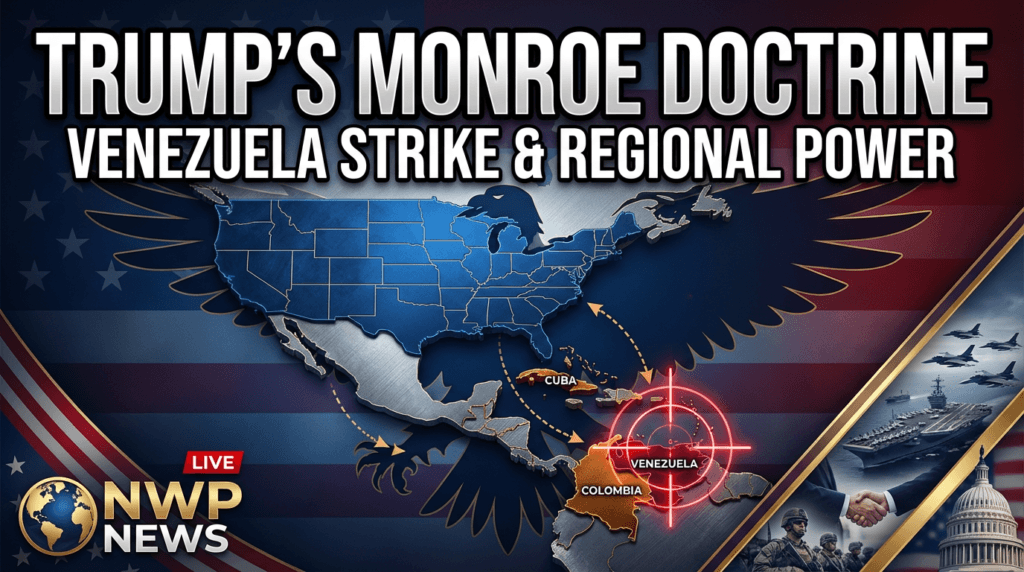
President Donald Trump’s January 3, 2026 military strike on Venezuela—resulting in the capture of dictator Nicolás Maduro and his wife Cilia Flores—represents the most decisive assertion of American power in the Western Hemisphere in decades. Within hours of announcing Maduro’s capture, Trump made clear this wouldn’t be an isolated action, suggesting that Cuba is “ready to fall,” threatening military intervention in Colombia, and reaffirming American interest in acquiring Greenland for national security purposes.
The mainstream media predictably erupted in outrage, with critics invoking terms like “imperialism” and “illegal aggression.” International bodies condemned the action. Latin American governments issued statements about violated sovereignty. But these reactions miss the fundamental question conservatives should be asking: Does America have legitimate security interests in preventing hostile narco-states, communist dictatorships, and drug cartels from operating freely in our hemisphere?
Trump calls his approach the “Donroe Doctrine”—a play on the 1823 Monroe Doctrine that established American preeminence in the Western Hemisphere. Critics mock the branding, but the principle is sound: America has both the right and responsibility to prevent hostile foreign powers and criminal enterprises from threatening our security in our own neighborhood.
Support Independent Local Journalism
TheTownHall.News is a non-profit reader-supported journalism. Just $5 helps us hire local reporters, investigate important issues, and hold public officials accountable across Alameda County. If you believe our community deserves strong, independent journalism, please consider donating $5 today to support our work.This isn’t about nation-building or exporting democracy. It’s about recognizing that weak, corrupt, or hostile governments on our doorstep directly threaten American citizens through drug trafficking, illegal immigration, and geopolitical instability. Let’s examine why conservatives should support this reassertion of American strength—and where legitimate concerns about overreach require careful consideration.
The Case for Action: Venezuela’s Threat to American Security
The Narco-State Problem
Venezuela under Maduro wasn’t simply another socialist failure—it became a narco-state actively facilitating drug trafficking into the United States. Maduro faced federal indictment in the United States on drug trafficking charges, with prosecutors alleging he conspired with Colombian cartels to flood American communities with cocaine.
This isn’t theoretical harm. Tens of thousands of Americans die annually from drug overdoses, with much of that supply chain running through Venezuela. The Trump administration’s National Security Strategy explicitly identifies controlling drug trafficking as a core justification for reasserting the Monroe Doctrine in Latin America.
Conservatives understand that government’s primary responsibility is protecting citizens from foreign threats. When a hostile government actively facilitates the poisoning of American communities, that’s not an internal matter—it’s an act of aggression requiring response.
The Cuba Connection
Trump’s prediction that Cuba is “ready to fall” isn’t wishful thinking—it’s strategic assessment. Cuba’s communist regime relied heavily on Venezuelan oil subsidies to survive. The Trump administration’s blockade of Venezuelan oil tankers cut Cuba off from this critical energy supply, leaving the island nation economically vulnerable.
Secretary of State Marco Rubio, the son of Cuban immigrants and a longtime critic of the Castro regime, made the administration’s position clear: “If I lived in Havana and I was in the government, I’d be concerned.”
Cuba has spent over six decades as a Soviet client state turned Chinese outpost, hosting intelligence operations, supporting anti-American movements, and oppressing its own people. The prospect of the communist government finally collapsing—without direct American military intervention—represents exactly the kind of strategic victory conservatives should celebrate.
The Colombian Complication
Trump’s threats toward Colombia require more nuanced analysis. Unlike Venezuela and Cuba, Colombia has been a traditional American ally in the region. However, current President Gustavo Petro—a leftist with ties to Maduro—has moved Colombia away from its historical alignment with the United States.
Trump’s criticism focuses on Colombian cocaine production: “Colombia is very sick. They’re making cocaine. They’re sending it into the United States.” When asked whether the U.S. would conduct operations in Colombia, Trump responded: “Sounds good to me.”
Support Independent Local Journalism
TheTownHall.News is a non-profit reader-supported journalism. Just $5 helps us hire local reporters, investigate important issues, and hold public officials accountable across Alameda County. If you believe our community deserves strong, independent journalism, please consider donating $5 today to support our work.This represents the tension in Trump’s approach. While Colombian cocaine factories genuinely threaten American communities, military action against a sovereign nation that isn’t actively at war with the United States raises legitimate constitutional and strategic concerns. Conservatives should support strong pressure on Colombia to shut down drug production while questioning whether military intervention is proportionate or wise.
The Monroe Doctrine: Historical Context and Modern Application
What the Original Monroe Doctrine Established
President James Monroe’s 1823 doctrine declared that European powers should no longer colonize or interfere in the Americas. In exchange, the United States would not interfere in European affairs. This wasn’t imperialism—it was establishing that the Western Hemisphere would not become a playground for hostile foreign powers.
For nearly two centuries, this principle guided American foreign policy with varying degrees of enforcement. During the Cold War, it justified opposition to Soviet expansion in Cuba, Nicaragua, and elsewhere. Critics called it paternalistic; defenders called it pragmatic recognition that hostile powers operating near American borders threaten national security.
Trump’s “Donroe Doctrine” Revival
Trump’s National Security Strategy explicitly states the administration is “reasserting and enforcing the Monroe Doctrine to restore American preeminence in the Western Hemisphere, control migration, and stop drug trafficking.”
This represents a fundamental departure from the globalist consensus that dominated American foreign policy for decades. That consensus treated American interests in our own hemisphere as equivalent to any other region, subject to endless international consultation and approval. Trump’s approach recognizes what conservatives have always understood: geography matters, proximity creates legitimate security interests, and America has both the right and power to prevent hostile actors from operating in our neighborhood.
The “Donroe” branding may be playful, but the principle is serious. America will no longer tolerate narco-states, communist dictatorships, and drug cartels threatening our citizens while hiding behind sovereignty claims.
Conservative Principles: Where This Policy Succeeds and Where Concerns Remain
The Strengths: Protecting American Citizens
The strongest conservative case for Trump’s Venezuela action centers on government’s primary responsibility: protecting citizens from foreign threats. Maduro’s regime facilitated drug trafficking that killed Americans, harbored terrorists and criminals, and created refugee flows that strained our immigration system.
Traditional diplomacy failed for years. Sanctions didn’t work. International pressure accomplished nothing. At some point, conservative principles about limited government must yield to the reality that some threats require forceful response.
The operation itself demonstrated competence and precision. With 150 jets from 20 airbases, U.S. forces captured Maduro and his wife while minimizing broader casualties. This wasn’t nation-building or regime change for ideological reasons—it was removing a specific threat through targeted action.
The Concerns: Constitutional Authority and Mission Creep
However, conservatives must also grapple with legitimate concerns about executive war powers and mission creep. The Constitution grants Congress—not the President—authority to declare war. While presidents have broad latitude for military operations protecting American interests, the Venezuela strike wasn’t responding to an imminent attack or ongoing combat.
Trump cited Maduro’s federal indictment as partial justification, essentially treating the operation as a law enforcement action against a fugitive. This creative legal theory deserves scrutiny. Can presidents order military strikes to arrest foreign leaders under indictment? What precedent does this set for future administrations?
Additionally, Trump’s suggestions about potential operations in Colombia, Cuba, and Mexico raise questions about where this ends. If the standard is “drug trafficking threatens Americans,” that could justify intervention across Latin America. Conservatives rightly oppose endless foreign entanglements and nation-building. We need clear principles about when military force is appropriate and what objectives justify intervention.
The Greenland Question: Strategic Necessity or Overreach?
Trump’s renewed push to acquire Greenland seems disconnected from Latin American policy, but it reflects the same principle: America must secure strategic territory from hostile powers.
“We need Greenland from a national security situation,” Trump explained. “It’s so strategic. Right now, Greenland is covered with Russian and Chinese ships all over the place. We need Greenland from the standpoint of national security, and Denmark is not going to be able to do it.”
The Strategic Case
Greenland’s location makes it critical for Arctic security, missile defense, and controlling northern shipping routes. As climate change opens Arctic passages, competition for access and resources intensifies. China and Russia have dramatically increased their Arctic presence, with implications for both commercial shipping and military positioning.
The United States already maintains Thule Air Base in Greenland under agreement with Denmark. But Trump argues that Denmark cannot adequately defend Greenland from increasing Chinese and Russian encroachment. Denmark’s Prime Minister Mette Frederiksen rejected Trump’s suggestions, noting that Greenland is part of NATO and covered by alliance security guarantees.
The Conservative Tension
Here conservatives face competing principles. On one hand, securing strategic territory from hostile powers aligns with national security priorities. On the other hand, pressuring allied nations to cede territory strains relationships and violates the sovereignty principles conservatives claim to support.
The better approach might be negotiating expanded American defense commitments in Greenland while respecting Danish sovereignty—essentially achieving the security objectives without the territorial acquisition. This would demonstrate that American strength doesn’t require imperial expansion.
What’s Missing: Clear Objectives and Exit Strategies
The most significant concern about Trump’s Latin America policy is the absence of clearly articulated objectives and exit strategies. Capturing Maduro accomplished a specific goal, but what comes next for Venezuela? Who governs? How long do American forces remain? What prevents the country from descending into chaos that creates even worse problems?
Trump has indicated that American companies will take over Venezuela’s oil production—a pragmatic approach that could stabilize the country while benefiting American interests. But the details matter enormously. Are we prepared for a long-term commitment? What if Venezuelan factions resist? How much will this cost American taxpayers?
Conservatives learned hard lessons from Iraq and Afghanistan about the dangers of military action without clear objectives, realistic timelines, and honest cost assessments. We should demand the same scrutiny for Venezuela that we applied to Middle Eastern interventions.
Similarly, threatening military action in Colombia without explaining what specific actions would trigger intervention creates dangerous ambiguity. Does Trump want Petro removed? Specific cocaine factories destroyed? A change in Colombian policy? Without clear red lines, we risk stumbling into conflicts without proper planning or public support.
The Broader Foreign Policy Vision: America First Means American Strength
Trump’s actions in Venezuela and threats toward other nations reflect a broader foreign policy philosophy that conservatives should largely embrace: America First means American strength, not American retreat.
For decades, the foreign policy establishment treated American power as something to be apologized for and constrained. We were told that asserting our interests was “unilateral,” that we needed endless consultation with international bodies, that American strength itself was destabilizing.
This worldview produced disastrous results—ISIS conquering territory while we “led from behind,” Iran emboldened by weak nuclear deals, China expanding unchecked in the South China Sea, and narco-states operating freely in our own hemisphere.
Trump’s approach recognizes that American strength, properly applied, creates stability. Hostile actors respect power, not process. Maduro spent years ignoring diplomatic pressure because he believed America lacked the will to act. That calculation changed on January 3.
However, strength without wisdom produces different disasters. Conservative foreign policy should emphasize:
Clear national interests – We intervene when American security is directly threatened, not to export ideology or engage in humanitarian missions disconnected from our interests.
Proportionate responses – Military force should match the threat level. Capturing an indicted narco-dictator differs from invading allied nations over policy disputes.
Constitutional processes – Congress should authorize extended military operations, ensuring democratic accountability and public support.
Fiscal responsibility – Foreign interventions cost money. We should demand honest accounting of expenses and commitment timelines.
Exit strategies – Before acting, we should know what success looks like and how we’ll achieve it without indefinite occupation.
International Response: Why Criticism Doesn’t Equal Illegitimacy
The predictable international condemnation of Trump’s Venezuela action deserves examination. Brazil, Chile, Colombia, Mexico, and Uruguay all criticized the strike. The United Nations will likely pass resolutions. International law scholars will write op-eds about violated sovereignty.
Conservatives should view this criticism with appropriate skepticism. International bodies have spent decades failing to address Venezuela’s humanitarian catastrophe, drug trafficking, and regional destabilization. These same critics offered no solutions when Maduro stole elections, imprisoned opponents, and drove millions of refugees to neighboring countries.
International law, as currently constructed, often protects hostile governments from accountability while constraining democracies from defending their interests. The same international system that condemns American action in Venezuela does nothing about Chinese genocide, Russian aggression, or Iranian terrorism.
This doesn’t mean international law is irrelevant—norms against aggression serve important purposes. But conservatives should recognize that international approval isn’t required for legitimate American action. Our authority comes from the Constitution and our responsibility to protect American citizens, not from UN resolutions or European opinion.
Conclusion: Strength With Strategy
President Trump’s Venezuela strike and broader Latin America policy represent a necessary correction to decades of American passivity in our own hemisphere. Conservatives should support the principle that America has legitimate security interests requiring forceful action when diplomacy fails.
The capture of Maduro removes a narco-dictator who actively harmed American citizens. The pressure on Cuba might finally end a six-decade communist dictatorship without direct American intervention. The message to other hostile actors in the region is clear: America will no longer tolerate threats in our own neighborhood.
However, conservatives must also demand strategic clarity, constitutional process, and fiscal accountability. Strength without wisdom produces different disasters than weakness. We need clear objectives, honest cost assessments, and realistic exit strategies for any extended operations in Venezuela or elsewhere.
Trump’s “Donroe Doctrine” revival could represent the kind of confident American leadership conservatives have long advocated—or it could become another open-ended commitment draining resources without achieving objectives. The difference will be determined by whether the administration applies strategic discipline to match its tactical boldness.
The Monroe Doctrine worked for nearly two centuries because it established clear principles about American interests in our hemisphere. The modern version should do the same: America will act decisively against direct threats, support allies, pressure hostile governments, and prevent foreign powers from operating freely near our borders. But we’ll do so with clear objectives, constitutional authority, and commitment to achieving specific goals rather than endless nation-building.
That’s conservative foreign policy—strong, strategic, and accountable.
Call to Action: Demand Strategic Clarity
Contact Your Representatives – Tell your senators and representatives that you support strong action against narco-states and dictatorships, but demand clear objectives, constitutional authorization for extended operations, and honest cost assessments. Find your representatives at house.gov and senate.gov.
Stay Informed Beyond Headlines – The mainstream media will focus on international criticism while ignoring the genuine security threats that justified action. Follow conservative foreign policy analysts, read the administration’s National Security Strategy, and understand the strategic rationale beyond sound bites.
Support Constitutional Process – If Trump extends operations in Venezuela or launches new actions elsewhere, Congress should authorize and oversee these commitments. Conservative principles demand that major military operations receive democratic accountability through proper constitutional channels.
Distinguish Strength from Overreach – Not every aggressive statement serves American interests. Support decisive action against genuine threats while questioning vague threats that lack clear strategic purpose. Conservative foreign policy requires both strength and wisdom.
Share This Analysis – The foreign policy debate needs conservative voices emphasizing both American strength and strategic discipline. Share this article with friends, family, and social networks so more Americans understand the principles at stake.
The fight for conservative foreign policy—strong, strategic, and constitutional—requires engaged citizens holding leaders accountable. Will you be part of that effort?