Trump’s $2,000 Tariff Dividend Checks: Why Returning Money to Americans Beats Government Waste
A Different Kind of Stimulus
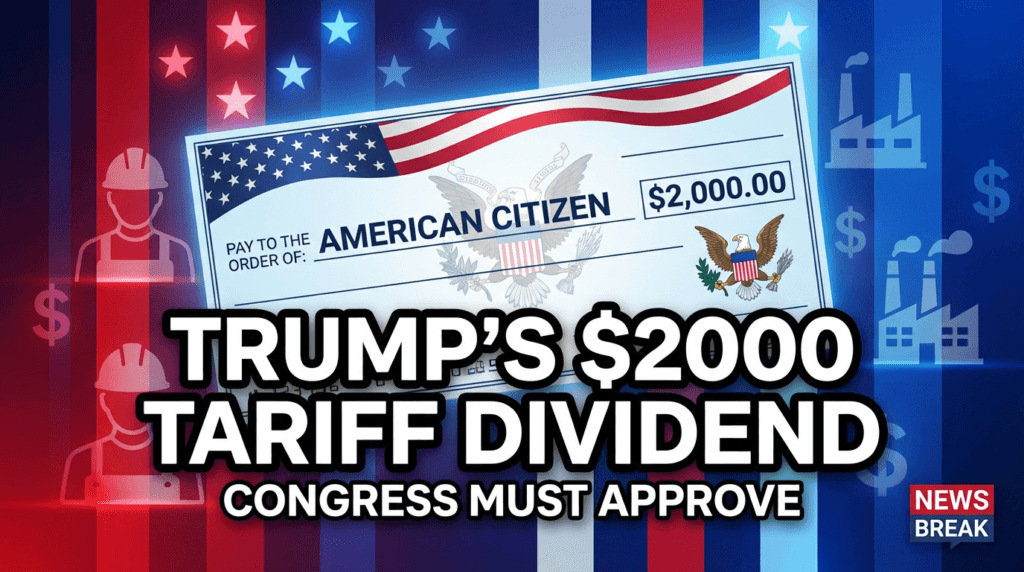
President Donald Trump’s announcement of potential $2,000 “tariff dividend” checks for American families has sparked a national conversation about trade policy, fiscal responsibility, and who truly benefits from government revenue. Unlike the reckless spending sprees that characterized previous administrations, Trump’s proposal represents a fundamentally conservative principle: money collected from foreign entities should benefit American workers, not grow the bureaucratic state.
The concept is straightforward. The Trump administration’s aggressive tariff policies have generated over $200 billion in revenue from foreign competitors who have exploited American markets for decades. Rather than allowing Washington to absorb these funds into endless government programs, Trump proposes returning a portion directly to middle-income American families—those earning under $100,000 annually who have borne the brunt of unfair trade practices.
White House economic adviser Kevin Hassett confirmed on December 21 that the president will bring a formal proposal to Congress in 2026. While Congressional approval is required, the mere discussion highlights a crucial philosophical divide: Should revenue generated from protecting American interests enrich the federal bureaucracy, or should it flow back to the taxpayers who built this nation?
Support Independent Local Journalism
TheTownHall.News is a non-profit reader-supported journalism. Just $5 helps us hire local reporters, investigate important issues, and hold public officials accountable across Alameda County. If you believe our community deserves strong, independent journalism, please consider donating $5 today to support our work.This isn’t just another government handout. It’s a dividend on America’s renewed economic sovereignty.
The Conservative Case for Tariff Dividends
Protecting American Workers First
For decades, conservative economists and policymakers watched as American manufacturing hollowed out, shipped overseas to countries with lower labor costs and fewer regulations. The free trade orthodoxy promised cheaper goods and economic efficiency, but it delivered shuttered factories, devastated communities, and a dangerous dependence on foreign supply chains—particularly from adversarial nations like China.
Trump’s tariff strategy reverses this trajectory. By imposing duties on imports, particularly from countries that manipulate currency, subsidize industries, or engage in intellectual property theft, the administration has collected over $200 billion between January and December 2025, according to U.S. Customs and Border Protection data. This isn’t taxation on Americans—it’s a cost imposed on foreign competitors who want access to our market.
The tariff dividend represents a return on investment for American workers who suffered through decades of misguided globalist policies. Treasury Secretary Scott Bessent indicated that payments would target “working families” and those making under $100,000—the exact demographic abandoned by previous trade agreements that prioritized corporate profits over community stability.
This approach embodies genuine conservative values: protecting national interests, supporting working families, and ensuring that government revenue serves citizens rather than expanding bureaucratic power.
Fiscal Accountability Over Government Growth
One of the most compelling aspects of Trump’s proposal is what it doesn’t do—it doesn’t create new entitlement programs or expand the administrative state. Traditional stimulus packages funnel money through layers of government bureaucracy, each taking its cut before anything reaches citizens. The tariff dividend proposes direct payments, minimizing government intermediation.
Critics from libertarian think tanks like the Cato Institute argue that simply eliminating tariffs would be preferable. While reducing government intervention is generally sound conservative policy, this argument ignores the real-world context: we don’t live in a theoretical free market. We compete against state-subsidized Chinese industries, European agricultural protectionism, and currency manipulators. Unilateral disarmament isn’t conservative policy—it’s naive surrender.
The Congressional Budget Office projects tariff revenue of $3.3 trillion over the next decade. The Tax Foundation estimates Trump’s tariffs will generate $2.1 trillion, or $1.6 trillion after accounting for foreign retaliation. These aren’t trivial sums. The question becomes: should this money reduce the national debt, fund government programs, or return to the Americans who bear the economic adjustment costs of fair trade policies?
Trump has explicitly stated his preference for debt reduction, noting “the big thing we want to do is pay down debt.” The tariff dividend represents a balanced approach—returning some revenue to workers while maintaining fiscal discipline. This stands in stark contrast to the multi-trillion-dollar spending bills that Democrats routinely propose, which create permanent obligations funded by deficit spending.
Support Independent Local Journalism
TheTownHall.News is a non-profit reader-supported journalism. Just $5 helps us hire local reporters, investigate important issues, and hold public officials accountable across Alameda County. If you believe our community deserves strong, independent journalism, please consider donating $5 today to support our work.The Math: Can We Afford It?
Fiscal responsibility demands honest accounting. Three nonpartisan analyses—from the Tax Foundation, the Committee for a Responsible Federal Budget, and Yale’s Budget Lab—estimated that $2,000 payments to eligible Americans would cost between $280 billion and $607 billion, depending on eligibility criteria.
The most conservative estimate, limiting payments to those earning under $100,000, projects costs around $280 billion. The highest estimate, using COVID-era Economic Impact Payment eligibility (up to $75,000 for individuals, $150,000 for couples), reaches $607 billion.
Current annual tariff revenue sits around $200-300 billion. This creates a legitimate fiscal challenge. The payments would exceed single-year tariff revenue under most scenarios, potentially requiring multi-year funding or supplementation from general revenue.
However, this analysis misses crucial context. The tariff revenue represents new income to the federal government, generated specifically through policies designed to protect American workers. Previous administrations collected far less because they allowed unfair trade practices to continue unchecked. Trump’s policies created this revenue stream—it wouldn’t exist otherwise.
Moreover, the economic multiplier effect of direct payments to middle-income families differs dramatically from government spending. Working families spend money on goods and services, stimulating economic activity. Government bureaucracies consume resources while producing little economic value. From a conservative economic perspective, returning money to productive citizens beats expanding government every time.
The real fiscal question isn’t whether we can afford the dividend—it’s whether we can afford to continue allowing Washington to absorb every new revenue source into its insatiable appetite for growth.
Congressional Approval: The Constitutional Process
Unlike previous administrations that governed through executive overreach, Trump’s approach respects constitutional separation of powers. Kevin Hassett made clear that tariff dividends require Congressional appropriation. “Congress is going to have to send those money to those peoples,” Hassett stated on CBS’s “Face the Nation.” “This would have to be money that would be an appropriation.”
This is how government should work. The executive branch collects revenue and proposes policy. The legislative branch debates, amends, and approves spending. This process ensures democratic accountability and prevents the kind of executive overreach that characterized the Obama and Biden administrations.
Senator Josh Hawley (R-Missouri) introduced the American Worker Rebate Act of 2025, proposing rebates of at least $600 per individual, with families of four potentially receiving up to $2,400. While this bill hasn’t advanced from committee, it demonstrates Congressional interest in the concept.
The path forward requires building a coalition around core conservative principles: rewarding work, protecting American industry, and limiting government growth. Republicans should champion this proposal as an alternative to Democratic spending schemes that create permanent entitlements. Democrats who claim to support working families should be forced to explain why they oppose returning tariff revenue directly to those workers.
The Supreme Court Factor
The Supreme Court heard arguments on November 5, 2025, challenging the constitutionality of Trump’s tariff authority. This represents the final major obstacle to the tariff dividend proposal. If the Court rules against the administration, the government might face billions in refunds to businesses and individuals who paid the duties.
Treasury Secretary Bessent expressed confidence in the administration’s legal position, calling tariffs “an emergency authority” and noting that several peace deals rely on the tariff structure. Hassett similarly stated that requiring refunds was “pretty unlikely.”
From a conservative constitutional perspective, the case is strong. Congress has repeatedly delegated trade authority to the executive branch through statutes like the International Emergency Economic Powers Act and Section 232 of the Trade Expansion Act. These aren’t novel legal theories—they’re established law that previous administrations used, albeit less aggressively.
The real question is whether the Court will apply consistent constitutional principles or bow to political pressure from multinational corporations that benefited from the old trade regime. Conservatives should support executive authority when it’s properly delegated by Congress and used to protect national interests—exactly what Trump’s tariffs accomplish.
Addressing Conservative Concerns
Isn’t This Just Another Handout?
This concern deserves serious consideration. Conservatives rightly oppose government dependency and handout culture. However, the tariff dividend differs fundamentally from traditional welfare programs.
First, it’s temporary and finite, not a permanent entitlement. Second, it’s funded by revenue from foreign competitors, not domestic taxation. Third, it compensates Americans for economic disruptions caused by necessary policy changes to protect national interests.
When government policy imposes costs on citizens—even justified costs—returning some revenue acknowledges that burden. This isn’t creating dependency; it’s sharing the benefits of policies that strengthen America’s economic position.
What About Inflation?
Some economists warn that direct payments could fuel inflation, particularly if they hit the economy when it’s already running hot. This concern has merit and requires careful policy design.
However, the inflation risk from targeted payments to middle-income families pales in comparison to the trillions in deficit spending that both parties have embraced over the past two decades. Moreover, if the payments are truly funded by tariff revenue rather than printed money, the inflationary impact is minimal—it’s a transfer of existing resources, not monetary expansion.
The Federal Reserve’s primary policy tool—interest rates—can address demand-side inflation. What it cannot address is the structural economic weakness caused by dependence on foreign manufacturing. Tariffs address the latter problem, even if they create short-term price adjustments.
Shouldn’t We Just Pay Down Debt?
Absolutely—and Trump has explicitly stated this as his primary goal. “We’re going to be lowering our debt, which is a national security thing,” he noted. The national debt exceeds $38 trillion, representing an existential threat to American sovereignty and prosperity.
However, the choice isn’t binary. A portion of tariff revenue can return to workers who bore the costs of trade adjustments, while the majority goes toward debt reduction. This balanced approach maintains fiscal discipline while acknowledging the real hardships that sound policy sometimes imposes on citizens.
The perfect shouldn’t be the enemy of the good. Returning $300 billion to American workers while applying $1.5 trillion to debt reduction over a decade represents sound conservative governance. It certainly beats the alternative—watching Congress absorb all tariff revenue into new spending programs.
The Bigger Picture: Economic Sovereignty
The tariff dividend debate transcends the specific dollar amounts. It represents a fundamental question about America’s economic future: Will we continue allowing globalist policies to hollow out our industrial base, or will we rebuild economic sovereignty?
For decades, the conservative movement split between free-market purists who opposed any trade restrictions and economic nationalists who recognized that real-world competition requires strategic policy. Trump has forced this debate into the open, demonstrating that tariffs can generate revenue, protect industries, and strengthen negotiating positions with adversaries.
China didn’t become an economic superpower through free trade—it used state subsidies, intellectual property theft, currency manipulation, and market access restrictions. Europe protects its agriculture and industries through complex regulatory barriers. America’s competitors play hardball while we tied one hand behind our back in the name of theoretical economic efficiency.
The tariff dividend makes the benefits of economic nationalism tangible for ordinary Americans. When working families receive checks funded by duties on Chinese imports, they understand viscerally that protecting American interests has concrete benefits. This builds political support for the sustained policy changes necessary to rebuild our industrial capacity.
What Happens Next
Kevin Hassett’s December 21 statement provides the timeline: Trump will bring a formal proposal to Congress in 2026. This begins the legislative process where details get hammered out—eligibility criteria, payment amounts, funding mechanisms, and timing.
Several scenarios could unfold:
Best Case: Congress passes legislation providing targeted payments to middle-income Americans, funded by tariff revenue, with the majority of tariff income directed toward debt reduction. The Supreme Court upholds tariff authority. Payments arrive in mid-2026 as Trump indicated.
Compromise: Congress approves smaller payments (perhaps the $600-$2,400 range from Hawley’s bill) with stricter income limits. This reduces fiscal impact while maintaining the principle of returning some revenue to workers.
Obstruction: Democrats block the proposal to deny Trump a political victory, despite claiming to support working families. This exposes their actual priorities and sets up a clear contrast for voters.
Legal Defeat: The Supreme Court strikes down tariff authority, eliminating the revenue source and potentially requiring refunds. This would represent a victory for multinational corporations over American workers.
Conservative activists, elected officials, and citizens should engage in this debate now, before the legislative details are set. The principle matters: revenue from protecting American interests should benefit American workers, not grow government.
Conclusion: Choosing American Workers Over Bureaucratic Growth
President Trump’s tariff dividend proposal presents conservatives with an opportunity to demonstrate that our principles produce tangible benefits for working families. This isn’t about government dependency or fiscal irresponsibility—it’s about ensuring that policies designed to protect American interests actually benefit American citizens.
The alternative is allowing Washington to absorb hundreds of billions in new revenue into the bureaucratic machine, funding programs that expand government power while doing little for the workers who built this nation. That’s not conservative governance—it’s the same swamp politics that Trump was elected to drain.
Critics will argue about the details, and those debates are worth having. But the fundamental principle is sound: when government policy generates revenue by protecting American workers from unfair foreign competition, those workers deserve to share in the benefits.
This is what conservative governance looks like in practice—protecting national interests, supporting working families, respecting constitutional processes, and choosing citizens over bureaucracy every single time.
The question for every elected official is simple: Do you stand with American workers, or with the globalist establishment that sold them out for decades?
Call to Action
Stay Informed: The tariff dividend debate will unfold over the coming months. Follow developments closely and understand the details—don’t rely on mainstream media spin that serves corporate interests over American workers.
Contact Your Representatives: Tell your senators and representatives that you support returning tariff revenue to American workers. Make it clear that you’re watching how they vote on this issue. Find your representatives at house.gov and senate.gov.
Share This Article: The establishment media won’t give fair coverage to policies that put American workers first. Share this analysis with friends, family, and social networks. The more Americans understand what’s really at stake, the harder it becomes for politicians to vote against their interests.
Support Economic Nationalism: The tariff dividend is one battle in a larger war over America’s economic future. Support candidates and policies that prioritize American workers over multinational corporate profits. Economic sovereignty isn’t just good policy—it’s essential to preserving American freedom and prosperity.
The fight for America’s economic future is happening right now. Will you be part of it?