Trump’s Election Nationalization Push Threatens States’ Rights and Constitutional Order
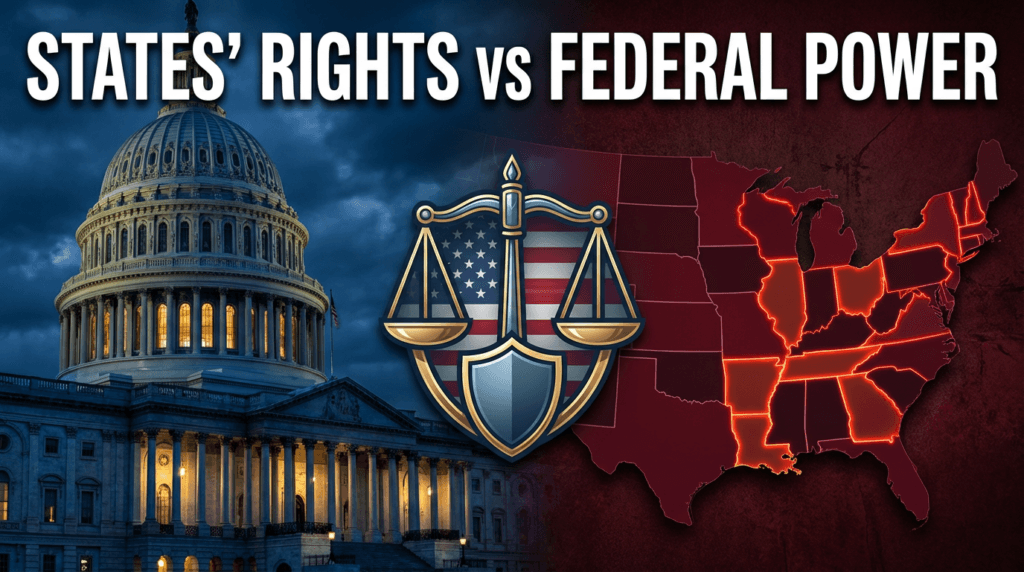
President Donald Trump’s recent declaration that Republicans should “nationalize the voting” and that “the federal government should get involved” in state elections represents a troubling departure from foundational conservative principles. While concerns about election integrity are legitimate and worth addressing, the solution Trump proposes—centralizing election authority in Washington—contradicts the very essence of limited government, federalism, and constitutional order that conservatives have championed for generations.
This is not a moment for partisan reflexes. It’s a moment for principled clarity about what conservatism actually means when the rubber meets the road.
The Constitutional Framework: Why States Run Elections
The United States Constitution deliberately assigns election administration to the states. Article I, Section 4 grants state legislatures the power to prescribe “the Times, Places and Manner of holding Elections,” while the Tenth Amendment reserves to the states all powers not explicitly delegated to the federal government. This wasn’t an oversight by the Founders—it was intentional design.
Support Independent Local Journalism
TheTownHall.News is a non-profit reader-supported journalism. Just $5 helps us hire local reporters, investigate important issues, and hold public officials accountable across Alameda County. If you believe our community deserves strong, independent journalism, please consider donating $5 today to support our work.The framers understood that diffusing power protects liberty. By keeping election administration close to the people, at the state and local level, they created a system where citizens could hold officials accountable, where diverse approaches could be tested, and where no single entity could manipulate the entire electoral process. This principle of federalism has served as a bulwark against tyranny for over two centuries.
When Trump suggests the federal government should “take over the voting in at least 15 places,” he’s not proposing a conservative reform—he’s advocating for precisely the kind of centralized power conservatives have historically opposed. The irony is striking: a president elected partly on promises to drain the swamp and limit federal overreach now proposes expanding Washington’s authority into an area the Constitution explicitly reserves for states.
Republican Secretaries of State Sound the Alarm
Perhaps most telling is the response from Republican state officials themselves—the very people responsible for administering elections in their states. These aren’t Democratic partisans or Never-Trumpers; they’re conservative Republicans who take election integrity seriously and have implemented meaningful reforms in their states.
Lt. Gov. Deidre Henderson of Utah, a Republican who oversees her state’s elections, called Attorney General Pam Bondi’s public statements about state election officials “quite appalling.” Henderson stated that Bondi “pretty much slandered all of us” by claiming secretaries of state aren’t doing their jobs and that the federal government must do it for them. “Not OK,” Henderson said firmly.

Michael Adams, Kentucky’s Republican Secretary of State, invoked President Reagan’s famous observation that “the federal government did not create the states; the states created the federal government.” Adams’s point cuts to the heart of conservative constitutional theory: states are sovereign entities that delegated certain limited powers to Washington—not the other way around.
These officials aren’t objecting because they oppose election integrity. They’re objecting because they understand that federalism isn’t just a talking point—it’s a governing principle that matters even when it’s politically inconvenient.
The Track Record: States Leading on Election Integrity
While Trump claims federal intervention is necessary to address “horrible corruption on elections,” the reality is that states have been actively strengthening election security without Washington’s heavy hand. Since 2021, numerous states have enacted voter ID requirements, updated voter roll maintenance procedures, enhanced ballot security measures, and invested in election infrastructure—all without federal mandates.
Georgia, despite being targeted by the FBI’s recent seizure of Fulton County ballots, has implemented some of the nation’s most comprehensive election reforms. Texas, Florida, and other states have passed legislation addressing mail-in ballot security, voter verification, and election observer access. These state-level reforms emerged from local debates, reflected community values, and could be tailored to each state’s unique circumstances.
This is federalism working as designed: states serving as “laboratories of democracy,” testing different approaches and learning from each other. When the federal government imposes one-size-fits-all solutions, it eliminates this beneficial diversity and prevents the kind of innovation that leads to better governance.
Support Independent Local Journalism
TheTownHall.News is a non-profit reader-supported journalism. Just $5 helps us hire local reporters, investigate important issues, and hold public officials accountable across Alameda County. If you believe our community deserves strong, independent journalism, please consider donating $5 today to support our work.The Dangerous Precedent of Federal Overreach
Conservatives should be particularly alarmed by the specific actions Trump’s administration has taken. The FBI’s seizure of 2020 ballots from Fulton County, Georgia—with Director of National Intelligence Tulsi Gabbard personally involved and allowing Trump to speak with agents on speakerphone—sets a disturbing precedent. The Justice Department’s lawsuits against nearly half the states to obtain complete voter rolls for a national database raises serious privacy and federalism concerns.
Consider what conservatives would say if a Democratic president deployed the FBI to seize election materials from Republican counties, built a national voter database over state objections, and declared that Washington should “take over” elections in states with Republican leadership. The outrage would be immediate and justified.
Principles matter most when they’re tested. If conservatives believe in limited government and states’ rights only when Republicans control state governments, then those aren’t principles—they’re just partisan preferences dressed up in constitutional language.
The Real Path to Election Integrity
Legitimate concerns about election integrity deserve serious attention. Americans across the political spectrum want to know their votes count and that elections are conducted fairly. But the solution isn’t to abandon constitutional principles and centralize power in Washington.
The conservative approach to election integrity should include:
Empowering States, Not Replacing Them: Support state-level reforms that enhance security while respecting constitutional authority. Encourage best practices through voluntary cooperation, not federal mandates.
Transparency and Accountability: Advocate for clear procedures, robust audit systems, and observer access at the state and local level where citizens can actually monitor and influence the process.
Protecting Voter Privacy: Resist the creation of massive federal voter databases that consolidate Americans’ personal information in Washington. States can cooperate on voter roll maintenance without surrendering their data to federal control.
Maintaining Constitutional Order: Defend the Tenth Amendment and the Elections Clause even when it’s politically inconvenient. Constitutional principles exist precisely to constrain government power when leaders are tempted to exceed their authority.
A Test of Conservative Principles
Trump’s push to nationalize elections presents conservatives with a fundamental choice: Do we actually believe in limited government, federalism, and constitutional constraints on executive power, or were those just convenient arguments when Democrats held the White House?
Former Washington Secretary of State Sam Reed, a Republican, called Trump’s proposal “unthinkable” and “shocking.” His reaction reflects what should be the conservative consensus: regardless of who occupies the Oval Office, the Constitution’s allocation of powers matters. States’ rights aren’t negotiable based on partisan advantage.
The most effective defense of election integrity is a robust federalist system where states compete to demonstrate best practices, where local accountability keeps officials responsive to citizens, and where no single point of failure exists for those who might seek to manipulate elections. Centralizing election authority in Washington creates exactly the kind of vulnerability conservatives should oppose.
Conclusion: Defending Federalism When It Matters Most
Election integrity and constitutional fidelity aren’t competing values—they’re complementary ones. We can have confidence in our elections precisely because power is distributed across fifty states, hundreds of counties, and thousands of local jurisdictions. That system makes widespread fraud virtually impossible while keeping authority close to the people.
Trump’s call to nationalize elections, backed by FBI raids on state election offices and Justice Department pressure campaigns, threatens this constitutional architecture. It’s a proposal that should concern anyone who values limited government, regardless of party affiliation.
True conservatism means defending constitutional principles even when political expediency suggests otherwise. It means trusting states to govern themselves even when we disagree with their choices. It means recognizing that the Tenth Amendment applies whether Republicans or Democrats control Washington.
The question before conservatives is straightforward: Will we defend federalism and limited government when it’s difficult, or only when it’s convenient?
Call to Action
The debate over election authority isn’t abstract constitutional theory—it will shape American governance for generations. Here’s what you can do:
Contact your state legislators and secretary of state. Let them know you support their constitutional authority to administer elections and oppose federal overreach.
Stay informed about election reforms in your state. Engage in local debates about election procedures, security measures, and transparency requirements. Democracy works best when citizens participate.
Hold all leaders accountable to constitutional principles. Support election integrity measures that respect federalism and oppose centralization efforts regardless of which party proposes them.
Share this article with friends, family, and fellow conservatives who value limited government and constitutional order. The conversation about election authority requires informed citizens willing to put principles above partisan advantage.
The Constitution’s framers gave us a federal system precisely to prevent the concentration of power that Trump now seeks. Defending that system isn’t partisan—it’s patriotic. And it’s never been more important than right now.