Truth, Tragedy, and Transparency: What the Iran School Strike Demands of America
When the Truth Is Harder Than the War
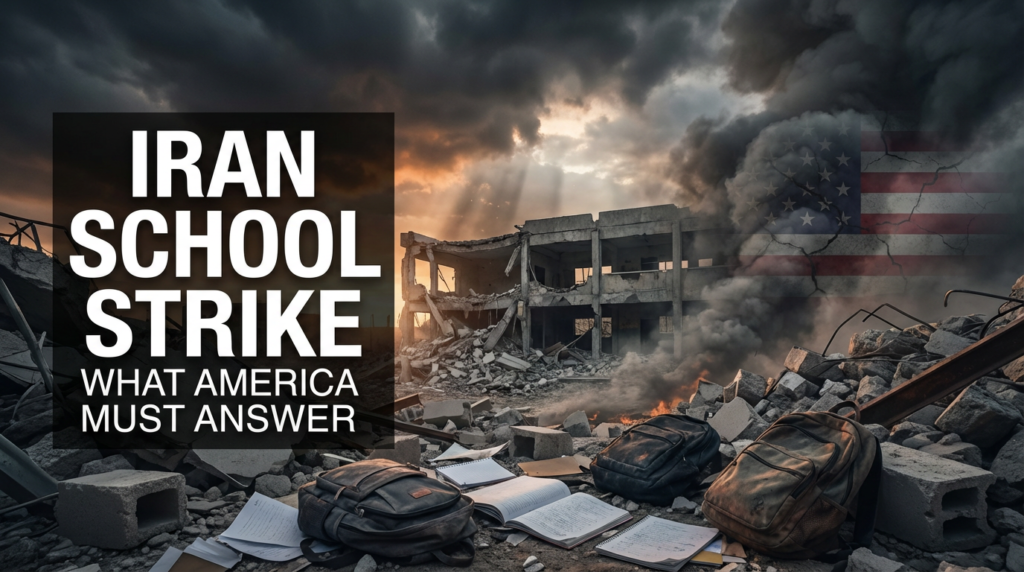
War is brutal. It always has been. But even in the fog of conflict, there are moments that demand something more than silence — moments that call every American, regardless of political stripe, to stop, look clearly at the facts, and insist on answers. The reported destruction of the Shajareh Tayyebeh girls’ elementary school in Minab, southern Iran, on February 28, 2026, is one of those moments.
According to Iranian state media, between 168 and 180 people were killed in the strike — the majority of them schoolgirls aged seven to twelve. U.S. military investigators have since determined it is likely that American forces were responsible. The school was in session. The children were in class. And the world is watching to see whether the United States will hold itself to the same standard of truth and accountability that it demands of others. For conservatives who believe in law, order, transparency, and the moral authority of American power, that question is not optional. It is urgent.
The Facts on the Ground
Let’s be clear about what we know and what we don’t. On the morning of February 28, 2026 — the first day of Operation Epic Fury, the joint U.S.-Israeli military campaign against Iran — a missile struck the Shajareh Tayyebeh girls’ school in Minab, Hormozgan province, at approximately 10:45 a.m. local time, as classes were in session. The two-story building was largely destroyed. Satellite imagery, analyzed by multiple independent experts, shows multiple simultaneous or near-simultaneous strikes using precision air-delivered munitions — not a stray rocket, not an Iranian misfired interceptor.
U.S. military investigators, according to a Reuters exclusive published March 6, 2026, tentatively concluded that American forces were likely responsible. Investigations by The New York Times, CBC, and NPR reached similar conclusions. Jeffrey Lewis, a leading satellite imagery specialist, noted that Minab’s location in southern Iran — near the Strait of Hormuz — aligns with the geographic pattern of U.S. strikes in the region. The school itself was a former military facility, converted into an all-girls elementary school by at least 2016. It sat approximately 600 meters from an IRGC naval facility. But by all credible accounts — from Al Jazeera to The Guardian to NBC News — it had been a clearly defined civilian institution for more than a decade, with no evidence of active military use at the time of the strike.
Secretary of Defense Pete Hegseth acknowledged the investigation on March 5, stating: “We, of course, never target civilian targets. But we’re taking a look and investigating that.” Secretary of State Marco Rubio affirmed the same. These are the right words. Now they must be matched by action.
Why This Matters to Every Conservative
Some will say: Iran started this. Iran has funded terrorism for decades, supplied weapons to Hamas and Hezbollah, launched direct ballistic missile attacks on Israel, and relentlessly pursued nuclear weapons in defiance of the international community. All of that is true. Operation Epic Fury was launched with clear objectives — to eliminate Iran’s nuclear capability and dismantle a regime that has been the world’s leading state sponsor of terror. These are legitimate and serious national security goals.
But moral clarity is not the same as moral immunity. The conservative tradition has always held that power, precisely because it is powerful, must be exercised with discipline, restraint, and accountability. Edmund Burke, the godfather of modern conservatism, did not simply celebrate strength — he insisted that strength be governed by principle. The rule of law does not disappear at the water’s edge. American military power is most respected — and most effective — when it is exercised with precision, honesty, and a willingness to confront its own errors.
This is not a liberal argument. It is a deeply conservative one. Personal responsibility means that when mistakes are made — even in war — they must be acknowledged, investigated, and learned from. The strength of American democracy has always rested not on its claim to perfection, but on its capacity to hold itself accountable.
The Hegseth Problem: Rules of Engagement Are Not “Stupid”
There is a deeper issue here that conservatives cannot afford to ignore. On March 2, 2026, Defense Secretary Pete Hegseth publicly dismissed what he called “stupid rules of engagement,” suggesting they interfere with “fighting to win.” Those remarks deserve serious scrutiny — because rules of engagement are not bureaucratic obstacles. They are the legal and moral framework that separates a professional military from a lawless one. They are what allow American forces to operate with the moral authority that distinguishes the United States from the regimes it opposes.
Prior to the Iran campaign, Hegseth’s Pentagon had already taken troubling steps: removing senior military lawyers, replacing the Army, Navy, and Air Force judge advocates general, and abolishing “civilian environment teams” — the very units tasked with minimizing harm to non-combatants during operations. The 2026 National Defense Strategy quietly omitted references to civilian protection. These are not cosmetic changes. They are structural decisions that directly affect how strikes are planned and approved.
Conservatives who care about law and order, about the dignity of human life, and about America’s long-term standing in the world should be asking hard questions about these decisions. A military that wins tactically while losing its moral compass does not win strategically. America’s power in the world is not just a function of its weapons — it is a function of its word.
The Children in the Classroom: A Moral Obligation
There is a temptation, in wartime, to reduce every tragedy to a data point or a talking point. That temptation must be resisted. The victims of the Minab strike were not combatants. They were not regime agents. They were girls — seven to twelve years old — sitting in classrooms on an ordinary school morning. The Iranian Ministry of Education reported 264 students present; human rights monitors recorded approximately 170. Whatever the precise number, the overwhelming majority of the dead were children.
Conservatives who champion parental rights and the sanctity of family know that no geopolitical calculation erases the weight of a child’s life. The small coffins draped in Iranian flags, shown on Iranian state television, are a provocation — yes, exploited by a hostile regime for propaganda purposes. But they are also real. And the parents of those children deserved better from the intelligence and targeting processes that were supposed to prevent exactly this.
This is not about sympathy for the Iranian regime. It is about the integrity of American values. We cannot champion the protection of children in our classrooms at home while refusing to examine what happened to the children in theirs.
What Accountability Looks Like in Wartime
The United States has a long — if imperfect — history of investigating its own military actions. The My Lai investigation. The Abu Ghraib accountability process. The CENTCOM investigations into civilian casualties in Syria. These were painful. They were politically costly. But they were also proof that this nation takes its own principles seriously.
What is required now is not hand-wringing or national self-flagellation. What is required is a full, transparent, and independent investigation into the Minab strike — who made the targeting decision, what intelligence was used, whether the school’s civilian status was known or should have been known, and whether the dismantling of civilian protection mechanisms played a role. That investigation should be made public in as much detail as national security allows. And if errors were made, they should be acknowledged clearly and corrective action taken.
This is what free speech demands: the freedom to hold power accountable, even when — especially when — that power is our own. This is what limited government means: that no institution, including the military, operates above scrutiny. And this is what fiscal and moral accountability looks like in practice: ensuring that the enormous power and resources of the American armed forces are exercised with the care and discipline that the taxpayers who fund them — and the world that watches them — have a right to expect.
Conclusion: Strength With Integrity
The United States launched Operation Epic Fury for legitimate reasons — to protect American security, to prevent a nuclear-armed Iran, and to dismantle one of the world’s most dangerous terrorist-sponsoring regimes. Those objectives remain valid. The mission is just.
But justice in warfare is not just about why you fight. It is about how you fight. The Minab school strike — if confirmed to be a U.S. action — represents a catastrophic failure of targeting intelligence that cost the lives of dozens of children. That failure deserves a full reckoning, not a cover-up, not a deflection, and not a dismissal.
The conservative movement’s greatest strength has always been its willingness to hold institutions accountable — to demand that government, at every level, answer to the people it serves. That principle does not pause for wartime. It does not take a back seat to political loyalty. It is, in fact, most necessary precisely when the stakes are highest.
America is strongest when it is honest. Let’s be honest now.
Call to Action
The story of what happened in Minab on February 28, 2026, is still unfolding — and the full truth has not yet been told. Stay informed. Demand transparency. Ask your elected representatives to support a full, independent investigation into the Minab school strike. Share this article with people who believe — as we do — that American power must always be matched by American accountability. Because the world is watching, and so is history.