Under Fire: Iran Bombed America’s Military Bases — and Our Troops Paid With Their Lives
No Warning. No Siren. Six Americans Dead.
It was just after 9 a.m. local time on Sunday, March 1, when an Iranian drone came in low over the port of Shuaiba, Kuwait. There was no warning. No siren. No counter-drone system in place to stop it.
The drone struck dead-center on the roof of a triple-wide trailer being used as a tactical operations center — a makeshift field office where American troops from the 1st Theater Sustainment Command out of Fort Knox, Kentucky, had gathered to manage logistics for Operation Epic Fury. The building was engulfed in flames. By the time CENTCOM finished recovering remains from the still-smoldering wreckage, six U.S. service members were dead and 18 others seriously wounded.
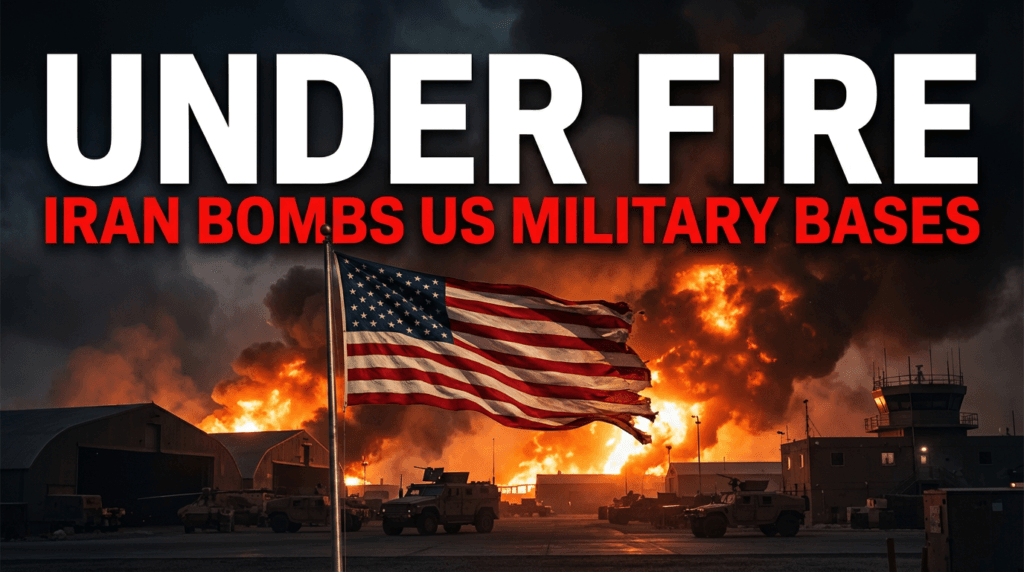
This is what every American needs to understand right now: Iran didn’t just retaliate in the abstract. It directly targeted United States military bases across the Middle East — striking them with hundreds of missiles and drones in one of the most sustained assaults on American forces in decades. Our troops were in the crosshairs. And in Kuwait, the crosshairs found them.
A Coordinated, Multi-Front Assault on America’s Bases
The scale of Iran’s retaliatory campaign was staggering. According to the Foundation for Defense of Democracies’ Long War Journal, Iran fired a documented 247 ballistic missiles and 230 drones at U.S.-allied Gulf states on February 28 alone. By March 2, those numbers had climbed dramatically. Every major U.S. base in the region was targeted.
Naval Support Activity Bahrain — Home of the U.S. 5th Fleet. This is the nerve center of American naval power in the Persian Gulf, hosting roughly 8,300 service members and their families. Iran hit it hard. Missiles and drones struck the headquarters compound through Saturday night and into Sunday. Satellite imagery analyzed by Reuters showed two satellite communications terminals destroyed and thick plumes of black smoke rising over Manama. Residential towers sustained damage. The Crowne Plaza hotel was struck. A U.S.-flagged oil tanker, the Stena Imperative, was hit at Bahrain’s Khalifa Port, killing one local worker. This was not a symbolic pinprick — it was a deliberate assault on the command hub of the U.S. Navy’s entire Central Command.
Al Udeid Air Base, Qatar — The Largest U.S. Base in the Middle East. Home to approximately 10,000 American service members and the forward headquarters of U.S. Air Forces Central Command, Al Udeid was targeted in Iran’s opening salvo with 65 ballistic missiles and 12 drones. Qatari air defenses intercepted the majority, but two missiles and a drone reached the base perimeter. Iran later launched a follow-on attack, publicly declaring the number of missiles it fired matched the number of bombs the U.S. had dropped on Iranian nuclear sites. The message was deliberate and unmistakable.
Ali Al-Salem Air Base, Kuwait — Where Americans Died. Kuwait bore the brunt of Iran’s campaign: 97 ballistic missiles and 283 drones fired between February 28 and March 2. Ali Al-Salem, home to the U.S. 386th Air Expeditionary Wing, was struck by ballistic missiles, with Italy reporting extensive damage to the base runway. At the nearby port of Shuaiba, six American soldiers were killed. Three U.S. F-15E jets were also downed by Kuwaiti air defenses in a friendly-fire incident — though all six aircrew ejected safely.
Al Dhafra Air Base, UAE — A Barrage in the Hundreds. Iran launched 165 ballistic missiles and 541 drones at the UAE — the largest single-country barrage of the entire campaign. UAE air defenses intercepted 152 of 165 missiles and 506 of 541 drones. But 35 drones still fell on UAE territory, killing three foreign nationals and injuring 58. Dubai International Airport was damaged. Explosions rocked Abu Dhabi and Dubai.
Erbil, Iraq — Consulate and Troops Under Attack. Iran-aligned factions claimed 23 drone attacks on U.S. sites in Erbil. Smoke was visible rising from the U.S. base near Erbil airport. The U.S. Consulate General was targeted, and troops sheltering in a nearby hotel were also struck.
Riyadh, Saudi Arabia — Even the Embassy Was Hit. Two Iranian drones struck the U.S. Embassy compound in Riyadh. Saudi Arabia intercepted five additional hostile drones approaching Prince Sultan Air Base — a key U.S. military installation.
Were Our Troops Adequately Protected?
Six Americans are dead. The circumstances of their deaths demand hard answers.
Three U.S. military officials with direct knowledge of the Kuwait attack told CBS News that the building hit at Shuaiba port was not meaningfully fortified. It was a triple-wide trailer — a standard field office — protected only by 12-foot concrete T-walls on the sides. T-walls guard against ground-level blasts and shrapnel. They offer zero protection against an overhead drone strike.
Two of those officials said they heard no warning sirens before the strike. Counter-battery systems had functioned all week — but they are built to detect larger incoming munitions, not slow, low-signature kamikaze drones. Worse: there was no American counter-drone defeat system at Shuaiba port at all. Requests for that capability had been made. They were never filled.
Before the attack, there were active discussions among troops on the ground about whether the operations center should even be in use, given that it concentrated personnel in a location that could not be defended. Those concerns were not acted upon in time.
Defense Secretary Pete Hegseth described the fatal drone as a “squirter” — a weapon that punched through defenses and the building’s fortifications. The officials on the ground tell a starker story: there was almost nothing there to punch through.
This is not a partisan attack. It is a question of personal accountability and military preparedness that every American — regardless of party — should demand be answered. These six soldiers were sustainment troops doing logistics work. They were trusting their chain of command to keep them safe. That trust was broken. Their families deserve the full truth. And the United States military, the greatest fighting force on earth, must never again leave its people exposed in a declared threat environment without the tools to survive.
Strength Is About How We Protect Our Own
Conservatives have long championed peace through strength — the conviction that a powerful, prepared America deters aggression and protects its people. Operation Epic Fury was a bold assertion of that principle. But strength is not only about the weapons we project outward. It is equally — critically — about how we protect the men and women we send into harm’s way.
There are between 30,000 and 40,000 U.S. troops deployed across the Middle East on any given day. They operate from bases that, as we have now seen, Iran is willing and capable of striking with hundreds of missiles and drones simultaneously. The Iranian regime deployed Shahed-136 “kamikaze” drones — cheap, expendable, and lethal against soft targets — across the entire theater.
The lesson is urgent: base hardening, counter-drone capability, and survivable command infrastructure must be non-negotiable priorities. These are not abstract budget debates. They are the difference between six flag-draped coffins and six soldiers going home to their families. Congress must demand a full accounting. The Defense Department must answer why a tactical operations center in a declared combat zone had no overhead protection and no drone defeat system. The American taxpayer funds the world’s most capable military — those funds must translate into adequate protection for every service member, at every location, at every hour.
Accountability Begins at Home
Iran made a deliberate choice to strike American bases and kill American service members. That is an act of war, and it must shape every future calculation regarding Tehran’s place in the world.
But accountability runs in multiple directions. President Trump submitted a War Powers Resolution notification to Congress on February 28 — the correct and constitutionally required step. Congress must now fulfill its oversight role as this operation continues. And the Defense Department must conduct a full, transparent investigation into the force protection failures at Shuaiba — not to score political points, but because those six soldiers deserved better, and the 30,000+ troops still downrange deserve it now.