USS George H.W. Bush Deploys to the Middle East — What America’s Three-Carrier Posture Means for Iran
The Nimitz-class supercarrier departed Norfolk on March 31, 2026, joining a three-carrier posture in the region — a clear signal that the United States is not backing down. Here’s what’s at stake and why it matters.
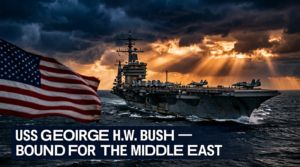
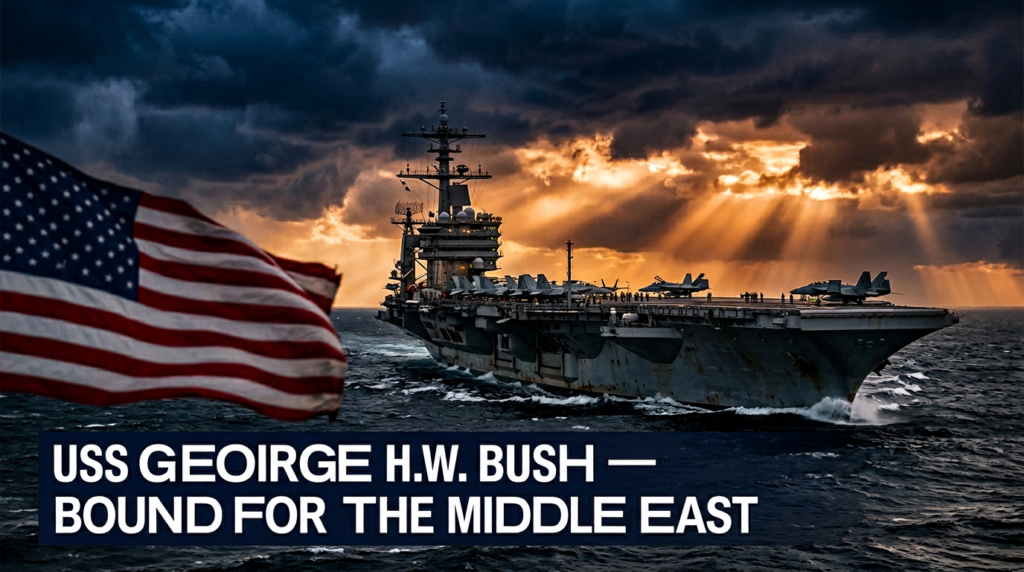
Yesterday morning, the USS George H.W. Bush (CVN-77) — a 102,000-ton nuclear-powered Nimitz-class aircraft carrier — slipped out of Naval Station Norfolk, Virginia, bound for the U.S. Central Command’s area of responsibility in the Middle East. Alongside her, three Arleigh Burke-class guided-missile destroyers — USS Ross, USS Donald Cook, and USS Mason — made their own departures over the preceding days, forming the George H.W. Bush Carrier Strike Group.
This deployment isn’t just a routine rotation. It arrives at a moment of extraordinary geopolitical tension: the United States and Israel conducted joint strikes on Iranian targets on February 28, 2026, and American forces have logged more than 7,000 combat missions in the region since late February. With the USS Abraham Lincoln already operating in the Arabian Sea and the USS Gerald R. Ford sidelined for repairs, America is repositioning its most powerful mobile assets to ensure the mission doesn’t lose momentum.
Support Independent Local Journalism
TheTownHall.News is a non-profit reader-supported journalism. Just $5 helps us hire local reporters, investigate important issues, and hold public officials accountable across Alameda County. If you believe our community deserves strong, independent journalism, please consider donating $5 today to support our work.Why the USS George H.W. Bush Deployment Changes the Equation
The timing of this deployment is no accident. The USS Gerald R. Ford — which had been on station since June 2025, a deployment stretched to nearly ten months — suffered a major onboard fire on March 12, 2026. The blaze, which originated in the ship’s laundry and spread through ventilation systems, burned for more than 30 hours. Over 200 sailors suffered smoke inhalation, more than 100 sleeping spaces were destroyed, and 75-plus aircraft were taken offline. The Ford is now undergoing repairs at Souda Bay, Crete.
The Bush fills that critical gap. Having completed its final pre-deployment certification exercises — known as COMPTUEX — on March 5, the carrier and her strike group were ready. With an estimated transit time of 10 to 12 days to the Eastern Mediterranean, the Bush will restore the dual-carrier presence alongside the Abraham Lincoln in short order.
This is how American military readiness is supposed to work: one battle group goes down, another steps up without missing a beat.
Three Carriers, One Clear Message to Tehran
When the Bush arrives on station, the United States will have three carrier strike groups in or near the Middle East simultaneously — a force projection rarely deployed outside of major wartime operations. That is not a coincidence. It is a deliberate strategy.

The USS Abraham Lincoln is already conducting operations in the Arabian Sea. A Marine Expeditionary Unit aboard amphibious warships has also entered regional waters, adding yet another dimension to American combat power in the theater. Combined with over 30,000 U.S. personnel based across Bahrain, Qatar, Saudi Arabia, Kuwait, and the UAE — supported by F-35s, F-15E Strike Eagles, Patriot batteries, and THAAD interceptors — this is the most concentrated display of American military resolve in the region in years.
When America deploys three supercarriers to a single theater, the world takes notice. That’s the point.
The Bush’s air wing alone comprises up to 90 aircraft, including F/A-18E/F Super Hornets, EA-18G Growlers for electronic warfare, E-2D Hawkeye airborne command aircraft, and MH-60 helicopters. In short: this is a city at sea, and it carries the full weight of American air power.
The Real Costs — And Why Accountability Still Matters
American military strength is not free. Fiscal conservatives are right to demand transparency, and the numbers here are significant. According to defense analysts, U.S. operations in the region have already consumed an estimated $12.7 billion in the first six days following the February strikes, with costs reaching an estimated $18 billion by the three-week mark. Projections for a sustained campaign range from $40 billion to over $100 billion.
More than 850 Tomahawk cruise missiles have reportedly been fired, each carrying a price tag of $2 million to $3.6 million. THAAD missile interceptors, costing $12.8 million apiece, have been deployed against Iranian drones that cost as little as $20,000 to $50,000 each — a stark reminder of the asymmetric cost burden that America bears when engaging adversaries who fight cheap and die expensive.
Support Independent Local Journalism
TheTownHall.News is a non-profit reader-supported journalism. Just $5 helps us hire local reporters, investigate important issues, and hold public officials accountable across Alameda County. If you believe our community deserves strong, independent journalism, please consider donating $5 today to support our work.None of this excuses reckless spending. Congress must exercise rigorous oversight. The American taxpayer funding this operation deserves transparency, accountability, and a clearly articulated strategy — not just open-ended commitments. Strength without strategy is simply expensive theater.
What Critics Get Wrong
Some voices in Washington have pushed back sharply. Senator Tim Kaine has described the conflict with Iran as an “unnecessary war of choice,” calling the escalating deployment posture dangerous. His concerns deserve a hearing — and a direct response.
The argument that America is manufacturing this conflict ignores recent history. Iran has spent decades funding proxy militias, targeting U.S. forces across Iraq, Syria, and the Red Sea, and advancing a nuclear program that threatens regional stability. The February 28 joint U.S.-Israeli strikes were not unprovoked aggression — they followed sustained Iranian attacks on American assets and allied shipping in the Strait of Hormuz, one of the world’s most vital commercial arteries.
Strength, properly deployed, deters conflict. The historical record consistently shows that an adversary who believes America is willing to act is far more likely to seek a negotiated resolution than one who senses hesitation. Walking away from the region now, with Iran on the back foot, would reward aggression and destabilize the very alliances America has spent decades building.
The men and women of the Bush Carrier Strike Group aren’t creating conflict. They are preventing it.
The Sailors Who Carry the Weight
Behind every policy debate, every carrier strike group deployment statistic, and every line item in a defense budget is a human being. The sailors and Marines now sailing out of Norfolk are sons, daughters, spouses, and parents. They volunteered. They trained. And now they’re heading toward one of the most volatile regions on earth.
The George H.W. Bush — named for America’s 41st president, himself a Navy pilot who was shot down in the Pacific during World War II — carries with it a legacy of service. That legacy now sails again, in the hands of a new generation of Americans who chose duty over comfort.
Whatever your politics, that deserves respect.
Key Takeaway
The deployment of the USS George H.W. Bush is not a provocation — it is a reassertion of American resolve at a critical moment. It restores combat capacity lost when the Ford was damaged, maintains pressure on Iran following joint U.S.-Israeli strikes, and sends an unmistakable signal that the United States will not abandon its strategic interests or its allies in the region. The costs are real and must be scrutinized. The mission must be clearly defined. But the courage of the men and women aboard that carrier is beyond debate.
Stay Informed — And Make Your Voice Heard
The decisions being made right now in Washington and in the waters of the Arabian Sea will shape the Middle East for a generation. Stay informed. Read beyond the headlines. Share this article with someone who needs to understand what’s actually happening — not partisan spin, but the facts on the ground. Support independent journalism that tells it straight. 🙏🏻🇺🇸
Sources: U.S. Navy, Army Recognition, The War Zone, CBS News/WTKR, Wall Street Journal.