When Fear Takes Flight: The Southwest Flight 2094 Incident and What It Reveals About Security, Vigilance, and the World We Live In
A Routine Flight That Became a National Wake-Up Call
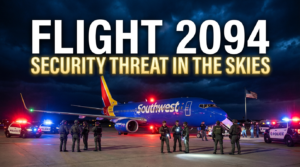
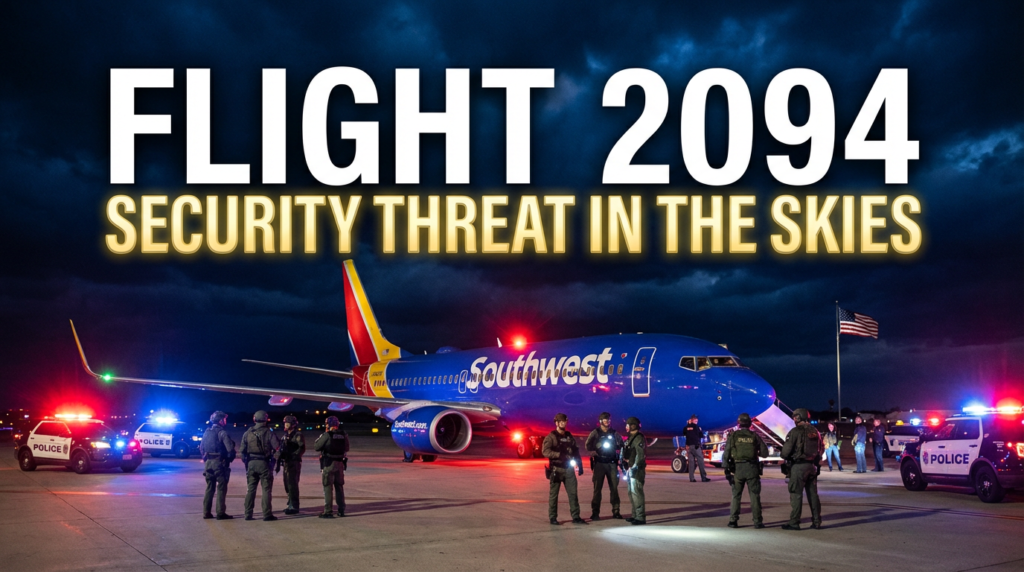
It was supposed to be an uneventful Friday night trip from Nashville to Fort Lauderdale. Instead, Southwest Airlines Flight 2094 became the scene of mid-air panic, a police intervention, and a sobering reminder that the threats facing ordinary Americans are no longer theoretical. At approximately 9:06 p.m. on March 6, 2026, the aircraft diverted to Hartsfield-Jackson Atlanta International Airport after a passenger’s behavior triggered a security response that drew in the Atlanta Police Department, the FBI, and the Department of Homeland Security.
Videos captured by passengers on board showed officers pulling a man from his seat, handcuffing him as fellow travelers kept their heads down and hands raised. The scene — unfolding at 30,000 feet — could have ended very differently. It didn’t, and that is something worth pausing on. But the full picture demands more than a sigh of relief. It demands honest reflection about the state of national security, the role of vigilant citizens, and why the systems designed to protect us must be both strong and trustworthy.
What We Know: The Facts of the Incident
According to multiple verified reports and statements from Southwest Airlines and law enforcement, Flight 2094 was en route from Nashville, Tennessee, to Fort Lauderdale, Florida, when it was diverted following a “possible security matter.” Passengers reported that a male traveler seated a few rows ahead appeared agitated — his bag was reportedly too large to fit under the seat, and a fellow passenger noticed what appeared to be alarming content on his phone. That passenger alerted flight attendants, who escalated the situation to the flight crew.
The captain ordered passengers to raise their hands and remain seated. The plane landed in Atlanta, where police boarded, removed the man, and handed the investigation over to the FBI and the Department of Homeland Security. Social media videos circulating after the incident included claims of a bomb threat and reports of the passenger shouting threatening phrases, though those specific claims were not officially corroborated.
The FBI Atlanta field office ultimately determined there was no credible threat. No charges were filed. The remaining passengers were re-accommodated on a separate aircraft and arrived in Fort Lauderdale just before 3:30 a.m. Southwest Airlines apologized for the disruption and offered passengers a $200 travel voucher.
A Tense Backdrop: Why This Moment Mattered
This incident did not occur in a vacuum. It unfolded just days after one of the most consequential military events in modern American history — a joint U.S.-Israeli operation on February 28, 2026 that resulted in the death of Iranian Supreme Leader Ayatollah Ali Khamenei. The operation triggered retaliatory missile and drone attacks by Tehran against U.S. military bases in the Gulf, with three American service members killed and five seriously wounded. Treasury Secretary Scott Bessent publicly warned of a potential escalation, including a forthcoming military campaign targeting Iranian missile infrastructure. President Trump ordered war-risk insurance for American ships in the Strait of Hormuz amid ongoing Iranian threats.
Against this backdrop, the anxiety felt by passengers on Flight 2094 was not irrational — it was human. Americans have been here before. In the weeks following September 11, 2001, the nation learned that vigilance on the home front is not paranoia; it is patriotism. The passenger who noticed something troubling on a fellow traveler’s phone and said something did exactly what a responsible citizen should do. That action — individual, immediate, and courageous — set the entire protective chain in motion.
The Power and Responsibility of Citizen Vigilance
Conservatives have long championed the principle that a free and self-governing people must take personal responsibility — not only for their own lives, but for the safety of their communities. The events aboard Flight 2094 illustrate this principle in the clearest possible terms. It was not a government database or an algorithmic surveillance system that flagged the threat first. It was a fellow American paying attention.
This is the essence of a vigilant civil society: neighbors watching out for neighbors, citizens extending their duty of care beyond themselves. The “See Something, Say Something” campaign has been criticized in some quarters as an invitation to government overreach or racial profiling. But when applied with good judgment and civic seriousness — as it appears to have been in this case — it works. A potential catastrophe was avoided not because the state was omnipresent, but because a private citizen made a responsible choice.
That is a conservative value. Personal responsibility, exercised in real time, saved lives — or at the very least, prevented a genuine crisis from unfolding.
Law and Order: The System Responded — And Got It Right
It is also worth acknowledging something that can be easy to overlook in an era of relentless criticism of law enforcement: the system, on this occasion, functioned as it was designed to. The flight crew acted decisively. The Atlanta Police Department responded professionally. The FBI and DHS took over, conducted a thorough investigation, and reached a transparent conclusion — no credible threat, no charges filed.
That last part matters enormously. In a time when public trust in institutions is fragile, the responsible use of authority is as important as the exercise of it. A man was detained, investigated, and released when the evidence did not support criminal charges. That is not a failure of the system — it is the system working. Due process, proportional response, and the presumption of innocence are not liberal talking points; they are foundational principles of American justice that conservatives have always defended.
The rule of law is not just about locking people up. It is about applying the law fairly, consistently, and without political interference. In this instance, federal authorities did exactly that.
The Geopolitical Reality We Cannot Ignore
There is a harder conversation embedded in this incident, and it would be intellectually dishonest to avoid it. The United States is engaged in active military conflict with a nation — Iran — that has publicly and repeatedly called for the destruction of America and its allies. Three American soldiers are dead. Retaliatory threats are ongoing. And in that environment, an incident on a domestic flight involving threatening behavior, reported anti-American statements, and the rapid involvement of federal counterterrorism agencies is not simply a travel inconvenience.
A fiscally and strategically serious approach to national security demands that we maintain — and adequately fund — the intelligence and law enforcement infrastructure that keeps Americans safe, both at home and abroad. Border security, airline screening, domestic counterterrorism capabilities: these are not budget line items to be negotiated away. They are the baseline obligations of a government that takes its first responsibility seriously.
At the same time, Americans must resist the temptation to let fear erode the very freedoms we are fighting to protect. History shows that overreach in the name of security carries its own costs — to civil liberties, to social trust, and to the constitutional order. The balance is difficult. But it is not impossible, and it starts with a public that is informed, engaged, and unwilling to be either complacent or hysterical.
Traditional Values in a Time of National Stress
There is one more dimension worth naming. Among the passengers on Flight 2094 was a Brentwood family who described the experience firsthand — the fear, the uncertainty, the instructions from flight attendants, and the eventual relief of a safe landing. Families travel. Parents protect their children. Communities rally when threatened. These are not abstract concepts; they are the lived reality of millions of Americans who simply want to go about their lives in safety and freedom.
Traditional values — faith, family, community, and country — are not just cultural preferences. They are the social fabric that holds a nation together when events conspire to tear it apart. In moments of crisis, it is those values that steady people: the quiet courage of a passenger who speaks up, the professionalism of a crew that keeps order, the discipline of officers who follow the law even under pressure. These things do not happen by accident. They are the product of a culture that still, at its best, believes in doing the right thing.
Conclusion: Stay Alert, Stay Free
Southwest Flight 2094 landed safely. The FBI found no credible threat. Life went on. But the incident is a reminder — sharp and timely — that the world is not safe, that threats are real, and that the responsibility for security does not belong to government alone. It belongs to all of us.
Stay informed about the ongoing U.S.-Iran situation and its implications for domestic security. Support the law enforcement professionals who stand between order and chaos. And if you ever find yourself in a position where something doesn’t feel right — trust your instincts, and say something.
Freedom is not free, and it is not self-maintaining. It requires vigilance — and that starts with you.