When Giants Stumble: BlackRock’s Withdrawal Freeze Is a Warning Middle-Class Americans Can’t Ignore
The Gate Just Closed — Are You on the Right Side of It?
On March 6, 2026, one of the most powerful financial institutions in the world quietly told its investors: you can’t have your money back — at least not all of it, and not right now.
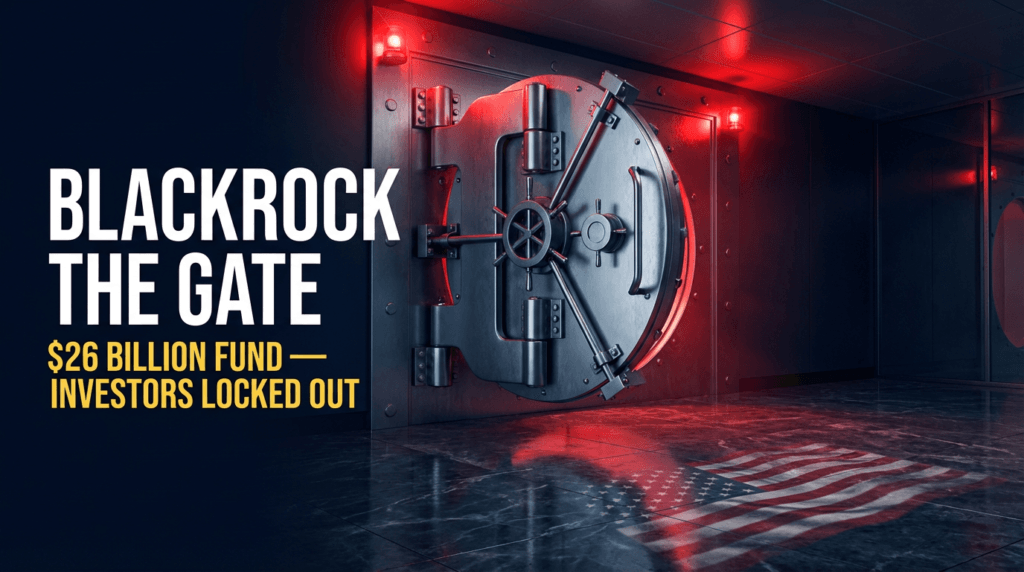
BlackRock, the world’s largest asset manager with over $11 trillion in assets under management, announced it was limiting withdrawals from its $26 billion HPS Corporate Lending Fund (HLEND) after receiving $1.2 billion in redemption requests — more than double what the fund’s rules allow to be paid out in a single quarter. BlackRock honored only $620 million of those requests, invoking a contractual “gate” that caps quarterly redemptions at 5% of shares outstanding.
This is not a run-of-the-mill financial footnote. It is a signal — and if history has taught us anything, it is that when giants like BlackRock start closing gates, ordinary Americans had better pay attention.
What Actually Happened — The Facts
HLEND is a Business Development Company (BDC), a type of investment vehicle designed to funnel capital from wealthy individuals and retail investors into loans made to mid-sized private companies. It is part of the broader $3 trillion private credit market — a shadow banking ecosystem that has exploded in size since the 2008 financial crisis pushed lending activity out of traditional banks and into the hands of large asset managers.
In the first quarter of 2026, HLEND investors sought to withdraw approximately 9.3% of the fund’s net asset value. That figure blew past the 5% quarterly cap — marking the first time in the fund’s history that withdrawal requests have breached that threshold. BlackRock paid out $620 million and restricted the rest.
The reasons for the surge in redemption requests are not hard to understand. Investor confidence in private credit has been deteriorating for months:
- September 2025: Two major private credit borrowers — First Brands Group (an auto parts manufacturer) and Tricolor Holdings (a subprime auto lender) — filed for bankruptcy in the same month.
- December 2025: Federal prosecutors charged Tricolor’s executives with running a “systematic fraud” spanning seven years, during which they allegedly inflated collateral values to raise billions from lenders.
- January 2026: First Brands’ founders were charged with defrauding lenders of billions of dollars.
- February 2026: Blue Owl Capital permanently froze redemptions from its $1.6 billion private credit fund.
- March 2026: Blackstone raised its redemption cap from 5% to 7% on its $82 billion private credit vehicle after record redemption requests of $3.8 billion in Q1.
And now: BlackRock. The pattern is unmistakable — and deeply unsettling.
The Conservative Case for Alarm — Accountability Starts with Transparency
Conservatives have long championed a straightforward set of principles when it comes to money: earn it honestly, spend it wisely, and be accountable for how you manage what belongs to others. Those principles apply just as forcefully to trillion-dollar asset managers as they do to individual households.
The private credit market has operated in near-total opacity for years. Unlike publicly traded stocks or bonds, private credit loans are not priced daily on an open market — their valuations are largely determined by the managers themselves. When Morningstar senior analyst Greggory Warren warned that this situation “should serve as a warning sign for the industry and the rulemakers about the downside of illiquid funds for retail investors,” he was identifying a structural accountability gap.
Retail investors — many of them retirees, small business owners, and working Americans seeking yield in a difficult rate environment — were marketed these funds as stable, income-generating alternatives to volatile public markets. What they were not always told clearly enough is that their liquidity could, in fact, be legally withheld at the manager’s discretion. That is a system designed to privatize the gains and socialize the panic.
Personal Responsibility Requires Informed Choice — And That Requires Truth
Conservatives believe deeply in personal responsibility. But personal responsibility is only meaningful when individuals have access to honest, complete information. You cannot be responsible for decisions you were not empowered to make clearly.
BlackRock acquired HPS Investment Partners — HLEND’s original manager — in a $12 billion deal in 2024, doubling down on private credit at the very moment warning signs were emerging. HLEND’s portfolio carries a 19% exposure to the software sector, a segment being disrupted at speed by AI-first startups. Those risks deserved far more prominent disclosure.
This is where the conservative instinct toward limited government must be balanced with an equally important conservative value: rule of law and honest dealing. The answer is not more sprawling bureaucracy — it is clearer disclosure requirements, enforceable fiduciary standards, and real consequences for those who mislead investors. As Jamie Dimon warned last fall: “When you see one cockroach, there are probably more.” We are now watching them multiply.
Big Government Is Not the Answer — But Neither Is Blind Deference to Big Finance
There is a temptation on the left to respond to moments like this with calls for sweeping new regulations and expanded federal oversight. That is the wrong answer — and conservatives should push back against it loudly.
But here is the harder truth: the private credit boom was partly a creature of government distortion to begin with. Near-zero interest rates for over a decade, engineered by the Federal Reserve, pushed capital into riskier and less transparent corners of the market. Easy money inflated valuations and relaxed lending standards across the board. The bankruptcies of Tricolor and First Brands did not happen in a vacuum — they happened in a market shaped by years of artificially cheap capital and regulatory blind spots.
The conservative answer is to demand fiscal accountability from institutions managing public savings, enforce the rule of law against those who defraud investors, and ensure the rules governing semi-liquid investment vehicles are written clearly and applied consistently — before the next gate closes.
What This Means for You — And What You Should Do
If you or your financial advisor has money in private credit funds — BDCs, interval funds, or similar vehicles — now is the time to ask hard questions: What are the redemption terms? What is this portfolio’s exposure to software or AI-disrupted sectors? Has this fund ever been gated before?
These are not hostile questions. They are the questions every responsible investor should be asking right now.
Freedom and prosperity are not self-sustaining. They require vigilance, accountability, and the willingness to confront uncomfortable truths — whether in Washington or on Wall Street. BlackRock’s gate is a reminder that no institution is immune from the consequences of opacity and misaligned incentives.
Conclusion: The Gate Is a Warning Bell — Heed It
History does not always announce itself with fanfare. Sometimes it arrives quietly, in the form of a Friday afternoon press release from a firm managing more money than the GDP of most countries, telling investors they cannot withdraw their own funds.
The BlackRock withdrawal limit is not, by itself, a catastrophe. The private credit market is $3 trillion strong and capital is still flowing. But the pattern — from Tricolor’s fraud to Blue Owl’s permanent freeze to Blackstone’s record redemptions to BlackRock’s gate — demands serious attention. Transparency, accountability, and honest dealing are not outdated values. They are more urgent than ever.
Americans who hold those principles should not wait for Washington to protect them. Stay informed, ask hard questions, and hold powerful institutions to the standards we hold ourselves.
Call to Action
Don’t let the financial establishment assume you’re not paying attention — because they’re counting on it.
Share this article with friends, family, and fellow investors who deserve to know what is happening in the private credit market right now. Subscribe to The Town Hall for clear, fact-based analysis of the financial and political stories that matter most. And if you have money in a private credit fund, talk to your financial advisor today — not next week.
The gate is closed. Make sure you know which side you’re on.