When Sanctuary Becomes Target: The St. Paul Church Disruption and the Erosion of Religious Freedom
A Line Crossed
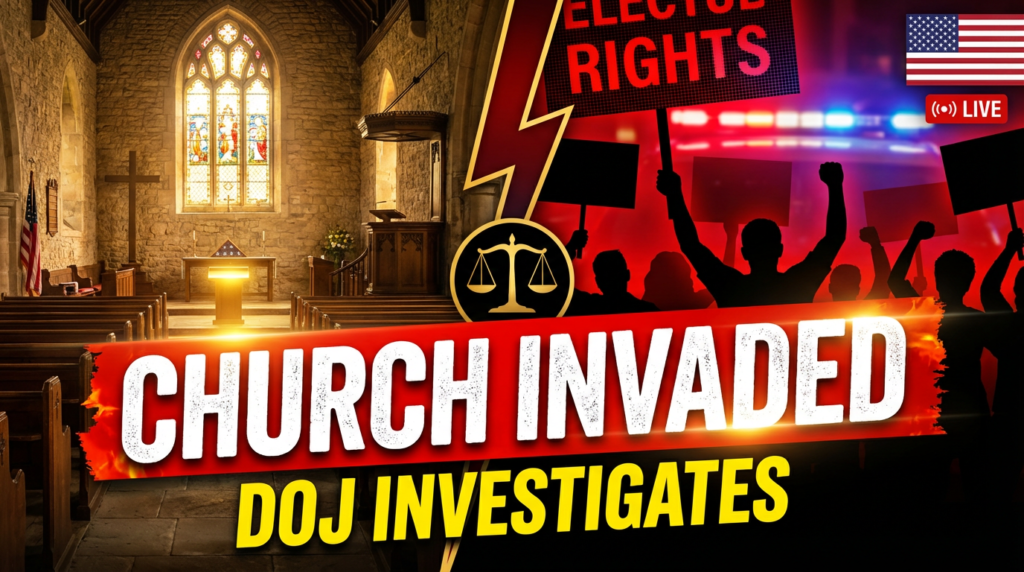
On Sunday, January 18, 2026, something unprecedented occurred at Cities Church in St. Paul, Minnesota. During a worship service, dozens of protesters stormed into the sanctuary, chanting “ICE out” and disrupting congregants attempting to practice their faith. Their target? David Easterwood, a church pastor who also serves as the acting field office director for Immigration and Customs Enforcement (ICE) in St. Paul.
The incident has sparked a federal investigation by the Department of Justice, with President Trump calling the demonstrators “agitators and insurrectionists” who should face jail time or deportation. While the immigration debate continues to divide Americans, this incident transcends policy disagreements and strikes at something far more fundamental: the right of Americans to worship freely without intimidation, and the principle that in a nation of laws, there are boundaries even the most passionate activism cannot cross.
What happened in St. Paul wasn’t protest—it was disruption. And the distinction matters profoundly for anyone who values ordered liberty, personal responsibility, and the constitutional protections that make peaceful civil society possible.
Support Independent Local Journalism
TheTownHall.News is a non-profit reader-supported journalism. Just $5 helps us hire local reporters, investigate important issues, and hold public officials accountable across Alameda County. If you believe our community deserves strong, independent journalism, please consider donating $5 today to support our work.The Facts: What Happened at Cities Church
The protesters, who identified themselves as part of anti-ICE activist groups, entered Cities Church during Sunday services with a specific mission: to confront Easterwood about his role in immigration enforcement. Video footage shows demonstrators shouting inside the sanctuary, creating chaos as church leaders, including lead pastor Jonathan Parnell, attempted to engage with them.
The protesters’ grievance centered on Easterwood’s dual role as both a church pastor and an ICE official overseeing enforcement operations. They also invoked the name of Renee Good, apparently referencing ongoing immigration enforcement actions in the area. The disruption lasted several minutes before protesters eventually left the premises.
The Department of Justice, under the leadership of Civil Rights Division head Harmeet Dhillon, swiftly announced a federal investigation, citing potential violations of the Freedom of Access to Clinic Entrances (FACE) Act. This 1994 federal law prohibits the use of force, threat of force, or physical obstruction that interferes with any person seeking to exercise their First Amendment right to religious freedom at a place of worship.
The Legal Framework: Why This Matters Under Federal Law
The FACE Act exists precisely for situations like this. While originally conceived to protect access to abortion clinics and houses of worship from violent extremists, the law explicitly protects religious freedom by making it a federal crime to intimidate or physically obstruct anyone “seeking to exercise the right of religious freedom at a place of religious worship.”
This isn’t about stifling legitimate protest. The First Amendment robustly protects peaceful demonstration, even when that speech is controversial or uncomfortable. Activists have every right to organize outside government buildings, hold press conferences, stage rallies, or use social media to voice opposition to immigration enforcement policies.
But the First Amendment does not grant license to hijack private religious services. It does not permit protesters to silence others or transform sanctuaries into stages for political theater. The freedom of speech is not a freedom to prevent others from speaking—or in this case, worshiping.
This distinction is crucial for anyone committed to ordered liberty. A society where activists can storm churches, synagogues, or mosques to target individuals based on their employment or political views is not a free society. It’s a society descending into mob rule, where the loudest voices claim the right to violate the peaceful assembly of others.
Personal Responsibility and the Boundaries of Activism
Conservative principles emphasize personal responsibility—the idea that individuals are accountable for their choices and actions. This applies equally to political activism. Passionate disagreement with government policy does not absolve protesters of responsibility for how they express that disagreement.
The activists who entered Cities Church made a choice. They could have organized a lawful demonstration outside the building. They could have pursued legal challenges to ICE policies. They could have engaged in community organizing, voter registration, or lobbying elected representatives. Instead, they chose disruption and intimidation, targeting not just a government official but an entire congregation of worshipers whose only “offense” was gathering for Sunday services.
Support Independent Local Journalism
TheTownHall.News is a non-profit reader-supported journalism. Just $5 helps us hire local reporters, investigate important issues, and hold public officials accountable across Alameda County. If you believe our community deserves strong, independent journalism, please consider donating $5 today to support our work.This choice reflects a troubling trend in American political life: the erosion of norms that once constrained even the most heated disagreements. When protesters believe their cause justifies any tactic—including invading houses of worship—they’re not championing justice. They’re claiming a form of moral superiority that places them above the rules that govern everyone else.
Personal responsibility means accepting that even righteous anger has limits. It means recognizing that the ends do not justify all means. And it means understanding that in a constitutional republic, there are proper channels for dissent that don’t involve trampling the rights of others.
Law and Order: The Foundation of Civil Society
The swift DOJ response to this incident underscores a principle that should transcend partisan politics: law and order is not optional. It’s the foundation upon which all other freedoms rest.
Without the rule of law, the strong dominate the weak. Mob action replaces reasoned debate. And the rights of minorities—whether political, religious, or otherwise—become subject to the whims of whoever can organize the most disruptive demonstration.
ICE agents, like all federal law enforcement officers, carry out duties prescribed by Congress and overseen by the executive branch. Americans can and should debate immigration policy vigorously. But targeting individual officers for doing their jobs—particularly in houses of worship—crosses a bright line from policy advocacy into harassment and intimidation.
David Easterwood took an oath to enforce federal immigration law. He also serves his church community as a pastor. These roles are not contradictory. Throughout American history, public servants have balanced civic duty with religious commitment. The notion that government employees forfeit their right to worship freely, or that congregations must answer for the professional roles of their members, is both legally and morally untenable.
Religious Liberty: America’s First Freedom
The Founders placed religious freedom first in the Bill of Rights for a reason. They understood from bitter experience that when government or mobs could dictate the terms of worship, all other liberties hung in the balance.
The Cities Church disruption represents a direct assault on this first freedom. When protesters storm a sanctuary to target an individual, they’re not just violating federal law—they’re attacking a principle that predates the Constitution itself. The right to worship according to one’s conscience, free from coercion or intimidation, is foundational to American identity.
Conservatives have long warned about the progressive erosion of religious liberty, often in the context of government mandates or court decisions. But threats to religious freedom can come from any direction. When activists claim the right to disrupt worship services because they disagree with a congregant’s employment, they’re asserting a form of secular authority over religious space that should alarm anyone who values pluralism and tolerance.
Houses of worship must remain sanctuaries in the truest sense—places where Americans of all backgrounds can gather without fear of harassment or political targeting. The moment we accept that churches, synagogues, or mosques can be invaded based on the political views or professional roles of their members, we’ve surrendered something irreplaceable.
The Path Forward: Accountability and Renewed Respect for Boundaries
The DOJ investigation represents an important step toward accountability. Federal prosecutors must now determine whether the protesters violated the FACE Act and, if so, pursue appropriate charges. This isn’t about criminalizing dissent—it’s about enforcing clear legal boundaries that protect religious freedom.
President Trump’s strong rhetoric calling for jail time or deportation reflects legitimate frustration with activists who appear to believe they’re above the law. While the specific penalties will ultimately be determined by prosecutors and courts applying established legal standards, the broader point stands: actions have consequences, and those who violate federal law in pursuit of political goals must be held accountable.
At the same time, this incident should prompt broader reflection about the state of American civic discourse. We live in polarized times, with deep disagreements about immigration, law enforcement, and the proper role of government. But polarization cannot become an excuse for abandoning the norms and laws that make peaceful coexistence possible.
Churches, synagogues, mosques, and temples must be off-limits for political disruption. Full stop. This isn’t a partisan position—it’s a baseline requirement for a functioning pluralistic democracy. Religious communities across the theological and political spectrum should unite in defending this principle, regardless of their views on immigration policy.
Conclusion: Defending Ordered Liberty
The disruption at Cities Church in St. Paul represents more than an isolated incident. It’s a symptom of a broader cultural crisis in which some activists believe their political objectives justify any tactic, including the violation of others’ fundamental rights.
Conservatives have always understood that freedom and order are not opposites—they’re complementary. True freedom exists only within a framework of law that protects the weak from the strong, the unpopular from the mob, and the worshiper from the political agitator.
The federal investigation into this incident will test whether America still maintains that framework. Will we enforce laws protecting religious freedom, or will we allow political passion to override constitutional protections? Will we hold activists accountable for crossing bright legal and moral lines, or will we excuse lawlessness in the name of favored causes?
These questions matter far beyond immigration policy or one church in Minnesota. They go to the heart of what kind of country we want to be: one governed by law and mutual respect for rights, or one where the loudest voices and most disruptive tactics carry the day.
The choice should be clear to anyone who values the principles that have made America exceptional—personal responsibility, limited government, religious liberty, and the rule of law. These principles demand that we defend the right of all Americans to worship freely, that we hold lawbreakers accountable regardless of their political motivations, and that we maintain the boundaries that separate legitimate protest from intimidation and disruption.
What happened at Cities Church cannot become the new normal. If we care about preserving religious freedom for future generations, we must draw a line here and now.
Call to Action
Stay Informed: Follow the DOJ investigation into this incident and demand transparency about how federal authorities will enforce laws protecting religious freedom.
Support Religious Liberty: Contact your elected representatives and urge them to defend houses of worship from political disruption. Religious freedom is a bipartisan value that deserves bipartisan protection.
Engage Your Community: Have conversations in your own faith communities about the importance of maintaining sanctuaries as places of peace, free from political targeting and intimidation.
Share This Article: Help others understand what’s at stake when activists cross the line from legitimate protest to unlawful disruption. The more Americans understand these issues, the stronger our defense of ordered liberty becomes.
Get Involved: Support organizations that defend religious freedom and the rule of law. Whether through donations, volunteer work, or simply staying educated, every citizen has a role in preserving the principles that make America free.
The sanctuary must remain sacred. The rule of law must be enforced. And Americans of goodwill must stand together in defense of the freedoms that belong to all of us—regardless of our politics, our professions, or our views on any particular policy debate.