When the “Human Rights” Elite Enslaves: The Lydia Mugambe Verdict Exposes the Global Accountability Crisis
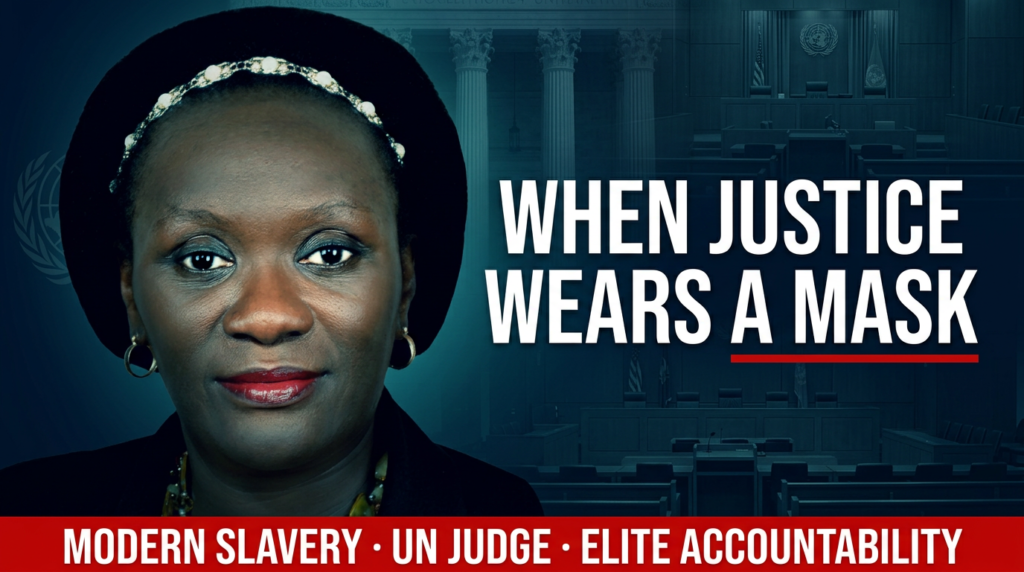
A Human Rights Champion Who Kept a Slave
There are moments in public life that strip away pretense so completely that they demand our full attention. The conviction and sentencing of Lydia Mugambe — a sitting Ugandan High Court judge, a former United Nations criminal tribunal judge, a doctoral student at the University of Oxford, and an alumna fellow of Columbia University’s human rights program — is one of those moments.
On March 13, 2025, Mugambe was found guilty on four counts at Oxford Crown Court, including trafficking a young Ugandan woman to the United Kingdom under a fraudulent visa and forcing her to work as an unpaid maid and nanny. On May 2, 2025, she was sentenced to six years and four months in prison. She was also ordered to pay her victim £12,160 in compensation and is subject to an indefinite restraining order.
The woman she enslaved lived in what prosecutors described as “almost constant fear.” She said she may never return to Uganda and may never see her mother again.
Support Independent Local Journalism
TheTownHall.News is a non-profit reader-supported journalism. Just $5 helps us hire local reporters, investigate important issues, and hold public officials accountable across Alameda County. If you believe our community deserves strong, independent journalism, please consider donating $5 today to support our work.This is not a story about one bad actor. It is a story about power, accountability, and the dangerous illusion that elite credentials and progressive credentials are the same thing as moral character.
The Facts of the Case
Let the record speak plainly. Mugambe, 50, arranged a fraudulent visa that falsely stated the victim would be employed as a paid private servant at the Ugandan diplomatic residence in London. In reality, the young woman was picked up from the airport and brought directly to Mugambe’s home in Kidlington, Oxfordshire, where she was made to work without pay.
John Mugerwa, Uganda’s former deputy high commissioner in London, sponsored the fraudulent visa. In return, prosecutors told the court, Mugambe would assist him in a separate legal matter in Uganda in which he was a defendant — a corrupt exchange, hidden behind diplomatic paperwork and institutional titles. Mugerwa could not be charged because the Ugandan government refused to waive his diplomatic immunity. Justice, in that instance, was blocked by the very system designed to protect it.
When police arrived to arrest Mugambe, bodycam footage captured her telling officers: “I even have immunity.” She did not. The jury convicted her on all four counts. Judge David Foxton noted at sentencing that she showed “absolutely no remorse” and attempted to forcibly blame the victim for what happened.

Crown Prosecutor Lynette Woodrow summed it up clearly: “As a qualified lawyer, a Ugandan High Court judge, and a United Nations Criminal Tribunal judge, Lydia Mugambe understood the rule of law — and chose to overlook it.”
The Credential Gap: When Elite Pedigree Means Nothing
This case presents a challenge that conservatives have long raised and that the mainstream has long dismissed: credentials are not character, and institutional prestige is not a proxy for integrity.
Mugambe did not merely have a law degree. She held positions at the highest levels of international jurisprudence. She studied at Oxford. She was trained by Columbia University — an institution that has built much of its modern identity around human rights advocacy. She was appointed to the United Nations International Residual Mechanism for Criminal Tribunals, a body charged with prosecuting war crimes and crimes against humanity.
And she kept a slave.
The hypocrisy is not incidental. It goes to the heart of a problem conservatives have identified for years: an elite class that wraps itself in the language of justice, equity, and human dignity, while operating under a private moral code that places their own comfort and ambition above the rights of the most vulnerable. This is not a coincidence of biography. It is a structural failure of a system that rewards signaling over substance.
Support Independent Local Journalism
TheTownHall.News is a non-profit reader-supported journalism. Just $5 helps us hire local reporters, investigate important issues, and hold public officials accountable across Alameda County. If you believe our community deserves strong, independent journalism, please consider donating $5 today to support our work.Personal responsibility — one of the foundational pillars of a just and functioning society — requires that no one be above the law. Not the powerful. Not the credentialed. Not the diplomat. The moment we allow the privileged to self-exempt from the rules that govern everyone else, we have abandoned the rule of law in all but name.
Diplomatic Immunity: A Shield for Wrongdoers
The Mugerwa dimension of this case deserves its own scrutiny. Here is a man who, according to prosecutors, conspired to facilitate the trafficking of a human being — and walked free because his government chose not to waive his diplomatic immunity.
This is not an abstract legal technicality. It is a real-world consequence of a system that, in practice, allows foreign nationals operating in positions of privilege to escape accountability for serious crimes on British — or American — soil. Conservatives have long argued that law and order must be applied uniformly and without favoritism. Diplomatic immunity, as it currently functions, is a loophole that enables exactly the kind of two-tiered justice system that erodes public trust in institutions.
The case against Mugambe succeeded because she did not hold immunity. But the man who conspired with her — by prosecutors’ own account — will face no criminal consequences. The victim’s suffering was real. The conspiracy was real. The injustice of that outcome is also real. Any serious conversation about reforming international accountability mechanisms must grapple with this.
The UN’s Accountability Problem
It is worth recalling that the UN was aware of the investigation against Mugambe as early as July 2024, at which point the International Residual Mechanism for Criminal Tribunals issued a statement noting they had “become aware” that she was under investigation. Mugambe subsequently resigned from her UN position.
This timeline raises uncomfortable questions. Was any action taken proactively? Was the victim’s welfare a consideration in how swiftly the institution moved? Conservatives have made principled arguments for decades that international bodies like the United Nations suffer from a chronic deficit of transparency and accountability, and that their institutional culture protects insiders at the expense of those with no power.
The Mugambe case provides a concrete, documented example of why those concerns are not paranoia — they are pattern recognition. The same institutions that issue global declarations on human rights, gender equality, and the dignity of workers must be held to the standards they profess. Anything less is not idealism. It is performance.
What Justice Looks Like
There is, in this story, something worth acknowledging clearly: the system, when pushed, worked. Thames Valley Police investigated. The Crown Prosecution Service prosecuted. A British jury convicted. A British judge sentenced. The victim — a young woman with no institutional power, no connections, and no immunity — was heard.
That is not nothing. That is the rule of law functioning as it should, and it is worth defending.
Chief Superintendent Ben Clark of Thames Valley Police said it plainly: “Modern slavery is an under-reported crime, and I hope that the bravery of the victim in this case encourages other victims of modern slavery to come forward.” The University of Oxford, for its part, called the crimes “appalling” and announced disciplinary proceedings that could result in Mugambe’s removal as a student.
These are the right responses. Accountability is not selective. It does not bend to titles or institutions or claimed immunities. It applies to all — and that principle is not a conservative idea or a liberal idea. It is a foundational idea, and one that must be defended loudly and consistently.
Conclusion: Watch What They Do, Not What They Say
The Lydia Mugambe case is a case study in the distance between rhetoric and reality. A woman whose career was built on the language of human rights — who trained at some of the most prestigious institutions in the world, who sat on benches designed to hold war criminals to account — enslaved a vulnerable young woman in a quiet English suburb and told arresting officers she had immunity from the law.
She did not.
The lesson here is not cynicism. The lesson is vigilance. Titles, fellowships, and UN appointments do not automatically confer virtue. Powerful institutions do not automatically police their own. The rule of law is not self-enforcing — it requires citizens who pay attention, demand consistency, and hold every person, regardless of status, to the same standard.
That is the conservative principle at the center of this story: not that elites are always corrupt, but that no one should be exempt from the consequences of their choices. Personal responsibility is not a burden placed only on the powerless. It is a universal standard — and when it is applied universally, justice is possible.
Call to Action
Justice only works when people are paying attention. Share this article with those who believe in equal accountability under the law, regardless of title or institution. Stay informed on modern slavery prosecutions, UN reform debates, and the ongoing fight to ensure that the most vulnerable among us are never sacrificed on the altar of elite privilege.
Follow The Town Hall News for fact-based, principled reporting that holds power to account — at every level.
Sources: Crown Prosecution Service (UK), BBC News, Reuters, Oxford Crown Court Sentencing Remarks, UN International Residual Mechanism for Criminal Tribunals, Thames Valley Police.