Fremont Fights Back: Why This City’s Homeless Camp Ban Is a Victory for Public Safety
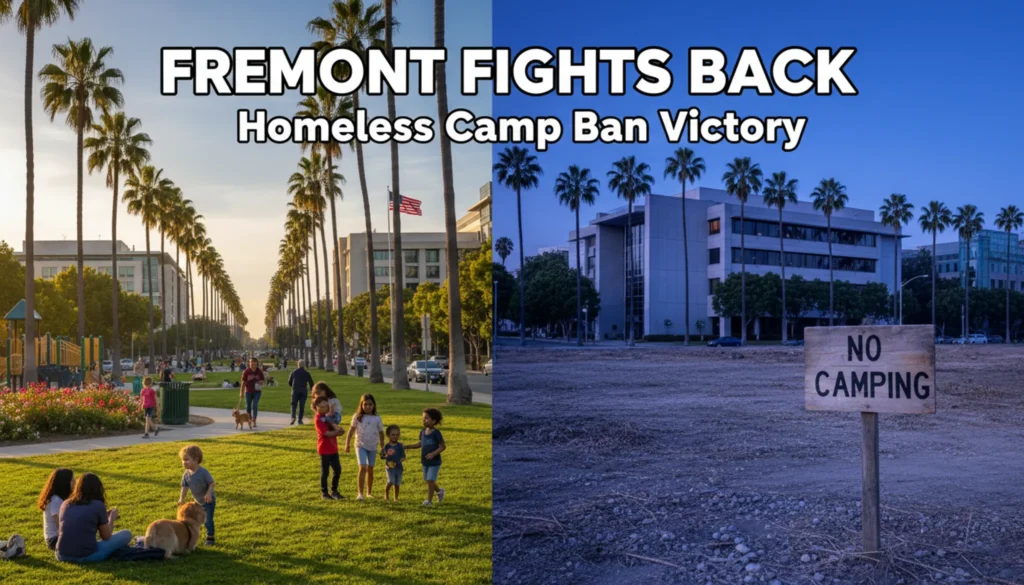
When the Fremont City Council voted 6-1 in February 2025 to implement one of California’s strictest camping bans, they weren’t just passing another ordinance. They were taking a stand for the thousands of law-abiding residents who deserve safe parks, clean sidewalks, and neighborhoods free from the chaos of unchecked homeless encampments. What followed—a lawsuit from advocacy groups and months of legal wrangling—perfectly illustrates the ongoing battle between common-sense governance and the activist class that prioritizes ideology over community welfare.
The good news? Fremont won. In September 2025, the lawsuit was dropped, and the city can now enforce its camping ban. This is a victory not just for Fremont, but for every community across America struggling to balance compassion with accountability.
The Crisis That Demanded Action
Let’s start with the facts. According to the 2024 Alameda County Point-in-Time Count, Fremont had 392 homeless individuals, with 308 living unsheltered on the streets. These aren’t just statistics—they represent real people sleeping in tents along sidewalks, in parks where children should play safely, and near businesses trying to serve their communities.
Support Independent Local Journalism
TheTownHall.News is a non-profit reader-supported journalism. Just $5 helps us hire local reporters, investigate important issues, and hold public officials accountable across Alameda County. If you believe our community deserves strong, independent journalism, please consider donating $5 today to support our work.Fremont residents watched their quality of life deteriorate. Parents couldn’t take their children to Lake Elizabeth without encountering encampments. Business owners on Albrae Street counted 41 RVs lining their properties. The situation had become untenable, and the city’s average household income of $175,000 suggests these weren’t people unable to afford basic services—they were taxpayers demanding their government provide the most fundamental responsibility: public safety and order.
Supreme Court Provides Legal Clarity
The Fremont ordinance came on the heels of the U.S. Supreme Court’s landmark June 2024 decision in City of Grants Pass v. Johnson. In a 6-3 ruling, the Court affirmed that cities can enforce camping bans on public property without violating the Eighth Amendment’s prohibition on cruel and unusual punishment. This was a watershed moment that finally gave municipalities the legal tools they needed to address a crisis that had spiraled out of control under years of permissive policies.
California Governor Gavin Newsom, facing intense political pressure over the state’s homeless crisis, even issued an executive order in July 2024 urging cities to take action. When even a progressive governor acknowledges the problem has reached crisis proportions, you know the status quo isn’t working.
A Reasonable Response to an Unreasonable Situation
Fremont’s ordinance was straightforward: no camping on city streets, sidewalks, parks, or other public property. Violators would face up to six months in jail and fines up to $1,000. The city wasn’t criminalizing homelessness itself—it was enforcing basic standards of public behavior that apply to everyone, regardless of housing status.
As City Councilmember Raj Salwan, who would later become mayor, understood, this was about creating a livable city. “Families should be able to take their children to the parks, to the libraries, without fear,” he stated during deliberations. This isn’t controversial—it’s common sense.
The ordinance initially included language prohibiting “aiding and abetting” encampments, which drew criticism. The city listened to community feedback and removed that clause in March 2025, demonstrating responsive governance. This wasn’t the authoritarian overreach that activists claimed—it was a city government refining policy based on input.
The Predictable Lawsuit and Its Collapse
Right on schedule, the California Homeless Union and faith-based organizations filed suit on March 4, 2025, calling the policy “unconscionable” and claiming it violated constitutional rights. The lawsuit sought an injunction to halt enforcement, arguing that homeless individuals were being “criminally persecuted” for their status.
But here’s what the lawsuit really represented: an attempt by advocacy groups to override the democratic will of Fremont’s elected representatives and the residents they serve. These organizations, however well-intentioned, wanted to impose their preferred solution—essentially, unlimited camping anywhere—on a community that had clearly rejected that approach.
The lawsuit quickly fell apart. Attorney Anthony Prince, representing the plaintiffs, missed two filing deadlines after the city removed the “aiding and abetting” clause. The city filed a motion to dismiss in August, and by September 5, the plaintiffs withdrew their case. Prince tried to spin this as a “political victory,” but the reality is clear: they lost.
Support Independent Local Journalism
TheTownHall.News is a non-profit reader-supported journalism. Just $5 helps us hire local reporters, investigate important issues, and hold public officials accountable across Alameda County. If you believe our community deserves strong, independent journalism, please consider donating $5 today to support our work.The Real Victory: Accountability Over Enablement
City spokeswoman Geneva Bosques confirmed that Fremont hasn’t issued any citations or made arrests under the ordinance as of September 2025, demonstrating the city’s measured approach. The goal isn’t mass incarceration—it’s establishing clear boundaries and expectations.
Conservative principles don’t mean lacking compassion. They mean recognizing that enabling destructive behavior doesn’t help anyone. The data from Fremont’s homeless count reveals that 46% of unsheltered individuals cited job loss or income-related issues as their primary cause of homelessness, while 36% were chronically homeless. These are complex problems requiring comprehensive solutions—not the failed strategy of allowing indefinite camping that has turned cities like San Francisco and Los Angeles into cautionary tales.
The Broader Implications: Law and Order Matters
Fremont’s successful defense of its camping ban sends an important message: cities don’t have to surrender their public spaces to chaos. Local governments have both the right and the responsibility to maintain order, protect property values, ensure public health and safety, and preserve the quality of life that attracts families and businesses.
The conservative approach recognizes several key principles:
Personal Responsibility: While circumstances can be difficult, individuals must be held accountable for their choices and behavior. Society can offer help, but it cannot eliminate consequences.
Limited Government with Clear Purpose: Government shouldn’t micromanage lives, but it must fulfill its core functions—protecting citizens and maintaining public order. Fremont’s ordinance does exactly that.
Fiscal Accountability: Fremont allocated resources toward homeless services while also enforcing standards. The city is working with Alameda County’s Measure W funding ($1.8 billion approved by voters in 2020) to provide stable housing options. This balanced approach—services plus enforcement—is far more fiscally responsible than the open-ended spending that accompanies permissive camping policies.
Community Standards: The 74% of Fremont’s homeless population who previously lived in Alameda County didn’t suddenly materialize. Many gravitated toward areas with the most permissive policies. When cities refuse to enforce standards, they become magnets for problems.
The Path Forward
Fremont’s camping ban, now enforceable, represents a template for other cities grappling with similar challenges. The ordinance survived legal challenge because it’s constitutional, reasonable, and necessary. More importantly, it reflects the will of the community.
The city has committed to prioritizing encampment interventions based on health and safety risks, not arbitrary enforcement. This measured approach, combined with efforts to connect individuals with services and housing, strikes the right balance.
What Fremont has proven is that cities don’t have to choose between compassion and order. They can—and must—pursue both. But compassion without accountability is enablement, and enablement has created the crisis we see across California.
Conclusion: Defending Civilization
The battle over Fremont’s camping ban was never really about one city or one ordinance. It was about whether local communities retain the right to govern themselves according to their values and needs, or whether activist organizations can impose their ideology through litigation and intimidation.
Fremont chose to fight, and they won. They demonstrated that with clear legal authority from the Supreme Court, responsive local leadership, and community support, cities can reclaim their public spaces while still offering pathways to help those in need.
The lesson is clear: law and order aren’t optional extras in a functioning society—they’re the foundation. When cities enforce reasonable standards, everyone benefits. Businesses thrive, families feel safe, and even those struggling with homelessness are better served by systems that combine accountability with genuine assistance rather than enabling indefinite street camping.
Fremont’s victory is a reminder that civilization requires maintenance. It doesn’t happen by accident, and it won’t survive if we’re unwilling to defend it.
Call to Action
The fight for safe, orderly communities isn’t over. If you believe cities should be able to enforce camping bans and maintain public order, share this article with your local elected officials and community members. Stay informed about how your city is addressing homelessness—and demand accountability from leaders who prioritize activist agendas over resident safety. Subscribe to our newsletter for more coverage of the policies and principles that protect American communities. Your voice matters—use it before your city becomes the next cautionary tale.