Hayward 2026 District Elections: A Historic Shake-Up — And a Fiscal Crisis That Demands Real Answers
For the first time in 150 years, Hayward voters will elect their City Council by district. But before they cast a ballot, they deserve the full picture — including a financial disaster hiding in plain sight.
A City at a Crossroads
There are moments in a city’s history when the stars of politics, policy, and accountability align — for better or for worse. Hayward, California, is living one of those moments right now.
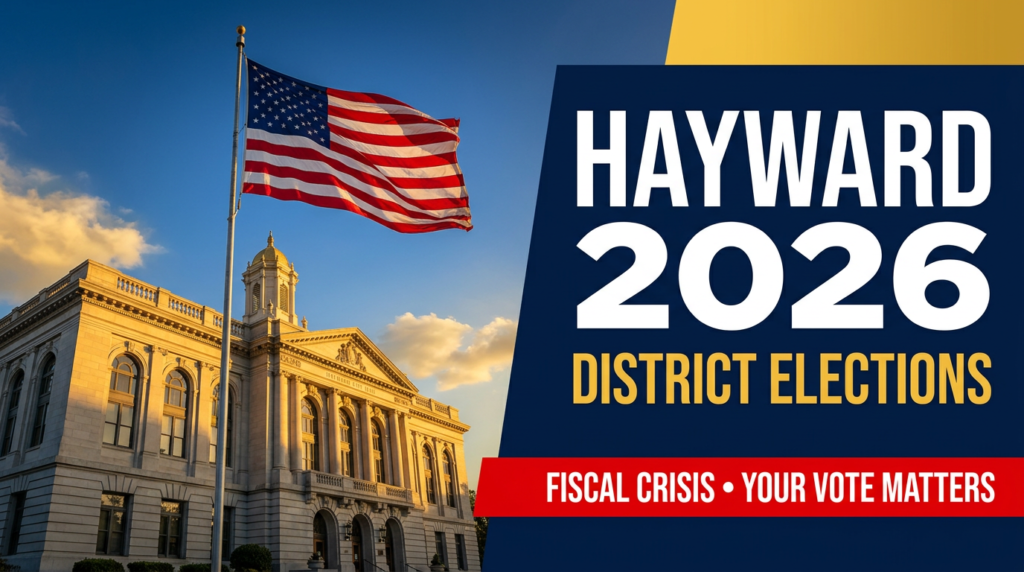
On the evening of March 12, 2026, Mayor Mark Salinas stepped to the podium at the Hayward Unified School District Performing Arts Center to deliver his annual State of the City address. It was the first major political event of a pivotal election year — and no ordinary one at that. The November 3, 2026 election will be the first in Hayward’s 150-year history in which voters elect City Council members by geographic district rather than through a citywide at-large vote. That alone makes this a watershed moment. But add a looming $30 million budget deficit, a public safety crisis, and city reserves teetering near empty, and what you have is not just an election — it is a reckoning.
Support Independent Local Journalism
TheTownHall.News is a non-profit reader-supported journalism. Just $5 helps us hire local reporters, investigate important issues, and hold public officials accountable across Alameda County. If you believe our community deserves strong, independent journalism, please consider donating $5 today to support our work.Hayward residents have every reason to pay close attention. The decisions made in the next eight months will determine the direction of this city for a generation. And in that context, the principles of fiscal accountability, local representation, law and order, and limited government have never been more urgently relevant.
The End of At-Large Voting — And Why It Matters
Under Hayward’s old at-large system, every registered voter in the city cast a ballot for every non-mayoral City Council seat. On paper, that sounds democratic. In practice, it consistently favored well-funded, well-connected candidates with the resources to run expensive, citywide campaigns. A teacher from the east side, a small business owner from the Tennyson corridor, or a veteran from South Hayward had virtually no chance against an incumbent with a fat campaign war chest and name recognition across zip codes they had never lived in.
That system is now gone — the result, it must be noted, not of grassroots civic action, but of a 2021 lawsuit filed under the California Voting Rights Act. Local resident Jack Wu and the organization Neighborhood Elections Now argued that the at-large structure diluted the political power of Asian American voters. The city settled in May 2024, agreeing to draw six new geographic districts and paying $125,000 in attorney fees. Mayor Salinas, to his credit, was the only council member to vote against the settlement — not because he opposed fair representation, but because he was rightly frustrated that a structural change of this magnitude was being driven by litigation rather than by the community’s own voice.
That frustration is legitimate. When lawyers, not citizens, decide how democracy is structured, something has gone wrong. Still, the outcome — district-based elections — is fundamentally sound. It brings government closer to the people it serves. Starting November 3, residents in Districts 1 and 6 will vote for a council member who actually lives in their neighborhood, who shares their commute, shops at their grocery store, and sends their kids to their local school. Districts 2 through 5 will follow in 2028.
This is, at its core, a conservative victory — even if it arrived by an awkward path. Smaller districts mean smaller campaigns, lower costs, and a genuine opening for everyday citizens — teachers, veterans, entrepreneurs — to run for and win public office. It returns power to the neighborhood level, exactly where it belongs.
A Budget in Freefall — The Numbers Don’t Lie
But let’s be honest with ourselves: a reformed election structure means nothing if the city it governs is financially collapsing.
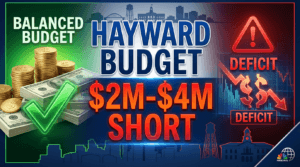
Hayward is staring down a $30.6 million structural budget deficit for fiscal year 2025-26. That is not a rounding error. That is a systemic failure of financial management. The city’s reserves — the fiscal cushion that every responsible government maintains for emergencies — have been nearly wiped out, sitting at just $1.2 million after the city spent $21 million over budget in a single fiscal year. For reference, the city’s total general fund expenditures run into the hundreds of millions annually. That reserve figure isn’t a safety net. It’s a tightrope.
The cause is not mysterious. Salaries and benefits now consume a staggering 80% of Hayward’s general fund. A single Fire Department battalion chief reportedly received nearly $250,000 in overtime compensation in one year. Meanwhile, the city has implemented a hiring freeze, asked the mayor and council to voluntarily cut their own pay by 6.5%, and proposed a 4% cut for department heads. New taxes and fee hikes are on the table — this in a city that already levies one of California’s highest sales tax rates at 10.75%, one of the heaviest tax burdens residents in the entire state.
This is what happens when government grows beyond its means, when personnel costs expand unchecked, when no one at the council table has the political courage to say “enough.” Hayward residents did not create this crisis. Their elected officials did. And now voters are being asked — implicitly or explicitly — to consider whether more taxes are the answer, or whether real accountability, structural reform, and fiscal discipline are what this city actually needs.
Support Independent Local Journalism
TheTownHall.News is a non-profit reader-supported journalism. Just $5 helps us hire local reporters, investigate important issues, and hold public officials accountable across Alameda County. If you believe our community deserves strong, independent journalism, please consider donating $5 today to support our work.The answer should be clear to anyone who believes in the basic principle that government must live within its means.
Public Safety Cannot Be an Afterthought
If the budget crisis represents a failure of governance, the public safety situation represents its human cost.
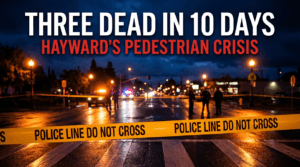
In a ten-day stretch earlier this year, three pedestrians were killed in Hayward — three separate tragedies, each a reminder that the most fundamental obligation of local government is to keep its residents safe. Law and order is not a political slogan. It is the bedrock promise of civil society. When that promise is broken, no amount of progressive programming or city marketing campaigns can paper over the failure.
Public safety, like fiscal solvency, requires prioritization. It requires resources allocated with discipline and purpose, not spread thin across an ever-expanding list of government ambitions. The new district election system creates a direct mechanism for accountability here. When a council member lives in your district, you can look them in the eye at the school drop-off line. You can hold them personally responsible when streetlights go dark or crime goes unaddressed. That proximity is not just symbolic — it is politically powerful.
What Voters Must Demand
Mayor Salinas’s State of the City address was the opening shot in what promises to be Hayward’s most consequential election season in living memory. But speeches are not solutions. The real test begins now — in the candidate forums, the campaign debates, and ultimately in the voting booth.
Hayward voters deserve candidates who will answer, plainly and on the record, the following questions:
- On the budget: Will you cut spending before raising taxes? Will you renegotiate compensation structures that have placed 80 cents of every discretionary dollar on the payroll?
- On public safety: Will you fully fund law enforcement and hold city leaders accountable for the safety of Hayward streets?
- On transparency: Will you publish clear, plain-language financial reports so ordinary residents — not just insiders — can understand where their money is going?
- On local control: Will you resist state and regional mandates that override the will of Hayward’s own community?
These are not partisan questions. They are the questions of a functioning democracy. And in a city that has just restructured its elections to bring representation closer to the people, they have never been more answerable — or more necessary.
A Historic Opportunity — If Voters Seize It
Hayward’s shift to district elections is a genuinely historic moment. For the first time, the residents of Districts 1 and 6 will choose a voice that is unmistakably, undeniably theirs. That is worth celebrating. But the new system is only as good as the voters who use it and the candidates who earn their trust.
The old at-large model rewarded money and connections. The new district model rewards community roots, credibility, and genuine service. That is a better deal for Hayward — if residents show up to claim it.
This city has the talent, the diversity, and the civic backbone to turn its fiscal crisis into a turning point. What it needs are leaders willing to make hard choices, voters willing to demand real answers, and a community willing to hold both accountable. The election is November 3, 2026. The season has already begun.
📣 Call to Action
Hayward voters — your city needs you now more than ever. Find your district at hayward-ca.gov/forward, show up to candidate forums, and ask the hard questions. Share this article with a neighbor, a colleague, or anyone who cares about where Hayward is headed. Democracy works best when citizens are informed, engaged, and unwilling to be ignored. Don’t sit this one out.