Hayward 2026 Elections Will Look Nothing Like Before And Every Voter Needs to Know Why
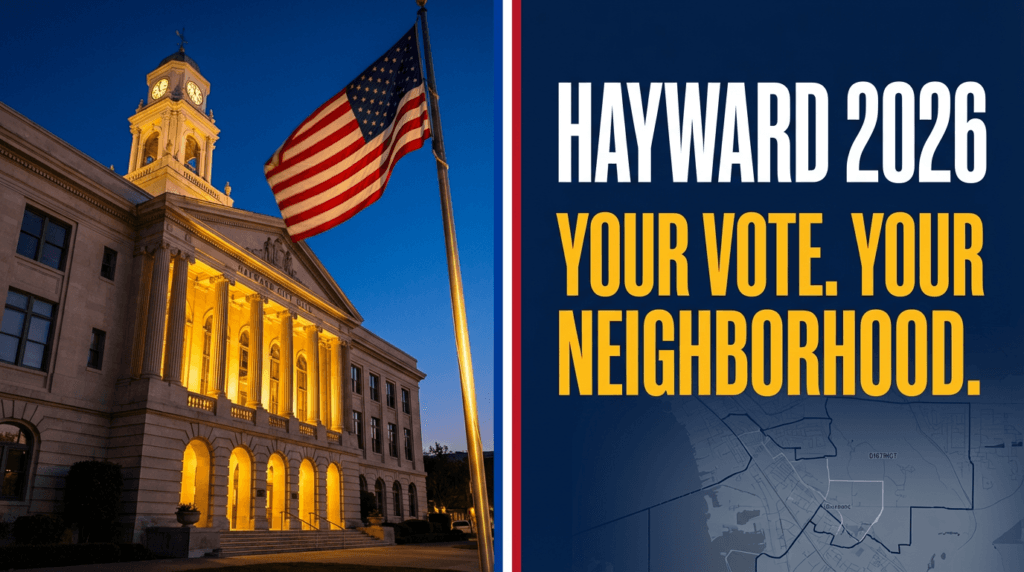
Something historic is happening in Hayward this November — and most residents don’t know it yet.
For the first time in the city’s 150-year history, Hayward voters will elect City Council members from their own neighborhoods. No more choosing from a slate of citywide candidates you’ve never heard of. No more representation by politicians who live across town and only show up at election time. Starting November 3, 2026, if you live in District 1 or District 6, you will vote for someone who lives in your community, knows your streets, and will have to look you in the eye at the grocery store.
That’s a big deal. But here’s what’s also true: this change didn’t come from the people of Hayward. It came from a lawsuit. And it arrives at the worst possible moment — as the city teeters on the edge of a $30.6 million budget deficit, with reserves nearly depleted and a tax rate already among the highest in California.
The 2026 elections are not just different. They may be the most consequential in Hayward’s recent memory. And whether this new system becomes a genuine tool for accountability or just another reshuffling of the same political deck depends entirely on whether voters show up — informed, engaged, and demanding answers.
A Historic First: What’s Actually Changing
Under Hayward’s old at-large system, every voter citywide chose every non-mayoral Council seat — an arrangement that favored candidates with name recognition and resources over ordinary residents. That changes in 2026. The City Council has been divided into six geographic districts; each representative must live in their district, and only district residents vote for them. The Mayor remains elected citywide.
This November, Districts 1 and 6 go first. The seats held by Councilmember Julie Roche (District 1) and Mayor Pro Tempore George Syrop (District 6) are on the ballot. Districts 2, 3, 4, and 5 follow in 2028.
Hayward is one of California’s most diverse cities. According to U.S. Census data, the city of 158,440 residents is 41.3% Hispanic, 30.5% Asian, 12.7% non-Hispanic White, and 7.9% Black — with over 43% foreign-born and nearly 62% speaking a language other than English at home. Under the new system, those communities will have a direct pipeline to City Hall through representatives who actually share their neighborhoods.
How We Got Here: A Lawsuit, Not a Vote
Let’s be honest about how this change came about — because it matters.
Hayward residents never voted for district elections. No ballot measure was put to the public. No community petition drove this reform. Instead, in 2021, a local resident named Jack Wu and the group Neighborhood Elections Now Inc. filed a legal challenge, represented by Southern California attorney Scott Rafferty, arguing that Hayward’s at-large elections violated the California Voting Rights Act (CVRA) by diluting the political power of Asian Americans.
The CVRA, passed in 2001, is notably broader than its federal counterpart. While the federal Voting Rights Act requires proof of intentional discrimination, California’s version allows lawsuits based on “racially polarized voting” — a statistical standard that makes virtually any at-large system legally vulnerable. The mere threat of litigation is often enough to force compliance, since defending against a CVRA challenge can cost a city far more than simply settling.
That’s exactly what happened here. In May 2024, Hayward settled — creating six districts and paying $125,000 in attorney fees to Rafferty, billed to taxpayers. Mayor Mark Salinas was the only council member to vote against the resolution, expressing frustration that the change was driven by litigation rather than community will.
Conservatives should sit with that. A structural change affecting every Hayward resident for decades was not decided by voters — it was decided in a courtroom settlement, driven by a law that doesn’t require proof of actual discrimination. That is state power overriding local democracy, and it is a pattern repeating across California.
To be fair: the underlying concern is legitimate. Minority communities deserve equal representation, and Hayward’s council historically did not reflect its population. But the mechanism — litigation over legislation, courts over communities — raises serious questions about local self-determination that voters of every stripe should consider.
The Real Stakes: A City in Financial Freefall
Whoever wins in Districts 1 and 6 this November won’t be stepping into an easy job. They’ll be inheriting a city in genuine fiscal distress.
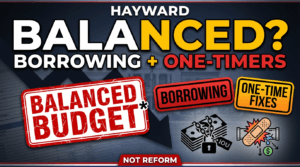
In Fiscal Year 2025, Hayward spent $248 million — more than $21 million over budget — and drained its reserves down to just $1.2 million. The current FY2025-26 budget carries a projected $30.6 million deficit if not corrected. Salaries and benefits now consume 80% of the general fund and absorb approximately 90% of general fund revenue, according to Interim City Manager Jayanti Addleman. A single Fire Department battalion chief received nearly $250,000 in overtime last year alone.
The city’s response has included a hiring freeze, a voluntary 6.5% pay cut for the mayor and council, a 4% cut for department heads, and the creation of a “budget war room.” These are not the actions of a government in control. They are the actions of an institution that spent beyond its means for years and is now scrambling. And yet City Hall is eyeing new taxes and fee hikes — in a city that already carries one of California’s highest tax rates at 10.75%.
This is where district elections matter most. Under the old system, a voter frustrated with fiscal mismanagement had to take on a citywide incumbent with a deep war chest. Under the new system, if your councilmember votes for a tax hike without cutting spending first, you know exactly who to hold accountable — and exactly who to vote out. That is fiscal accountability. That is limited, responsible government.
The Conservative Case for Neighborhood Representation
Here’s a core conservative principle: the closer government is to the people it serves, the better it serves them.
District elections change the entire relationship between a resident and their representative. Your councilmember will live in your neighborhood, deal with the same traffic, and attend the same community events. That proximity breeds accountability that citywide elections have never delivered.
Smaller districts also require less money to campaign in, meaning qualified candidates who aren’t wealthy or well-connected can run. Teachers, small business owners, veterans, parents — anyone can compete for a seat without a six-figure budget. That’s democracy that actually works.
A budget crisis that burned through $31 million in reserves didn’t happen overnight. It happened because officials made costly decisions year after year with too little pushback. District elections give every Hayward neighborhood a direct lever. The question is whether residents will use it.
What to Watch: November 3, 2026 and Beyond
The immediate races to watch are in Districts 1 and 6. As candidates begin to emerge, voters in those districts should demand clear answers:
- The budget — Do they support new taxes, or will they insist on spending reform first?
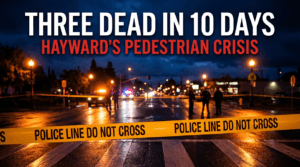
- Public safety — Hayward suffered three pedestrian deaths in a single 10-day stretch. How will they address it?
- Local control — Will they stand up to Sacramento overreach, or defer to state mandates?
- Transparency — Will they hold public sessions in their district, not just at City Hall?
On March 12, Mayor Salinas delivers the State of the City address — the first major political moment of this election year. Pay attention. For residents in Districts 2–5, your election is 2028 — but informed citizenship doesn’t wait. Learn your district boundaries now and hold your current representatives accountable in the meantime.
Your City. Your Voice. Your Responsibility.
Hayward’s 2026 elections are a reset — a rare moment when the political map is literally redrawn and citizens have a genuine chance to demand better governance. The city faces real problems: a budget in freefall, streets that are killing pedestrians, a tax burden squeezing working families, and a government that has repeatedly spent more than it takes in.
The values this moment calls for — fiscal discipline, personal accountability, limited government, strong and self-governing communities — don’t enforce themselves. They require engaged citizens who take their civic responsibility seriously.
The 2026 elections will look nothing like before. The only question is whether the voters of Hayward will rise to meet that moment.
Take Action
- Find your district — Visit hayward-ca.gov/your-government/elections to confirm your district and voter registration.
- Attend the State of the City address — Thursday, March 12, 2026, 6 p.m.
- Show up to City Council meetings — Your voice matters before Election Day.
- Share this article — Your neighbors deserve to know what’s changing.
- Stay informed — Follow The Town Hall News for ongoing Hayward 2026 coverage.
Tom Wong is an investigative reporter covering municipal governance and fiscal accountability in Hayward and the greater Bay Area.