Hayward Explosion Burglary Arrest Shows Why Law and Order Still Matters
When disaster hits, a community’s first instinct is to help. Neighbors check on neighbors. First responders run toward danger. Families pray that the injured recover and that the damage can be repaired.
But tragedy also reveals something uglier: opportunism.
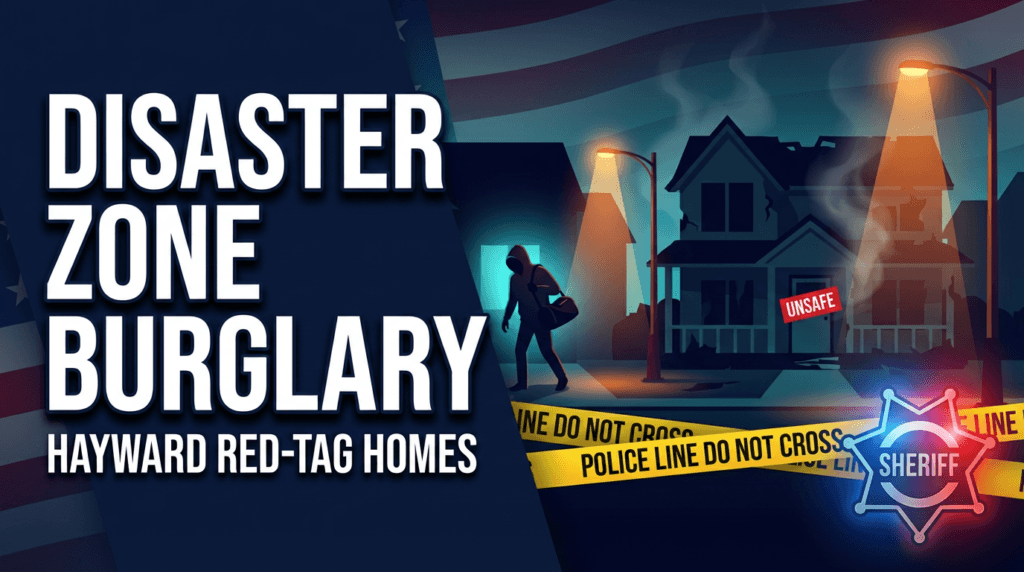
In Hayward, after a devastating Dec. 11, 2025 explosion damaged multiple homes on Lewelling Boulevard and injured six people, authorities say a man was later caught burglarizing the damaged properties—homes that had already been through hell. According to KRON4, deputies responded to a trespassing call on Jan. 4, 2026 at 877 and 867 Lewelling Boulevard, where they allegedly found 41-year-old Michael Yonning burglarizing the damaged homes. The Alameda County Sheriff’s Office said deputies determined Yonning had burglarized a nearby red-tagged residence and stolen property. He was arrested for burglary and other criminal charges.
Support Independent Local Journalism
TheTownHall.News is a non-profit reader-supported journalism. Just $5 helps us hire local reporters, investigate important issues, and hold public officials accountable across Alameda County. If you believe our community deserves strong, independent journalism, please consider donating $5 today to support our work.This is not just another crime blotter item. It is a clear reminder that law and order is not a slogan—it’s the foundation that allows families to rebuild after catastrophe, businesses to reopen, and neighborhoods to feel safe again.
Primary reporting source: KRON4.
(KRON4: “Man arrested for burglarizing exploded Hayward homes”)
What We Know (And What We Should Not Assume)
Let’s start with facts, because credibility matters.
KRON4 reports:
- The explosion occurred Dec. 11, 2025, damaging multiple homes and injuring six people.
- Officials confirmed it was caused by an underground gas explosion.
- PG&E stated that a third-party, non-PG&E crew damaged an underground gas line while digging in the area prior to the explosion.
- On Jan. 4, deputies responded around 9:50 a.m. to a trespassing report at 877 and 867 Lewelling Blvd.
- Deputies allegedly found Michael Yonning, 41, burglarizing the damaged properties and determined he also burglarized a nearby red-tagged home and stole property.
- He was arrested for burglary and other charges.
We should be careful not to embellish beyond what’s reported. We do not know, from KRON4’s story, the full list of charges, whether Yonning has prior convictions, what items were taken beyond “property,” or how prosecutors will file the case. But we know enough to confront the underlying reality: after a disaster, unsecured and unoccupied homes become targets, and the people who exploit that moment are not committing “victimless” crimes.
Burglary After Disaster Is Not “Desperation”—It’s a Choice
A conservative view begins with a simple premise: people have moral agency.
Yes, life can be hard. Yes, the Bay Area is expensive. Yes, some people struggle with addiction, unemployment, or mental illness. But none of that turns someone else’s ruined home into a free-for-all.
A burglary in the aftermath of an explosion is not just theft—it’s theft layered on top of trauma. Those homes weren’t “abandoned.” They were likely temporarily uninhabitable while families navigated insurance claims, inspections, medical recovery, and the brutal logistics of displacement.
Calling this sort of crime “understandable” is not compassion. It’s a soft form of surrender that tells law-abiding families: your suffering is negotiable; your property rights depend on someone else’s impulses.
Support Independent Local Journalism
TheTownHall.News is a non-profit reader-supported journalism. Just $5 helps us hire local reporters, investigate important issues, and hold public officials accountable across Alameda County. If you believe our community deserves strong, independent journalism, please consider donating $5 today to support our work.A community can hold two ideas at once: we can support genuine recovery and treatment for those who need it—and we can also say, clearly, crime is crime. The answer to hardship is help and opportunity, not permission to victimize others.
Red-Tagged Homes Expose a Predictable Security Gap
A “red tag” is not a suggestion. It means a structure is unsafe to occupy. In practical terms, it often means:
- owners can’t stay inside to protect what’s left,
- doors/windows may be damaged,
- the area may be partially cordoned,
- attention shifts from security to survival and repairs.
That’s the window criminals look for.
This is where a limited-government, fiscally accountable approach actually becomes practical: government can’t prevent every bad act, but it can prioritize core functions—public safety and the rule of law—especially during vulnerable periods.
Counties and cities should treat disaster zones the way responsible homeowners treat storm season: plan for the predictable. That can include short-term patrol surges, clear signage about enforcement, coordination with residents about property access, and fast processes for securing structures.
None of this requires building a sprawling new bureaucracy. It requires doing the basics well.
Why “Law and Order” Is a Compassionate Policy
Critics sometimes frame law-and-order politics as harsh. But ask the families on Lewelling Boulevard whether consequences for burglars feel “harsh” or necessary.
When enforcement is weak, the people who suffer most are not the wealthy. They are working families, seniors, and immigrants—people least able to absorb another hit.
In a disaster’s wake, victims already face:
- temporary housing costs,
- lost wages,
- medical bills,
- insurance delays,
- the emotional toll of displacement.
Add theft to that list and you deepen the harm.
That is why conservatives emphasize enforcement that is certain and swift, not just symbolic. The goal isn’t vengeance; it’s deterrence and restoration of community confidence. A functioning justice system tells victims: we see you, and we will not normalize what was done to you.
Corporate and Contractor Accountability Matters Too
The KRON4 report includes an important detail: PG&E says a third-party crew damaged an underground gas line while digging, contributing to the explosion.
That raises a broader point conservatives should not shy away from: accountability applies to everyone—individual criminals and powerful entities alike.
If a contractor failed to follow safety rules, they should be held responsible. If oversight was lax, it should be scrutinized. If civil penalties are warranted, they should be pursued through transparent processes.
But we should also resist a familiar political temptation: using every crisis as a rationale for a vast expansion of regulatory power that primarily produces paperwork and raises costs for everyone who builds, repairs, or renovates. The better path is targeted accountability—clear standards, real enforcement, and consequences for negligence—without smothering the economy in red tape.
Safety and growth are not enemies. Competence is the bridge.
What Local Leaders Should Do Next (Without Growing Government)
A conservative approach emphasizes practical steps, not grandstanding:
- Prioritize disaster-zone security for a defined period
Short, time-limited patrol emphasis around red-tagged areas is a core public-safety function. - Coordinate with residents for property access and documentation
Clear communication reduces confusion—and reduces opportunities for criminals to claim “I thought it was empty.” - Improve prosecution transparency
Residents deserve to know: Were charges filed? Was bail set? What were the case outcomes? Transparency builds trust. - Encourage community-level resilience
Neighborhood networks, watch groups, and rapid reporting matter. This is civil society doing what it does best. - Demand accountability from the responsible parties for the explosion
If digging damage caused the gas event, consequences should be real—not just PR statements.
This isn’t “big government.” It’s effective government doing less, better.
The Cultural Issue: Stop Excusing Criminal Behavior
There is also a cultural rot that shows up after stories like this: the reflex to treat criminals as the primary victims and everyone else as background scenery.
A healthy society teaches:
- personal responsibility, even when life is difficult,
- respect for property, because property is the fruit of labor,
- neighborliness, especially after tragedy,
- and moral clarity: wrong is wrong.
Traditional values aren’t nostalgic ornaments. They are the social glue that keeps communities from sliding into cynicism and fear. When people believe the rules are optional—and enforcement is selective—trust evaporates. Families leave. Businesses close. The tax base shrinks. Services degrade. That’s not compassionate governance; it’s a slow-motion civic failure.
Conclusion: Rebuilding Requires Safety, Accountability, and Moral Clarity
The alleged burglary at red-tagged homes on Lewelling Boulevard is a small story with a big lesson: recovery is not just about construction crews and insurance checks. It’s about security. It’s about consequences. It’s about whether we still believe that hard-hit families deserve protection, not predators.
Hayward—and Alameda County more broadly—can choose a path that defends the vulnerable the right way: enforce the law, prosecute crimes, demand accountability from those whose negligence causes harm, and rebuild a culture that honors responsibility over excuses.
Call to Action
Stay informed on this case and local public-safety decisions. Ask city and county leaders what they’re doing to protect disaster-affected neighborhoods, and demand transparent reporting on arrests and prosecutions. If you found this worth reading, share it—because public pressure is often what separates real accountability from another forgotten headline.