Oakland Hospital’s $1.4 Billion Budget Scandal: The Layoffs That Didn’t Have to Happen
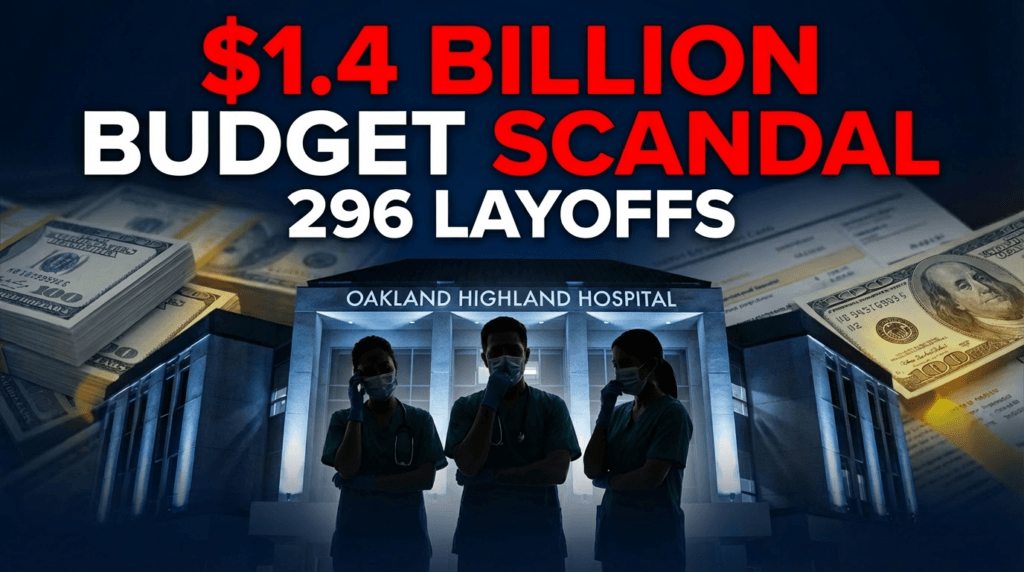
On Monday, January 6, 2026, nearly 300 employees at Oakland’s Alameda Health System (AHS) will receive layoff notices—a painful but predictable consequence of years of unsustainable spending practices finally colliding with fiscal reality. While union representatives and progressive advocates are quick to blame federal Medicaid cuts from H.R. 1, the “Big Beautiful Bill,” the deeper story reveals a healthcare system that failed to prepare for inevitable reforms and a state that has long prioritized expansion over efficiency.
The layoffs affecting 296 workers across management, clinical care, and administrative services aren’t just about federal policy changes. They’re a case study in what happens when government-funded institutions operate without the discipline that private sector organizations face daily: the need to balance budgets, eliminate waste, and plan for changing circumstances.
The Real Numbers Behind the Crisis
Alameda Health System operates with a $1.4 billion annual budget and employs approximately 5,000 people across multiple facilities including Highland Hospital, Alameda Hospital, and San Leandro Hospital. The system projects losing $100 million annually by 2030 due to federal Medicaid reforms—a significant but manageable 7% reduction in their total budget.
Support Independent Local Journalism
TheTownHall.News is a non-profit reader-supported journalism. Just $5 helps us hire local reporters, investigate important issues, and hold public officials accountable across Alameda County. If you believe our community deserves strong, independent journalism, please consider donating $5 today to support our work.Yet AHS leadership claims they’ll run out of cash by August 2026 without “immediate action.” This raises an obvious question: How does a $1.4 billion organization with months of advance notice find itself unable to absorb a 7% budget adjustment without mass layoffs?
The answer lies in decades of bloated bureaucracy, administrative excess, and a fundamental lack of fiscal planning that conservative principles have long warned against.
Administrative Bloat: The Hidden Crisis
Recent healthcare industry data reveals that hospital administrative costs have skyrocketed to 199% of direct patient care costs as of 2023—nearly double what hospitals spend on actually treating patients. Administrative expenses now constitute 15-30% of total U.S. healthcare expenditures, with some estimates suggesting administrative tasks alone cost the industry $83 billion annually.
AHS is no exception to this trend. The system reported 1,691 employees earning over $100,000 annually, with an average salary of $90,132. While competitive compensation is necessary to attract talent, the ratio of high-earning administrative staff to frontline caregivers raises legitimate questions about organizational efficiency.
Consider this: when budget cuts loom, why are 296 workers—including nurses, social workers, and therapists who directly serve patients—facing unemployment while administrative layers remain largely intact? This is the opposite of what fiscal responsibility demands.
The Medicaid Expansion Trap
California’s aggressive expansion of Medi-Cal (the state’s Medicaid program) created a dangerous dependency for safety-net hospitals like AHS. The system derives roughly 60% of its revenue from Medi-Cal, making it extraordinarily vulnerable to federal policy changes. This isn’t prudent financial management—it’s putting all your eggs in one basket controlled by Washington bureaucrats.
The H.R. 1 reforms that AHS blames for its crisis include common-sense measures like work requirements for able-bodied Medicaid recipients and six-month eligibility verification. These aren’t radical proposals; they’re basic accountability measures designed to ensure that limited taxpayer resources go to those who genuinely need assistance.
When Arkansas implemented similar work requirements seven years ago, approximately 10% of enrollees lost coverage—primarily those who couldn’t demonstrate they were working, seeking work, or engaged in qualifying activities. This isn’t cruel; it’s responsible stewardship of public funds and an incentive for personal responsibility.
The California Waste Factor
California’s Medicaid program has become a cautionary tale of unchecked spending. The state overbilled the federal government by $500 million for providing care to undocumented immigrants—funds that could have supported legitimate beneficiaries or reduced the deficit. California spends $8.4 billion annually on healthcare for illegal aliens, a figure that dwarfs the $100 million AHS expects to lose.
Support Independent Local Journalism
TheTownHall.News is a non-profit reader-supported journalism. Just $5 helps us hire local reporters, investigate important issues, and hold public officials accountable across Alameda County. If you believe our community deserves strong, independent journalism, please consider donating $5 today to support our work.The state Attorney General’s office acknowledges that Medi-Cal fraud could amount to billions of dollars annually. Yet instead of aggressively pursuing waste, fraud, and abuse, California has consistently chosen expansion over efficiency, creating systems dependent on ever-increasing federal transfers.
This is the progressive governance model in action: expand programs without sustainable funding mechanisms, create dependency, then cry crisis when fiscal reality intrudes.
Leadership Accountability: Where Does the Buck Stop?
AHS employees rightly question why layoffs are necessary when other cost-cutting options exist. Clinical dietitian Reilly Gardine pointed to executive salaries, expensive office leases in downtown Oakland, and reliance on costly traveling contractors instead of permanent staff.
These are legitimate concerns that deserve answers. While AHS’s CEO salary of $775,202 is actually 47% below the median for peer institutions, the broader question remains: Has leadership exhausted all administrative efficiencies before cutting frontline staff?
Conservative principles demand accountability from the top down. If 296 positions must be eliminated, leadership should demonstrate they’ve first eliminated unnecessary administrative layers, renegotiated expensive contracts, and exhausted every alternative to cutting patient-facing staff.
The Free Market Solution Healthcare Needs
The AHS crisis illuminates why healthcare reform must embrace market principles rather than doubling down on government dependency. Private sector hospitals facing revenue shortfalls don’t immediately threaten mass layoffs—they identify inefficiencies, renegotiate contracts, improve billing practices, and find innovative ways to deliver care more cost-effectively.
Government-funded healthcare systems, insulated from market pressures, lack these incentives. The result is administrative bloat, inefficient practices, and ultimately, crises like the one AHS now faces.
True healthcare reform requires:
Price Transparency: Patients should know costs upfront, enabling competition and informed decision-making.
Reduced Administrative Burden: Streamline regulations that drive up administrative costs without improving patient outcomes.
Competitive Markets: Enable insurance competition across state lines and reduce barriers to entry for healthcare providers.
Personal Health Savings Accounts: Empower individuals to make their own healthcare decisions with tax-advantaged savings.
Targeted Safety Nets: Focus public resources on the truly vulnerable rather than universal entitlements that create dependency.
The Work Requirement Debate: Dignity Through Employment
The work requirements in H.R. 1 that AHS criticizes aren’t punitive—they’re pro-dignity. Conservative philosophy recognizes that work provides more than income; it offers purpose, community connection, and self-respect.
Able-bodied adults should contribute to society through employment, job training, or community service. This isn’t about denying healthcare to the needy; it’s about distinguishing between those who cannot work and those who choose not to.
The progressive model treats government assistance as an entitlement requiring no reciprocal responsibility. The conservative model recognizes that a healthy society balances compassion with accountability, ensuring help for those who need it while encouraging self-sufficiency for those who can achieve it.
Looking Forward: Sustainable Healthcare Requires Fiscal Discipline
The Alameda Health System layoffs should serve as a wake-up call, not just for AHS but for healthcare systems nationwide that have built unsustainable models dependent on unlimited federal spending.
Federal Medicaid reforms aren’t attacks on the vulnerable—they’re overdue corrections to programs that have grown beyond their original scope and mission. Safety-net hospitals like AHS can survive and thrive, but only if they embrace the fiscal discipline and efficiency that private sector organizations maintain as a matter of survival.
This means:
- Conducting thorough audits to eliminate waste and redundancy
- Reducing administrative overhead to focus resources on patient care
- Diversifying revenue sources to reduce federal dependency
- Implementing performance metrics that reward efficiency and outcomes
- Being transparent with employees and communities about financial realities
The 296 AHS employees facing layoffs deserve better—better leadership, better planning, and better management of the resources entrusted to their organization. Their situation isn’t primarily the result of federal policy changes; it’s the consequence of years of unsustainable practices finally meeting accountability.
Conclusion: Fiscal Responsibility Isn’t Optional
Conservative principles aren’t about lacking compassion—they’re about ensuring that compassion is sustainable, efficient, and effective. The Alameda Health System crisis demonstrates what happens when organizations prioritize expansion over sustainability, dependency over self-sufficiency, and political narratives over fiscal reality.
The path forward requires honest assessment, difficult decisions, and a commitment to operating within means—principles that apply equally to households, businesses, and government institutions. The federal government’s role isn’t to provide unlimited funding for poorly managed state programs; it’s to establish reasonable guidelines that ensure taxpayer dollars are used responsibly.
For AHS, the layoffs are painful but potentially transformative. This crisis offers an opportunity to restructure operations, eliminate inefficiencies, and build a more sustainable model that serves the community without requiring ever-increasing federal subsidies.
The question isn’t whether fiscal accountability should apply to public healthcare systems—it’s why it hasn’t been applied all along.
CALL TO ACTION
The Alameda Health System story is playing out in communities across America. Don’t let bureaucratic mismanagement and fiscal irresponsibility continue unchecked.
What You Can Do:
- Stay Informed: Follow your local healthcare system’s financial reports and board meetings. Transparency requires engaged citizens.
- Demand Accountability: Contact your state and local representatives. Ask hard questions about administrative costs, executive compensation, and efficiency measures before layoffs.
- Support Reform: Advocate for healthcare policies that emphasize competition, transparency, and personal responsibility rather than government dependency.
- Share This Article: Help others understand that fiscal crises in public healthcare aren’t inevitable—they’re the result of choices that can be changed.
- Get Involved Locally: Attend Alameda County Board of Supervisors meetings or your local equivalent. Public healthcare systems answer to taxpayers—make your voice heard.
The future of healthcare depends on citizens who demand both compassion and accountability. Which kind of citizen will you be?
Share this article with anyone concerned about healthcare sustainability, government spending, and the real-world consequences of fiscal mismanagement.
Sources:
- KQED: Alameda Health System to Lay Off Hundreds in January After Massive Federal Cuts
- Oaklandside: Federal cuts carve $100M hole in Alameda Health System’s budget
- HFMA: Administrative costs outpace direct patient care at US hospitals
- Alameda Health System Board Documents