Oakland Violence Escalates: 5 Dead in New Year Shootings as City Focuses on Blocking ICE
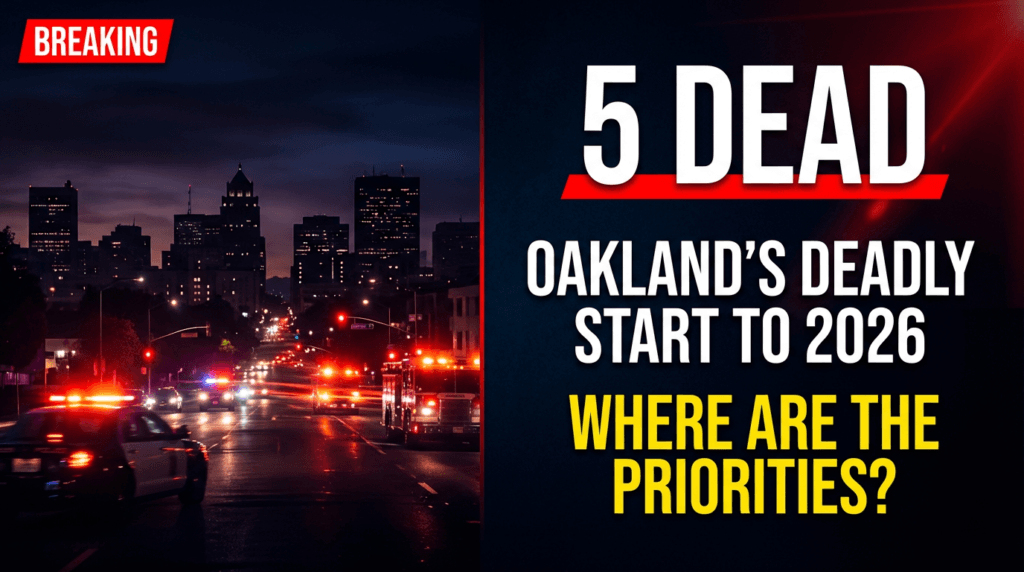
Oakland residents rang in 2026 with a grim reminder that despite celebrated crime reductions in 2025, violence remains a persistent threat in their community. Five people were killed in three separate shootings over just four days at the start of the new year—a stark contrast to the optimistic crime statistics city leaders touted just weeks earlier.
Yet as families mourned these victims and neighborhoods grappled with renewed fear, Oakland’s political leadership turned its attention elsewhere: joining Alameda County’s effort to create “ICE-free zones” and restrict federal immigration enforcement. The juxtaposition raises uncomfortable questions about priorities, resource allocation, and whether Oakland’s leaders are addressing the threats that matter most to residents.
The Tale of Two Oaklands: Progress and Persistent Danger
To understand Oakland’s current predicament, we must acknowledge both the progress made and the challenges that remain. In 2025, Oakland achieved its lowest homicide total in decades—67 deaths, including 57 classified as murders. This represented a 27% drop from 2024’s 82 homicides and a dramatic decline from the 125 homicides recorded in 2021.
Support Independent Local Journalism
TheTownHall.News is a non-profit reader-supported journalism. Just $5 helps us hire local reporters, investigate important issues, and hold public officials accountable across Alameda County. If you believe our community deserves strong, independent journalism, please consider donating $5 today to support our work.The city’s overall violent crime rate fell 25%, with robberies down 41%, firearm robberies cut in half, and carjackings reduced by 50%. Property crimes also declined significantly: burglaries dropped 19%, motor vehicle thefts plummeted 45%, and larceny fell 17%. By nearly every measurable metric, Oakland became safer in 2025.
City officials credited this improvement to targeted interventions like the Ceasefire program, community partnerships, and strategic policing. Mayor Sheng Thao and Police Chief Floyd Mitchell celebrated these achievements, arguing that investments in public safety were paying dividends.
Then came January 2026. Five homicides in four days shattered any illusion that Oakland had solved its crime problem. The victims’ names and stories received minimal attention as city leaders quickly pivoted to another issue entirely: immigration enforcement.
Misplaced Priorities: ICE Restrictions While Bodies Pile Up
As Oakland residents processed the new year’s violence, their elected officials were busy crafting policies to obstruct federal immigration authorities. Alameda County’s Board of Supervisors unanimously approved “ICE-free zones” that ban Immigration and Customs Enforcement agents from county-owned facilities—including jails where criminal suspects are held.

Oakland’s leadership enthusiastically supported this measure. Rather than convening emergency meetings about the spike in homicides or announcing new strategies to prevent further violence, city officials joined Berkeley and other jurisdictions in condemning ICE operations and promising to shield immigrants from federal enforcement.
The timing is jarring. Five families lost loved ones to violence in Oakland’s streets, yet the city’s political energy flowed toward protecting individuals in the country illegally—including those with criminal records—from federal authorities seeking to enforce immigration law.
This isn’t about lacking compassion for immigrants. It’s about the fundamental responsibility of local government: protecting residents from violence and ensuring public safety. When city leaders spend more time and political capital obstructing federal law enforcement than addressing the homicides in their own jurisdiction, they’ve lost the plot.
The Real Cost of Sanctuary Policies
Oakland’s embrace of sanctuary policies carries consequences that extend far beyond political symbolism. When local jails refuse to honor ICE detainer requests for individuals with criminal convictions, they’re making a choice to release those individuals back into Oakland’s neighborhoods rather than transferring them to federal custody.
According to Department of Homeland Security data, approximately 70% of ICE arrests involve individuals convicted of or charged with crimes in the United States. These aren’t families seeking opportunity being torn apart at traffic stops. These are individuals who have demonstrated criminal behavior beyond immigration violations—people convicted of assault, drug trafficking, sexual offenses, and violent crimes.
Support Independent Local Journalism
TheTownHall.News is a non-profit reader-supported journalism. Just $5 helps us hire local reporters, investigate important issues, and hold public officials accountable across Alameda County. If you believe our community deserves strong, independent journalism, please consider donating $5 today to support our work.Oakland’s decision to prioritize protecting these individuals from federal enforcement over protecting law-abiding residents from criminal violence represents a profound failure of governance. The victims of crimes committed by individuals released despite ICE detainers often come from the very communities sanctuary policies claim to protect.
Consider the logic: Oakland celebrates reducing homicides from 125 to 67 over four years—a reduction of 58 deaths. That’s genuine progress worth celebrating. But how many of those 67 victims might still be alive if the city had cooperated with federal authorities to remove criminal offenders from the community? How many of the five people killed in early January 2026 might have been spared if Oakland’s leaders prioritized public safety over political posturing?
We’ll never know, because Oakland doesn’t track or publicize data on crimes committed by individuals released despite ICE detainers. That’s not an accident—it’s a deliberate choice to avoid accountability for the consequences of sanctuary policies.
Budget Realities: Spending on Politics Instead of Protection
Oakland’s budget priorities tell a revealing story. The city’s FY 2025-2027 biennial budget totals $2.16 billion, with police and fire services consuming approximately 70% of the general fund—a higher percentage than most comparable cities. Despite this massive investment, the city set aside a record $72 million for police overtime over two years, acknowledging that existing resources remain insufficient to meet public safety demands.
Meanwhile, Oakland faces nearly $25 million in federal funding cuts in 2026, creating additional budget pressure. The city eliminated more than 400 mostly vacant positions in its recent budget, along with one police academy class, to balance the books.
In this constrained fiscal environment, every dollar and every hour of staff time matters. Yet Oakland’s leadership dedicates significant resources to developing and implementing sanctuary policies that actively hinder federal law enforcement operations. These policies don’t just fail to improve public safety—they make it harder for federal authorities to remove criminal offenders from Oakland’s streets.
The opportunity cost is staggering. Every hour city attorneys spend crafting legal frameworks to obstruct ICE is an hour not spent prosecuting violent criminals. Every dollar allocated to training city employees on sanctuary protocols is a dollar not invested in violence prevention programs. Every political meeting dedicated to expanding ICE restrictions is a meeting not focused on addressing the homicides that took five lives in four days.
Oakland residents deserve leaders who understand that public safety isn’t about virtue signaling—it’s about making hard choices that actually protect people from violence.
The Minneapolis Connection: Using Tragedy to Justify Overreach
Oakland’s renewed focus on restricting ICE enforcement didn’t emerge in a vacuum. It came in response to two controversial shootings involving federal immigration agents in Minneapolis: Renee Good, shot by an ICE agent on January 7, and Alex Pretti, shot by federal agents on January 25.
These incidents sparked nationwide outrage and calls for accountability. Berkeley’s City Council passed a resolution calling for abolishing ICE entirely. Oakland leaders joined the chorus, using the Minneapolis shootings as justification for expanding local sanctuary policies.
But here’s the problem: Oakland isn’t Minneapolis, and the appropriate response to alleged misconduct by federal agents isn’t to create blanket policies that prevent all immigration enforcement. If ICE agents acted improperly in Minneapolis, those individuals should face investigation and potential prosecution. That’s how accountability works in a nation of laws.
What Oakland is doing instead is exploiting tragedies in another state to justify policies that have nothing to do with preventing similar incidents and everything to do with nullifying federal immigration law. It’s political opportunism disguised as moral urgency.
Moreover, Oakland’s own track record on police accountability is hardly spotless. The city has faced numerous controversies over police use of force, officer misconduct, and inadequate oversight. Oakland leaders demanding the abolition of ICE while defending their own police department’s shortcomings represents a glaring double standard.
If the principle is that law enforcement agencies with problematic incidents should be abolished, Oakland would need to abolish its own police department. If the principle is that law enforcement agencies deserve due process and the opportunity to reform, then ICE deserves the same consideration.
What Oakland Really Needs: Law and Order, Not Political Theater
Oakland’s challenges are real and complex. Despite significant progress in 2025, the city still recorded 67 homicides—more than one per week. The five deaths that started 2026 demonstrate that progress remains fragile and reversible. Residents in Oakland’s most affected neighborhoods live with daily fear that violence could erupt at any moment.
These residents don’t need their elected officials spending time and resources on sanctuary policies. They need:
Sustained investment in proven violence reduction strategies. Programs like Ceasefire work, but they require consistent funding and implementation. Oakland’s budget cuts threaten to undermine the very programs that produced 2025’s improvements.
Cooperation with all law enforcement agencies. Public safety requires coordination between local, state, and federal authorities. When Oakland creates barriers to federal law enforcement, it doesn’t just affect immigration enforcement—it hampers collaboration on gang investigations, drug trafficking cases, and organized crime that crosses jurisdictional boundaries.
Honest accountability about sanctuary policy consequences. Oakland should track and publicize data on crimes committed by individuals released despite ICE detainers. Residents deserve to know whether sanctuary policies are making them safer or putting them at greater risk.
Political leaders who prioritize residents over ideology. Oakland’s elected officials should spend less time virtue signaling about immigration and more time addressing the violence that actually threatens their constituents. The five families mourning loved ones lost in early January deserved better.
The Broader Pattern: Progressive Cities Choosing Politics Over Safety
Oakland isn’t unique. Across California and the nation, progressive jurisdictions are expanding sanctuary policies even as they struggle with persistent crime challenges. San Francisco, Los Angeles, and numerous other cities have adopted similar approaches, creating a patchwork of local policies that undermine federal law enforcement and create safe havens for criminal offenders.
The pattern is consistent: celebrate crime reductions when they occur, blame systemic factors when crime spikes, and always, always prioritize protecting illegal immigrants—including those with criminal records—over cooperating with federal authorities.
This approach might win applause from progressive activists and sympathetic media outlets, but it fails the fundamental test of governance: protecting residents from harm. The proper role of local government isn’t to nullify federal law or engage in political theater. It’s to maintain order, enforce laws, and create conditions where families can live without fear of violence.
Oakland’s leaders have lost sight of this basic responsibility. They’ve chosen to make their city a battleground in the national immigration debate rather than focusing on the violence that actually threatens Oakland residents.
A Path Forward: Recommitting to Public Safety
Oakland can do better. The city’s progress in 2025 demonstrates that focused, evidence-based approaches to crime reduction work. But that progress will evaporate if leaders allow political ideology to override practical public safety priorities.
The path forward requires several concrete steps:
First, Oakland should reverse its opposition to ICE cooperation. The city doesn’t need to actively assist federal immigration enforcement, but it should stop actively obstructing it. When ICE requests custody of individuals with criminal convictions who are already in Oakland’s jail, the city should honor those requests. This costs Oakland nothing and removes dangerous individuals from the community.
Second, Oakland should redirect resources from sanctuary policy implementation to violence prevention. Every dollar and staff hour currently dedicated to obstructing federal law enforcement should be reallocated to programs that actually reduce crime.
Third, Oakland should demand transparency about sanctuary policy consequences. Residents deserve data on crimes committed by individuals released despite ICE detainers. Without this information, voters cannot make informed decisions about whether sanctuary policies serve their interests.
Fourth, Oakland’s leaders should recognize that law and order isn’t a partisan issue. Residents across the political spectrum want to live in safe communities. The five people killed in early January 2026 didn’t care about immigration politics—they wanted to survive. Oakland’s leaders owe them and all residents a single-minded focus on public safety.
Conclusion: Choose Safety, Not Symbolism
The contrast couldn’t be starker: five people dead in four days, and Oakland’s leaders focused on blocking ICE. This isn’t governance—it’s political malpractice.
Oakland residents deserve better than symbolic gestures that make progressive activists feel good while doing nothing to address actual threats to public safety. They deserve leaders who understand that protecting communities means enforcing all laws, cooperating with federal authorities, and prioritizing violence reduction over virtue signaling.
The progress Oakland achieved in 2025 demonstrates what’s possible when leaders focus on evidence-based public safety strategies. The five homicides that started 2026 demonstrate what happens when leaders take their eyes off the ball.
Oakland can continue down the path of expanding sanctuary policies and obstructing federal law enforcement, or it can recommit to the basic work of protecting residents from violence. It cannot do both.
The choice belongs to Oakland’s leaders, but the consequences will be borne by Oakland’s residents—particularly those in the communities most affected by violence. They deserve leaders who choose safety over symbolism, every single time.
Call to Action
If you’re an Oakland resident, your voice matters more than ever. Attend city council meetings and demand that your elected officials prioritize public safety over political theater. Ask specific questions about how sanctuary policies make your neighborhood safer and insist on data-driven answers.
Contact your city councilmember and the mayor’s office to express your views on ICE cooperation and public safety priorities. Elected officials respond to constituent pressure—but only if constituents actually apply it.
Support community organizations working on violence prevention and intervention. Programs like Ceasefire succeed when communities actively participate. Your involvement can save lives.
Finally, hold your local media accountable for how they cover these issues. When news outlets celebrate crime reductions without examining whether sanctuary policies undermine that progress, they’re failing their watchdog role. Demand comprehensive coverage that includes all relevant facts, not just those that fit a preferred narrative.
Oakland’s future depends on residents who refuse to accept political symbolism as a substitute for genuine public safety. The five people who lost their lives in early January 2026 can’t speak for themselves. Speak for them by demanding leaders who actually protect Oakland’s residents.
Your safety isn’t a political statement. It’s a fundamental right. Demand leaders who treat it that way.