Judge Hannah Dugan Convicted of Obstructing ICE Agents — Faces Up to 5 Years in Prison
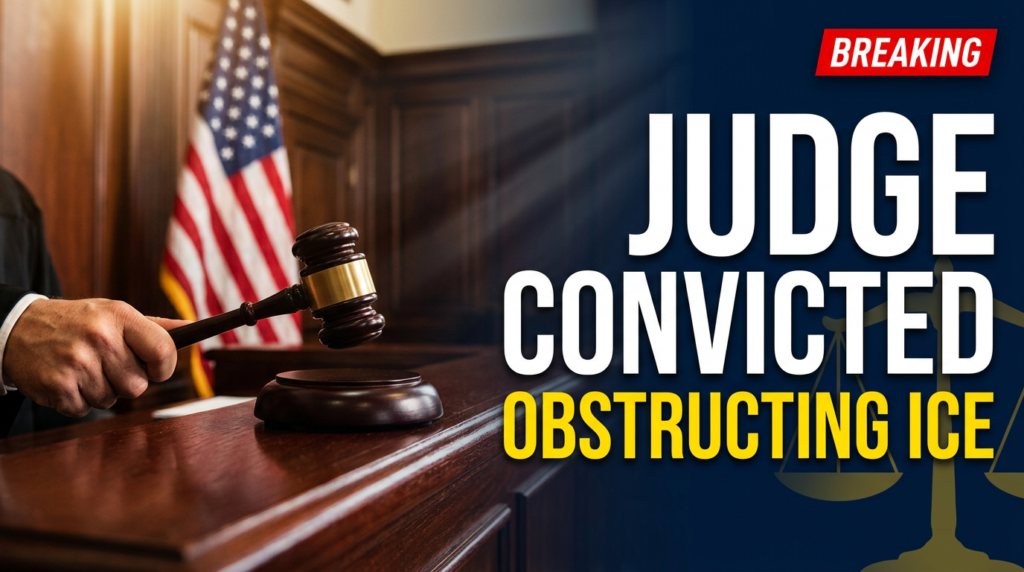
A sitting judge used the power of her courtroom to shield an illegal immigrant from federal arrest — and a federal jury said that’s a crime. The verdict isn’t just about one judge. It’s about whether the rule of law still means something in America.
When a judge walks into a courtroom, she wears the full authority of the state. She controls who speaks, who moves, and who faces justice. That power is a sacred public trust — not a personal tool to be weaponized based on political beliefs about immigration enforcement.
Milwaukee County Circuit Court Judge Hannah Dugan apparently forgot that. On April 18, 2025, she used that authority not to uphold the law, but to obstruct it — ushering an illegal immigrant out a private jury exit to help him evade a waiting team of federal agents. On December 19, 2025, a federal jury delivered its verdict: guilty. Her subsequent resignation has done nothing to erase the significance of what a jury of her peers confirmed. When a judge becomes an obstacle to federal law enforcement, the consequences must be real.
Support Independent Local Journalism
TheTownHall.News is a non-profit reader-supported journalism. Just $5 helps us hire local reporters, investigate important issues, and hold public officials accountable across Alameda County. If you believe our community deserves strong, independent journalism, please consider donating $5 today to support our work.What Actually Happened Inside That Milwaukee Courtroom
The facts of this case are not in dispute. Eduardo Flores-Ruiz, a Mexican national in the United States illegally and facing misdemeanor battery charges, appeared before Judge Dugan on April 18, 2025. Waiting for him were six federal officers — agents from the FBI, U.S. Immigration and Customs Enforcement, and the Drug Enforcement Agency — carrying an immigration arrest warrant.
According to an FBI affidavit, Dugan became “visibly angry” when she reviewed the type of warrant the agents had obtained. Rather than allowing federal law enforcement to proceed, she confronted the agents directly and directed them to report to the chief judge — a move that bought time. While agents were occupied, she led Flores-Ruiz and his attorney through a private exit typically reserved for jury members.
The plan failed. Agents caught Flores-Ruiz in the hallway. He was later convicted of illegal re-entry, sentenced to time served, and deported. But the incident exposed something deeply troubling: a sitting judge, from the bench, actively working to obstruct a federal arrest.
A federal grand jury indicted Dugan on two counts — obstructing a federal proceeding and concealing a person from arrest. The jury convicted her on the obstruction count. She faces up to five years in federal prison. Sentencing has not yet been scheduled.

Why This Verdict Matters Far Beyond Milwaukee
It would be convenient to dismiss this as an isolated incident involving one rogue judge in one city. That would be a mistake.
Dugan’s case reflects a pattern that has quietly spread across American institutions: public officials using their positions to nullify federal immigration law based on personal ideology. Sanctuary city policies. Local prosecutors declining to cooperate with ICE detainer requests. And now, a judge physically escorting a deportable immigrant through a back door while federal agents waited.
When elected or appointed officials decide which federal laws they will or won’t enforce, they don’t just break the law — they break the social contract that holds a constitutional republic together.
The Trump administration’s immigration enforcement push, aggressively deployed since January 2025, has sharpened this conflict. Supporters argue — with considerable legal merit — that enforcing immigration law is not optional. Immigration enforcement is a core executive function of the federal government. No state judge has the authority to unilaterally override it from the bench.
Deputy U.S. Attorney General Todd Blanche was direct after the verdict: “She betrayed her oath when she obstructed federal law enforcement during an immigration enforcement operation. Today, a federal jury of her peers found her guilty and sent a clear message: the American people respect law and order. Nobody is above the law.”
Support Independent Local Journalism
TheTownHall.News is a non-profit reader-supported journalism. Just $5 helps us hire local reporters, investigate important issues, and hold public officials accountable across Alameda County. If you believe our community deserves strong, independent journalism, please consider donating $5 today to support our work.The Consequences of Judicial Activism Gone Unchecked
There is a legitimate and important role for judicial independence in America. Courts must be free from political pressure when interpreting law and protecting constitutional rights. That independence is one of the republic’s greatest safeguards.
But judicial independence is not judicial immunity. It does not grant judges a license to personally intervene in law enforcement operations. It does not permit a judge to use her courtroom as a sanctuary. And it does not shield a public official from accountability when she takes deliberate, physical action to obstruct a federal arrest.
When judges face no consequences for this kind of conduct, the message to every other official in the country is clear: ideological motivation is a valid excuse to disregard federal law. That is not a precedent any serious democracy should be willing to set.
Facing impeachment by Wisconsin Republicans and the weight of a federal felony conviction, Dugan resigned her judgeship on January 3, 2026. In her resignation letter to Governor Tony Evers, she framed her departure as an act of civic responsibility — allowing Milwaukee County to “start the year with a judge on the bench.” Her legal team simultaneously announced they would appeal the conviction, maintaining she “did nothing wrong.”
The partial verdict — not guilty on the concealment charge — gives her defense team a foothold. But the core obstruction conviction stands. And for the families of crime victims, for the federal officers who were physically redirected from doing their jobs, and for every American who believes that no one — not even a judge — sits above the law, that conviction matters.
What the Critics Get Wrong
Defenders of Judge Dugan have argued that she was simply concerned about due process — that the type of warrant presented by agents was procedurally improper, and that she was acting to protect a defendant’s rights.
This argument has surface appeal but ultimately fails on the facts. Dugan’s own frustration with the warrant was the stated reason she sent agents to the chief judge. But the solution to a disputed warrant is a legal challenge — filed in court, argued by counsel, decided by a judge. The solution is not for the presiding judge to personally escort the target of that warrant out a side door.
Due process is a shield for defendants in legal proceedings. It is not authorization for a judge to physically obstruct a federal arrest operation. The two are categorically different. Conflating them obscures the real issue: Dugan made a unilateral decision that her view of immigration enforcement outweighed federal law, and she acted on it from the bench.
Furthermore, the immigrant she helped had a history of battery charges and had entered the country illegally. This was not a sympathetic victim of bureaucratic overreach. This was a case of a judge placing her political beliefs above her legal obligations — and a federal jury agreed.
The Broader Stakes: Accountability Starts at the Top
The rule of law is not self-enforcing. It depends on the people entrusted with its administration choosing, every day, to honor their oath over their ideology. When those at the top of our legal system abandon that standard, every layer beneath it weakens.
Prosecutors who selectively enforce. Mayors who declare their cities off-limits to federal agents. Judges who direct defendants out back doors. Each individual act may seem small. Cumulatively, they represent something more serious: the gradual hollowing out of a legal framework that took centuries to build.
A functioning republic cannot survive if its officers treat federal law as a buffet — picking what they like and discarding the rest.
The Hannah Dugan verdict is a necessary and important moment. Not because it satisfies partisan grievances, but because it affirms something foundational: that accountability applies equally, regardless of title, party, or ideology. That a black robe does not exempt anyone from the consequences of willfully obstructing justice.
Sentencing is still to come. Whatever that sentence is, it will send a signal — either that judicial misconduct carries real weight, or that it does not. Americans who believe in law and order, personal accountability, and the equal application of justice should be watching closely.
Key Takeaway
A federal jury found Judge Hannah Dugan guilty of obstruction for physically helping an illegal immigrant evade federal arrest. She resigned under threat of impeachment. She faces up to five years in prison. The case is a defining test of whether the rule of law applies equally to everyone — including the people sworn to uphold it.
Stay Informed. Stay Engaged.
This case is not over. Sentencing is pending, an appeal has been filed, and its legal and political ripple effects are still unfolding. Share this article to keep the conversation going — an informed public is the most powerful check on government misconduct of any kind. Follow our coverage for updates as this story develops.