UAE Leaves OPEC After 60 Years: What It Really Means for Oil Prices and the Dollar
The biggest defection in OPEC’s history just happened. What it means for oil prices, American families, and the future of energy freedom is far more complicated — and consequential — than viral social media posts are letting on.
A Seismic Shift Nobody Saw Coming — Until Now
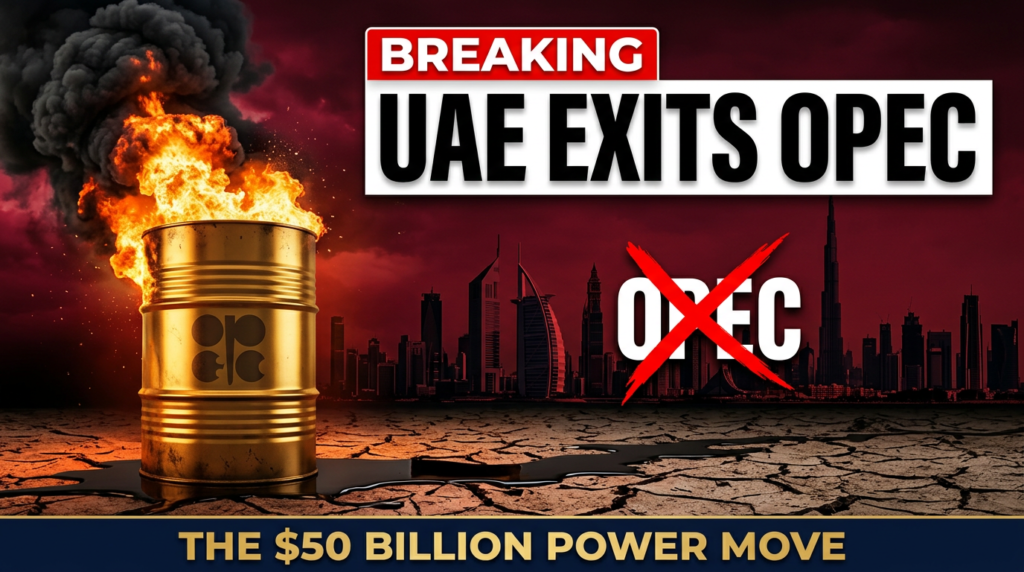
On April 28, 2026, the United Arab Emirates announced it will withdraw from OPEC effective May 1 — ending a membership that stretches back more than six decades. It is, without question, the most significant defection in the cartel’s history.
The UAE is OPEC’s third-largest producer. Its departure doesn’t just weaken the group numerically — it strikes at the very premise that a handful of governments should be able to dictate the price of the world’s most essential commodity. For Americans paying elevated energy bills, watching inflation erode their savings, and demanding accountability from institutions that shape their daily lives, this moment deserves serious attention — not just viral headlines.
Support Independent Local Journalism
TheTownHall.News is a non-profit reader-supported journalism. Just $5 helps us hire local reporters, investigate important issues, and hold public officials accountable across Alameda County. If you believe our community deserves strong, independent journalism, please consider donating $5 today to support our work.Why the UAE Walked Away
This didn’t happen overnight. The exit is the culmination of years of simmering tensions between Abu Dhabi and OPEC’s de facto leader, Saudi Arabia. The disputes have centered on production baselines, regional political rivalries, and fundamentally different visions for the future of Gulf energy policy.
The Abu Dhabi National Oil Company (ADNOC) has been aggressively expanding capacity, targeting five million barrels per day by 2027 — well above the quota OPEC had assigned it. Researchers at Rice University’s Baker Institute estimated that unconstrained production could generate the UAE more than $50 billion in additional annual revenues. Put simply: the UAE was being penalized for its own efficiency and ambition.
UAE Energy Minister Suhail Al Mazrouei said the disruption caused by the ongoing Iran conflict created what he described as an “opportune moment” for the move. The cartel, already under strain, has now lost its most economically dynamic member at the worst possible time.
“You can’t build a free energy market while a cartel of governments votes on how much of it you’re allowed to sell.”
What Critics Get Wrong About This Being a ‘Windfall’
Social media has been flooded with a simple, seductive chain: UAE leaves OPEC → more oil → cheaper prices → lower inflation → money printing → Bitcoin to the moon. It’s clean, shareable — and dangerously incomplete.

The reality is more sobering. Brent crude has already surged past $100 per barrel, driven not by OPEC quotas but by the Iran war choking the Strait of Hormuz — the narrow waterway through which roughly 20% of the world’s crude oil and liquefied natural gas normally passes. Iran’s threats to the strait are a physical constraint on supply that no production decision in Abu Dhabi can immediately fix.
BP’s profits more than doubled in the latest reporting period, directly attributable to war-driven energy prices. That profit surge is, in effect, a tax on every American family filling a gas tank or paying a utility bill. ADNOC pumping at full capacity is months away from delivering any real price relief — and that assumes the Hormuz situation stabilizes first.
Anyone telling you this is straightforwardly bullish for consumer prices right now is selling you a bumper sticker, not analysis.
The Petrodollar Problem Washington Doesn’t Want to Discuss
Here is where the story gets genuinely significant for anyone who believes in fiscal accountability and the long-term health of the U.S. economy.
The dollar’s share of global foreign exchange reserves has fallen to approximately 57% — a 25-year low, down from a peak of 72% in 2001. The petrodollar system — the arrangement under which oil is priced and traded in U.S. dollars, creating structural global demand for American currency — is quietly fraying at the edges.
Support Independent Local Journalism
TheTownHall.News is a non-profit reader-supported journalism. Just $5 helps us hire local reporters, investigate important issues, and hold public officials accountable across Alameda County. If you believe our community deserves strong, independent journalism, please consider donating $5 today to support our work.The UAE has already floated the idea of pricing some oil transactions in Chinese yuan should dollar liquidity tighten. Iran is accepting Bitcoin as payment for Hormuz tolls and selling increasing volumes of oil to China in yuan. India is reportedly exploring yuan-denominated purchases of Iranian crude. Deutsche Bank economists have warned that the current conflict is strengthening Iran-China economic ties and “could be remembered as a key catalyst for the erosion of petrodollar dominance.”
Meanwhile, Treasury Secretary Scott Bessent defended a $20 billion emergency dollar swap line for Abu Dhabi before a Senate appropriations subcommittee just days before the UAE’s OPEC exit was announced. Gulf sovereign wealth funds still hold more than $2 trillion invested in U.S. assets, and Gulf currencies remain pegged to the dollar — requiring an estimated $800 billion in supporting reserves. The relationship is deep, but it is no longer unconditional.
For citizens who believe in limited government and sound money, this is the real fiscal alarm bell — not the price of oil next week.
“When the dollar loses its grip on global energy markets, every American pays the price — in ways they never see on a receipt.”
The Case for Energy Freedom — Properly Understood
There is a legitimate, principled argument to be made from the UAE’s departure. OPEC is, at its core, a price-fixing cartel. It is a consortium of governments that collectively restricts production to keep prices artificially elevated — a mechanism that transfers wealth from consumers and productive economies to state-controlled energy monopolies. The UAE walking away from that system in favor of what its leadership called its “national interest” reflects a market logic that conservatives and free-market advocates should recognize.
The principle is straightforward: producers should be free to produce, and markets — not committees of government ministers — should set prices. That principle, applied consistently, leads to greater energy abundance, lower costs for families, and less geopolitical leverage for hostile regimes that depend on inflated oil revenues to fund their governments.
The problem is that we are in the middle of a war that has temporarily severed the market’s ability to absorb new supply. The principle is sound; the timing is complicated.
The Counterargument: Stability Over Freedom?
Some energy analysts and foreign policy voices will argue that OPEC, for all its flaws, provided a measure of market stability that benefited long-term investment planning — including for American energy companies with operations throughout the Gulf. They will argue that a fractured OPEC creates unpredictable price swings that are ultimately bad for consumers and businesses alike.
That is a fair observation as far as it goes. But stability engineered by a cartel is not the same as stability earned through competitive markets. History shows repeatedly that production cartels serve the interests of the governments running them — not the families and businesses on the receiving end of their pricing decisions. The instability we are seeing now is not caused by the UAE’s departure; it is caused by a war and a geopolitical crisis that OPEC’s price management did nothing to prevent.
What Comes Next — And Why You Should Be Paying Attention
The UAE’s exit from OPEC is not the end of the story. It is the opening act of a broader realignment in global energy that will play out over the next several years. The questions it raises are ones that every informed citizen should be tracking.
Will other producers — Kuwait, Iraq, others who have chafed under Saudi-imposed quotas — follow the UAE’s lead? Will the petrodollar system hold, or will the yuan’s quiet advance in energy markets accelerate? Will the United States use this moment to double down on domestic energy production and insulate American families from foreign market shocks? And will Washington be honest with the public about the fiscal risks of a weakening dollar’s global role?
These are not abstract economic questions. They will shape energy costs, inflation, and the purchasing power of every American household in the years ahead. They deserve coverage that goes beyond viral infographics and actually engages with the complexity.
The Takeaway
The UAE leaving OPEC is historic, consequential, and genuinely important. But the full picture is more nuanced than a social media post can contain. Oil prices are not falling — they are above $100 a barrel because of a war. Relief from UAE production is months away at best. The deeper story is about the slow erosion of dollar dominance in global energy markets and what that means for American fiscal stability.
A free market in energy is a worthy goal. Getting there requires honest analysis — not just optimism dressed up as economics.
Stay Informed. Stay Engaged.
If this article gave you a clearer picture of a story the headlines are oversimplifying, share it. Independent, fact-grounded journalism depends on readers who demand more than talking points. Follow the energy story. Engage your elected representatives on domestic production and dollar policy. And the next time a viral post promises a simple chain of cause and effect — ask who benefits from keeping it simple.