Hayward’s “Electrification” Pivot: Salinas and the Council Quietly Rewrote the Rules, and Contractors and Homeowners Will Foot the Bill
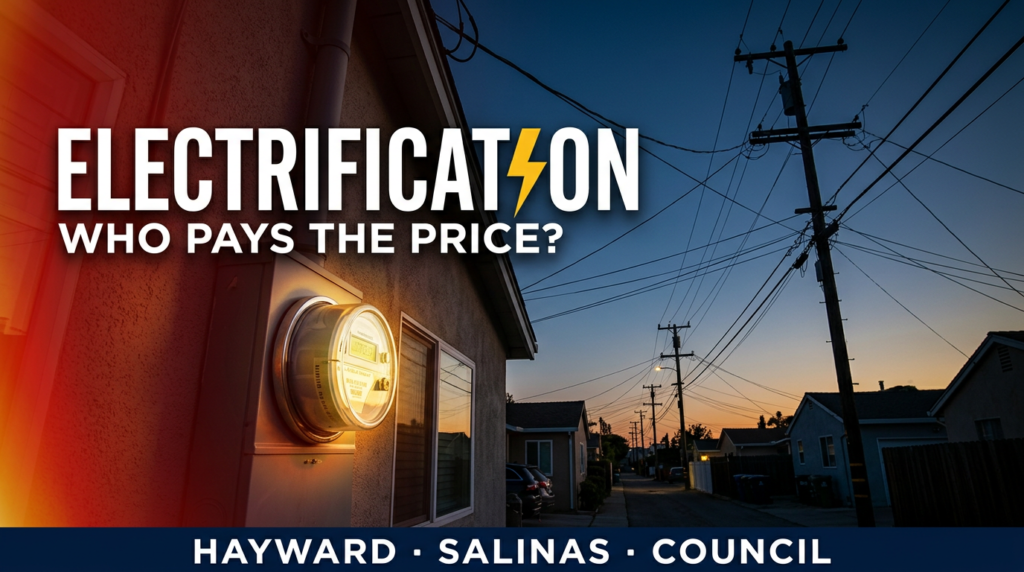
Hayward Mayor Mark Salinas and the City Council are again pushing climate policy through City Hall in the most familiar way possible: big moral language, vague accountability, and real-world costs that land on the people least able to absorb them.
This time it’s the City’s revised “electrification reach code,” tied to the incoming 2025 California Building Standards Code. The Council introduced revised local rules that will shape what future construction and major remodels must install, pre-wire, or “get ready” for, with knock-on effects for contractors, landlords, and homeowners trying to budget for repairs in an already expensive market.
If you listen to the sales pitch, it sounds like a tidy modernization plan. Read the staff paper trail, and what you see is something else: a government trying to keep its climate brand intact after legal and state-level headwinds, while shifting new compliance chores into the permitting process.
Support Independent Local Journalism
TheTownHall.News is a non-profit reader-supported journalism. Just $5 helps us hire local reporters, investigate important issues, and hold public officials accountable across Alameda County. If you believe our community deserves strong, independent journalism, please consider donating $5 today to support our work.The political reality: the city backed off all-electric, but still wants to force the wiring
Here’s the part voters should understand. Staff explicitly says it is not recommending adoption of any reach codes for new construction, citing the 2025 state code and a newer state law (AB 130). It also notes the city stopped enforcing prohibitions on natural gas infrastructure in new residential construction in January 2024 after a major court ruling related to Berkeley’s gas ban.
So the big “electrification” headline is shrinking in real time.
Instead of mandating all-electric new builds, Hayward is pushing an “Electric Readiness” approach, aimed at existing single-family homes doing “major additions and alterations.” In plain language: you can keep your gas appliances for now, but the city wants your remodel to include the electrical backbone to electrify later.
That might sound modest. It is not modest if you are the person paying the electrician.

What the revised reach code actually does: permit-triggered requirements for remodels
The staff report describes an Electric Readiness reach code designed to reduce future retrofit costs by requiring pre-work during major remodels. That means reserved breaker space and wiring or outlets near gas appliances so that, later, you can swap gas for electric without ripping your walls open.
The city is specifically talking about readiness for:
- cooking
- water heating
- clothes drying
- outdoor appliances
This is how compliance grows. Not by one dramatic ban, but by layers of “preparation” that become de facto mandates over time.
The permitting trigger is important: these requirements would apply when you pull permits for major additions and alterations. The city is turning the building counter into an enforcement gate, the same way it does with countless other policy goals.
And while staff says it wants a code “straightforward and simple to enforce” to minimize staff workflow impacts, that is a tell in itself. City Hall is designing this to be easy for government and costly for residents. That’s the pattern.
Support Independent Local Journalism
TheTownHall.News is a non-profit reader-supported journalism. Just $5 helps us hire local reporters, investigate important issues, and hold public officials accountable across Alameda County. If you believe our community deserves strong, independent journalism, please consider donating $5 today to support our work.The cost story: “low incremental costs” that can still run $1,000 at a time
This is where the Mayor and Council will try to reassure the public. Staff provides rough cost estimates and claims the incremental costs are low compared to a major remodel.
But “incremental” is doing a lot of work here.
Staff’s own estimates include:
- reserving breaker space: $0–$50
- running a new dedicated circuit: up to $1,000 per circuit
- adding conduit: up to $1,000
If you are a homeowner doing a permitted remodel and you get hit with multiple circuits, conduit, panel work, and the usual Bay Area labor rates, the “low incremental cost” framing starts to look like political spin.
Contractors and property owners know what happens next: design changes, plan checks, revisions, delays, inspections, and compliance costs that rarely match the optimistic staff memo.
And landlords will not absorb those costs out of kindness. They will push them into rents, renovation budgets, or deferred maintenance elsewhere. Renters will feel it even if the ordinance never mentions them.
Who pays, who benefits
This policy has a clear distribution of costs and benefits, and City Hall is not honest about it.
Those who bear the costs:
- Homeowners doing major additions or alterations, who must pay for extra electrical readiness work up front.
- Contractors who must redesign scopes, navigate permitting, and explain to clients why the city is requiring work that does not visibly improve the remodel today.
- Landlords who will face higher compliance costs on permitted renovations, and will pass those costs along.
- Small, local trades that get squeezed between city demands and client budgets.
Those who benefit:
- City Hall and its climate coalition, politically, because they get to claim continued “electrification progress” without legally risky all-electric mandates.
- Future electrification advocates, because readiness requirements can quietly lock in the infrastructure for later appliance mandates or incentives.
- Government staff workflows, explicitly, because staff is aiming for a simple enforcement mechanism tied to permits.
If you want to call this what it is, it’s a regulatory ratchet. Each step makes the next step easier, while the public is told each step is small.
What changed from staff’s recommendation during the meeting?
The honest answer is: we cannot confirm from the staff report alone. Your follow-up requires the meeting minutes and video to verify whether Council members amended the proposal, added direction, or pushed beyond staff’s “do not recommend reach codes for new construction” posture.
What we should pull from minutes/video to answer this definitively:
- Did the Mayor or Councilmembers pressure staff to expand reach codes beyond EV charging and remodel readiness?
- Did anyone propose going further than staff recommended, especially on new construction?
- Did Council set a firm timeline for returning with a final ordinance, or broaden enforcement triggers?
- Did Councilmembers acknowledge the legal constraints and the 2024 enforcement stop, or try to talk past them?
If you share the agenda item link or minutes, we can produce a clean “staff asked vs Council did” comparison.
What deadlines and metrics should watchdogs track next
The staff report gives several hard dates and stated goals worth pinning down.
Deadlines and timeline triggers:
- December 31, 2025: the current reach code expires.
- January 1, 2026: the 2025 California Building Standards Code takes effect.
- Staff anticipated returning to the committee with more information in November 2025 or January 2026 after further research and outreach.
Metrics the city will cite (and you should challenge):
- greenhouse gas reduction targets: 30% below 2005 by 2025, 55% below 2005 by 2030, and carbon neutrality by 2045.
Real-world performance metrics to demand (not just slogans):
- number of permits triggering the readiness requirements
- average incremental cost per project (actuals, not estimates)
- permit processing time impacts and inspection backlog impacts
- compliance rates and the number of exceptions/appeals
- measurable electrification outcomes over time (actual appliance conversions, not just “ready” wiring)
Because if the Mayor and Council cannot show outcomes, then this is not climate progress. It is paperwork and cost-shifting dressed up as virtue.
The bottom line
Mayor Salinas and the City Council want the political benefits of electrification without the legal risk of an outright ban, so they are moving policy downstream into remodel permitting through “Electric Readiness.” It’s framed as low-cost and commonsense, but it functions as a quiet mandate that forces private property owners to pre-pay for a future the city’s activists want.
The biggest question is not whether electrification is good or bad in the abstract. The question is whether Hayward’s leaders can be trusted to impose new compliance costs fairly, transparently, and with measurable results.
Given the city’s pattern, residents should assume the answer is no until proven otherwise.
Sources
- City of Hayward (Legistar attachment), ACT 25-053 – Attachment I Staff Report (Revised Electrification Reach Code; 2025 California Building Standards Code timeline; EV charging and electric readiness approach): https://hayward.legistar.com/View.ashx?M=F&ID=14753644&GUID=2600169B-7DB2-406E-99C3-16B051C90DB2