Hayward’s Sidewalk Shake-Down: Salinas and the Council Just Shifted Liability to Homeowners, Then Tossed in a $30,000 “Hardship” Fig Leaf
Hayward’s Mayor Mark Salinas and the City Council just pulled off one of local government’s favorite tricks: create a bigger legal burden for residents, then advertise a tiny relief program as if it solves the problem.
On November 18, 2025, the Council adopted an ordinance “clarifying” responsibility for sidewalk maintenance and repair. But read the actual language and the message is blunt: the city is formalizing a system that treats damaged sidewalks as a public nuisance and makes the property owner the responsible party for fixing it, paying for it, and absorbing the liability if someone gets hurt.
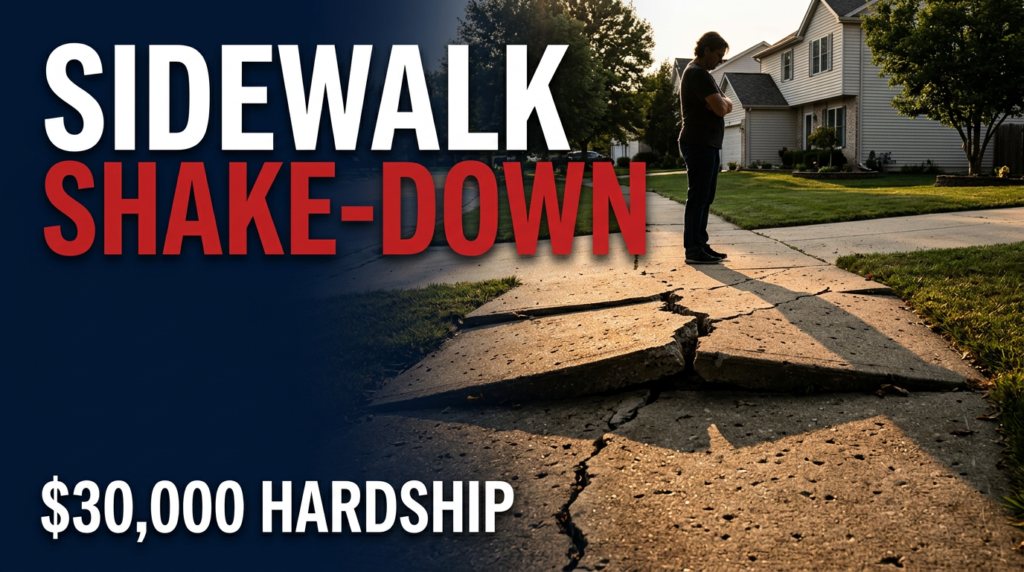
Then, to soften the blow, the Council set aside $30,000 for a so-called Sidewalk Repair Financial Hardship Program.
Support Independent Local Journalism
TheTownHall.News is a non-profit reader-supported journalism. Just $5 helps us hire local reporters, investigate important issues, and hold public officials accountable across Alameda County. If you believe our community deserves strong, independent journalism, please consider donating $5 today to support our work.Thirty thousand dollars.
In a city with tens of thousands of parcels, aging concrete, tree-root damage, and real injury liability exposure, $30,000 is not a safety net. It is a press-release budget.
The ordinance: “Your sidewalk is your problem,” and the city disclaims responsibility
The new ordinance (Ordinance No. 25-11) amends Hayward Municipal Code Chapter 7, Article 2 and spells out what the Council wants enforced going forward.
First, it declares that damaged sidewalks “reduce the value of private property,” “promote blight,” “endanger persons,” and interfere with public convenience. Then it labels unrepaired sidewalks abutting private property a public nuisance.

And the key move is the “Responsible Person” definition: the property owner is the responsible party.
The ordinance states the responsible person “shall owe a duty to members of the public to keep and maintain the sidewalk adjacent to the premises in a safe and non-dangerous condition.” This includes grinding, removal and replacement, curb and gutter repairs, and getting permits.
Then comes the liability hammer.
If an injured person can tie harm to the owner’s failure to maintain the sidewalk, “the Responsible Person shall be liable” for resulting damages. It also states failure to maintain “shall constitute negligence” and a public nuisance.
And the city’s position is equally clear: “The City shall not be liable for any injury caused by the negligence of the Responsible Person.”
Support Independent Local Journalism
TheTownHall.News is a non-profit reader-supported journalism. Just $5 helps us hire local reporters, investigate important issues, and hold public officials accountable across Alameda County. If you believe our community deserves strong, independent journalism, please consider donating $5 today to support our work.This is the political sleight of hand. The city controls the public right-of-way, but it is telling residents: you will pay to keep it safe, and if it is not safe, you will be the one sued.
The enforcement mechanism: fix it in four weeks, or the city fixes it and liens your property
The ordinance establishes a formal notice-and-lien process that looks a lot like a collection pipeline.
If the city decides a sidewalk is dangerous and you do not fix it, staff can notify you and require the work to start within four weeks after the notice is given and be “diligently completed.”
If the repair is not done, the enforcement officer can cause the repair to be made and bill the responsible person. The bill becomes due and payable 30 days later.
If unpaid, the cost becomes part of an annual assessment process, confirmed by Council resolution, and becomes a lien against the property. That lien can be collected “in the same manner as ordinary City taxes” and is subject to penalties and interest, with the same foreclosure and sale procedure as delinquent taxes.
That is not just “clarifying responsibility.” That is codifying financial pressure.
The “hardship” program: a $30,000 band-aid for a citywide liability shift
The Council also passed a resolution appropriating $30,000 from Fund 450, the Street System Improvement Fund, to establish a Sidewalk Repair Financial Hardship Program.
The resolution cites that at least 23% of owner-occupied units in Hayward are considered low-income households. And it references Council direction from the October 28, 2025 meeting to create a program to encourage and enable low-income property owners to repair damaged sidewalks.
But here is what is striking: the hardship resolution, as written, is essentially a funding authorization. It does not spell out eligibility, caps, or how many residents it will actually help.
In a city where a single concrete repair can easily run thousands of dollars, $30,000 could disappear after a handful of projects.
So what is the program really doing? It gives political cover.
It allows the Mayor and Council to say, “We’re helping low-income homeowners,” while implementing an ordinance that shifts duty, risk, and potential lawsuit exposure onto property owners across the city.
Who pays and who benefits
This ordinance creates clear winners and losers.
Homeowners pay in direct repair costs, permit compliance, and legal exposure. Renters do not technically “own” the duty, but they still pay when landlords pass along costs through higher rents or deferred property maintenance. Disabled residents pay when sidewalks remain broken or repairs are delayed, because accessibility and safety become a private financial negotiation rather than a public infrastructure standard.
And if someone is injured, the financial hit is not theoretical. The ordinance explicitly places liability onto the property owner for injuries tied to failure to maintain.
Neighborhoods with older infrastructure and more sidewalk damage bear the greatest practical burden. Areas with aggressive tree-root uplift, drainage problems, or higher pedestrian traffic will see more notices and more financial strain.
Who benefits?
City Hall benefits by reducing its exposure and pushing responsibility outward. The city also benefits by having a built-in enforcement and collection process that ends in liens and tax-roll collection.
And politically, the Mayor and Council benefit by getting to claim they are “fighting blight” while sidestepping the core truth: they are offloading costs and risks onto residents.
What changed during the meeting? The public deserves the receipts
The ordinance text confirms the final vote: unanimous approval, with Salinas and the full Council voting yes.
But your most important watchdog question still stands: what changed from staff’s recommendation during the meeting?
That cannot be responsibly answered from the ordinance text alone. We need the minutes and video to confirm:
- Did Council add the hardship appropriation at the dais, or was it in the staff packet as presented?
- Did Council narrow or expand enforcement timelines or cost-sharing language?
- Did any member discuss how many households $30,000 would realistically cover?
- Did anyone raise concerns about liability and insurance impacts for homeowners?
This is exactly the kind of item where the dais discussion matters more than the polished final language.
What deadlines and performance metrics should be checked next
Even without the minutes, the ordinance itself gives several obvious watchdog checkpoints:
- Notice compliance clock: repairs must be commenced within four weeks of notice.
- Billing clock: city-initiated repairs become due 30 days after billing.
- Annual assessment pipeline: staff prepares an annual report and assessment list; Council holds a confirmation hearing; unpaid costs become liens.
- Tax roll collection: liens can be collected like ordinary city taxes, with penalties, interest, and foreclosure procedures.
And for the hardship program, the big metric is simple: how many households were helped, and what was the average award.
If the city helps five or ten households and declares success, that is not success. That is rationing relief while enforcing a citywide shift of duty and liability.
The bottom line
Mayor Salinas and the City Council adopted a sidewalk ordinance that makes property owners the primary backstop for public walkway safety. It treats damaged sidewalks as a nuisance, imposes an enforcement and lien pathway, and shifts injury liability toward residents.
Then they tried to make the policy look compassionate with a $30,000 hardship fund that, as written, is too small to meet the scale of the problem.
This is how local government avoids hard infrastructure spending: it turns public maintenance into private obligation, backed by notices, liens, and legal risk.
If the Council wants to be honest, it should call this what it is: not “clarification,” but a transfer of responsibility from City Hall to the homeowner.