Before You Vote Yes on Hayward Measure G, Here’s What HUSD Isn’t Telling You
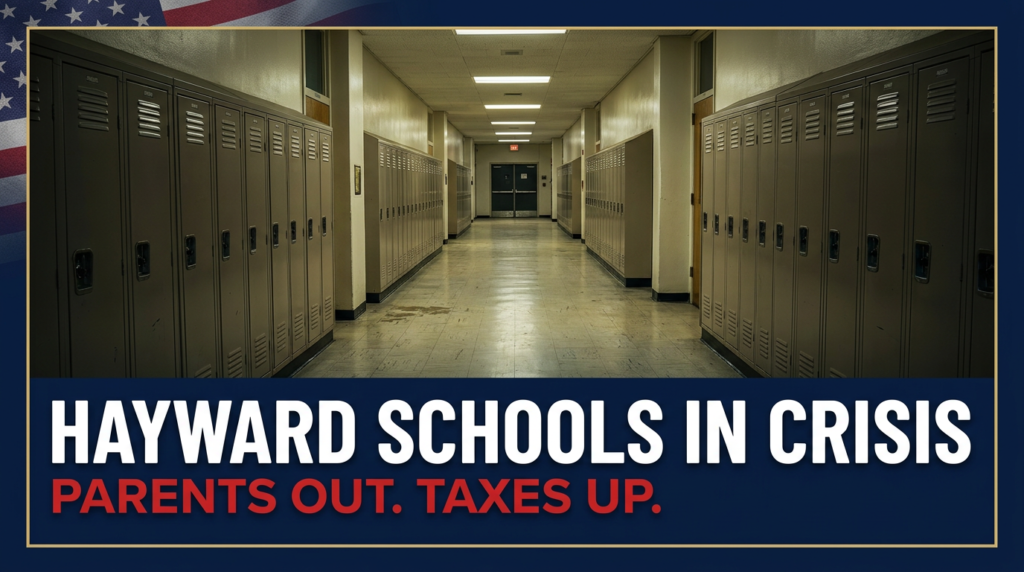
Hayward Unified has lost thousands of students, mismanaged millions in funding, and fractured publicly at the board level. Now it wants your property tax dollars. Voters should ask why before they write the check.
This June, Hayward residents will be asked to pass Measure G — a $98-per-parcel annual tax on property owners designed to shore up a school district hemorrhaging students and cash. Before you vote, you deserve the full picture of how Hayward Unified School District got here — and whether the people asking for more of your money have earned that trust.
The short answer is: they haven’t. Not yet.
Support Independent Local Journalism
TheTownHall.News is a non-profit reader-supported journalism. Just $5 helps us hire local reporters, investigate important issues, and hold public officials accountable across Alameda County. If you believe our community deserves strong, independent journalism, please consider donating $5 today to support our work.The Enrollment Freefall Hitting Hayward’s Budget
To understand Hayward’s fiscal crisis, start with California’s. The state’s Department of Education just reported that public school enrollment fell by nearly 75,000 students in the 2025–26 school year — the steepest single-year drop since the pandemic, and seven times worse than the 10,000-student decline state planners had forecast.
Hayward Unified is not insulated from that trend. It is one of its casualties.
California funds public schools on a per-pupil basis. Every student who walks out the door takes a proportional share of state funding with them. For HUSD, that math is brutal. The district’s own Fiscal Stability Plan projects a further decline of nearly 620,000 enrollment units statewide over the next decade — a trajectory that will continue squeezing district budgets regardless of local decisions.
But here’s what the district won’t lead with: enrollment decline explains the scale of HUSD’s financial problem. It does not explain the mismanagement that made the district so financially fragile when the decline arrived.

Years of Mismanagement, Now Coming Due
HUSD’s financial distress is not purely a victim-of-circumstances story. At the February 11, 2026 board meeting — a meeting that ran past midnight — Trustee Sara Prada said what many in the community have long suspected: “There’s a hard decision for HUSD almost every year because of mismanagement of funding. We need to do better.”
That is not an outside critic talking. That is a sitting board trustee describing her own district’s track record.
The district is now navigating the simultaneous loss of multiple funding streams. Federal grants that supported Hayward Promise Neighborhood programming ended abruptly due to decisions at the federal level — funding the district had built staffing structures around without adequate contingency planning. COVID-era relief dollars have expired. State budget pressures are tightening. And enrollment-driven revenue continues to fall.
The result is a district forced to make painful cuts: Social-Emotional Counselors, Community School Specialists, support staff for English Language Learners, and positions serving newly arrived refugee students — some of the most vulnerable children in the district — are all on the chopping block.
Selling the Building Instead of Fixing the Problem
One of HUSD’s most controversial responses to its fiscal crisis is the proposed closure and sale of Faith Ringgold School of Arts and Science. The district frames this as a necessary step toward financial stability. Parents and advocates frame it as a betrayal.
Support Independent Local Journalism
TheTownHall.News is a non-profit reader-supported journalism. Just $5 helps us hire local reporters, investigate important issues, and hold public officials accountable across Alameda County. If you believe our community deserves strong, independent journalism, please consider donating $5 today to support our work.Critics have raised serious concerns: that the sale process bypassed required environmental review, that disabled students who rely on Faith Ringgold’s specialized environment have been left without a clear placement plan, and that the community was not meaningfully consulted before decisions were effectively made.
The district is also looking to reorganize middle schools to include grades 6–8 — a move that would free up roughly 40 classrooms for growing TK and preschool programs. Administratively, that makes sense. But trustee Bruckner-Carrillo and others have raised concerns about whether site teams are being asked to absorb more operational load at the exact moment their support staff is being cut.
Selling buildings and reshuffling grades are the actions of a district managing decline — not reversing it.
The Parcel Tax: Who Pays, and Who Benefits?
Measure G asks Hayward property owners to pay $98 per parcel annually to fund district operations. It requires a two-thirds supermajority — roughly 67% approval — to pass in the June 2026 election.
Here is what the district’s own polling revealed: the only tax structure that polled above the 67% threshold was a lower flat-rate tax with a shorter term. Even then, the consulting firm hired by HUSD acknowledged the survey was conducted on a sample of likely voters that was not fully representative of the district’s actual population.
That matters because of a fundamental mismatch at the heart of this measure: most HUSD families are renters. The tax falls on property owners and landlords — many of whom do not have children in district schools — while the families whose children directly benefit largely won’t be paying it. One public commenter at the February meeting made exactly this point and recommended the district engage renter families to help build support for the measure rather than simply polling property-owning likely voters.
Fiscal accountability means asking hard questions before the vote. Is the district making the structural changes that justify new investment? Or is the tax a bridge to a next fiscal crisis without the reforms that would prevent one?
A Board That Can’t Agree at Midnight
Perhaps the most troubling element of HUSD’s current situation is not the budget numbers — it’s the governance.
The February 11th meeting is instructive. Trustees openly clashed over whether the Fiscal Solvency Plan was ready for a vote. Trustee Bruckner-Carrillo called the plan “not well-thought-out” and said he would not vote for it in its current form. Trustee Prada said the same. Board President Bufete accused both of “grandstanding” and warned against committing to changes without more information.
Meanwhile, the cuts in question — affecting counselors, specialists, and grant-funded community support roles — were left unresolved past midnight, with Superintendent Chen Wu-Fernandez reminding the board that some direction was actually needed. “Do we need to give direction on this item?” Trustee Oquenda asked — apparently genuinely uncertain.
A board that can’t agree at midnight on what to cut has no business asking residents to fund more at noon.
This is not ideological disagreement. It is a functional governance problem. And it is the environment in which Measure G is being presented to voters.
What Critics of This Coverage Get Wrong
To be fair: declining enrollment is a genuine structural challenge facing school districts across California and the nation. HUSD is not uniquely irresponsible for struggling with a statewide trend. The loss of federal grant funding was partly driven by decisions made in Washington, not Hayward. And the children who depend on HUSD — including ELL students, students with disabilities, and refugee newcomers — are real, and their needs don’t pause during a budget crisis.
No serious person wants to see Hayward’s children lose access to quality public education.
But acknowledging those pressures is not the same as writing a blank check. Voters can support public education and still demand accountability. They can care about vulnerable students and still ask why this district has faced a “hard decision every year” due to mismanagement — by the board’s own admission. Compassion and fiscal scrutiny are not opposites.
📌 Key Takeaways
- HUSD lost thousands of students and millions in per-pupil state funding — part of California’s 75,000-student enrollment collapse in 2025–26
- The district’s own trustee publicly cited years of funding mismanagement as a root cause
- Faith Ringgold School is being sold with questions unanswered about environmental review and disabled student placements
- Measure G asks property owners for $98/year, but most HUSD families are renters — a fundamental disconnect
- The HUSD board fractured publicly at a midnight meeting, unable to agree on a solvency plan
Hayward Deserves Better — And Can Demand It
The June 2026 vote on Measure G is not a referendum on whether children matter. It is a question of whether this board has demonstrated the governance, transparency, and fiscal discipline that earns the public’s continued investment.
Hayward’s parents have already answered part of that question — with their children’s enrollment. Now Hayward’s property owners will answer another. Before casting that vote, residents should attend a board meeting, read the Fiscal Solvency Plan, and ask their trustees directly: what changes before we fund more?
Stay Informed. Show Up. Hold the Line.
The Town Hall News will continue covering every HUSD board meeting, every budget vote, and every development on Measure G through the June election. Share this article with every Hayward resident you know. Subscribe for updates. And if you believe local accountability journalism matters, support the independent outlet doing the work your community depends on.
Subscribe to The Town Hall News — Hayward’s independent voice.