Hayward Illegal Marijuana Raid Nets $134M in Plants — California’s Black Market Crisis Exposed
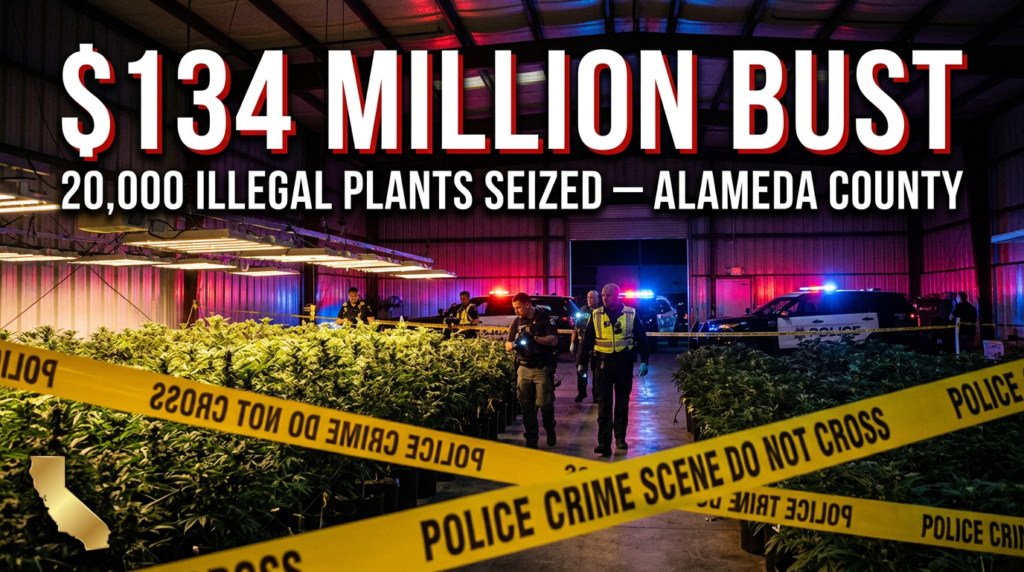
California authorities busted three Hayward warehouses packed with more than 20,000 cannabis plants, illegal foreign pesticides, and 24 detained suspects. It’s the state’s most expensive county-level drug seizure — and a sign that the black market is winning.
They didn’t find the plants in back alleys or rural fields. They found them in industrial warehouses, steps from a public airport, in a county where legal cannabis businesses operate under some of the heaviest regulatory burdens in the nation. On Thursday, April 17, 2026, California state authorities raided three warehouses in Hayward, Alameda County, seizing more than 20,000 marijuana plants valued at $134 million — the highest street value seizure of illegal cannabis in California history at the county level. Twenty-four people were detained.
This wasn’t random. It was the second major cannabis bust in the same city in under six months. And it raises a question that California’s political class seems determined to avoid: if the legal market is supposed to be working, why is the illegal one thriving right next door?
Support Independent Local Journalism
TheTownHall.News is a non-profit reader-supported journalism. Just $5 helps us hire local reporters, investigate important issues, and hold public officials accountable across Alameda County. If you believe our community deserves strong, independent journalism, please consider donating $5 today to support our work.The Scale of What Authorities Found
The operation was led by the California Department of Fish and Wildlife, targeting three industrial warehouses clustered south of Hayward Executive Airport. The numbers tell a damning story.
At 23986 Foley Street, officers seized 3,947 plants. At 23842 Cabot Boulevard — the largest of the three sites — they recovered 13,218 plants along with processed cannabis and detained six individuals. At 2255 American Avenue, another 2,968 plants were seized and 18 people were detained. In total, 20,133 plants were removed from the streets, and two dozen suspects are now in custody.
Authorities have not confirmed whether the three operations were linked, and the investigation remains ongoing. The identities of those behind the operations have not been publicly released.
What officials did confirm is this: illegal pesticides bearing foreign-language labels were found at all three locations. Not trace amounts. At every single site.

Foreign Pesticides, Real Danger
The discovery of foreign-labeled illegal pesticides isn’t a footnote — it’s the heart of the public health story here. These are chemicals that have not been approved by the U.S. Environmental Protection Agency, have not been tested for safety under American standards, and are being applied to a product that consumers then smoke or ingest.
Eric Farb, a cannabis industry expert, put it plainly: “Some of these bigger operations they are using PGRs and recycled water. Some of them are stuffing too many lights in a room and there is mold and mildew on the weed — and for the consumer it’s actually bad for their health.”
This is not a victimless crime. Every plant that leaves one of these warehouses and reaches a consumer represents a direct public health risk. The people buying this cannabis have no idea what’s on it, no label disclosures, no regulatory oversight, and no legal recourse if they’re harmed. That’s not freedom — that’s exploitation.
Why Law-Abiding Businesses Are Paying the Price
Here is the part that rarely makes it into the evening news: while illegal operators like these ran massive, untaxed, unregulated grow operations out of industrial warehouses, California’s licensed cannabis businesses paid some of the highest effective tax rates on any legal product in the state.
California charges a 15% retail excise tax on legal cannabis, and licensed businesses are also subject to local taxes, cultivation taxes, and full federal taxation under IRS rules — including Section 280E, which bars cannabis businesses from deducting standard business expenses. The result? Legal operators can pay effective tax rates exceeding 70% of their profits.
Support Independent Local Journalism
TheTownHall.News is a non-profit reader-supported journalism. Just $5 helps us hire local reporters, investigate important issues, and hold public officials accountable across Alameda County. If you believe our community deserves strong, independent journalism, please consider donating $5 today to support our work.Meanwhile, illegal grow operations pay nothing. No excise tax. No local business tax. No cultivation fee. No compliance costs. They undercut legal operators on price — and they don’t have to play by any rules to do it.
Legal cannabis sales in California dropped to approximately $3.9 billion in 2025, down from $4.2 billion in 2024. Taxable sales for Q1 2025 alone fell 30% from their 2021 peak. Illegal operations — estimated at two to three times the size of the legal market — are a primary driver of that decline.
Every illegal warehouse that operates freely is a direct tax on every legitimate business owner who chose to do things right.
Alameda County: A Pattern, Not a Coincidence
This raid didn’t happen in isolation. In 2025, Alameda County authorities destroyed 81,377 pounds of illegal cannabis — second only to Los Angeles County in total plant count statewide. The street value of those plants reached $134 million, the highest figure recorded in California.
And yet, six months after a major prior bust in the same city, three more warehouses were running at full capacity just south of a public airport — with neighbors reporting strong cannabis odors well before authorities moved in.
That’s not a failure of law enforcement. The officers who executed these raids acted decisively and effectively. That’s a failure of deterrence. It’s a signal that the penalty calculus for illegal operators still favors the risk. When a single warehouse can hold $50 million worth of product, fines and temporary shutdowns aren’t enough.
What Defenders of the Status Quo Get Wrong
Some advocates argue that aggressive enforcement of illegal cannabis operations disproportionately impacts immigrant communities or low-income workers who have limited economic alternatives. That’s a perspective worth hearing — and worth responding to honestly.
The workers detained at these sites deserve fair legal treatment and due process. No one disputes that.
But compassion for individuals cannot translate into tolerance for operations that flood communities with untested, pesticide-laced products, evade tens of millions in taxes that fund public services, undercut the legal entrepreneurs who built legitimate businesses, and create fire, electrical, and chemical hazards in shared industrial zones.
The real harm to vulnerable communities comes not from enforcing the law, but from allowing a black market to persist that exploits workers, endangers consumers, and makes it impossible for honest operators to compete. Enforcement isn’t the problem — it’s part of the solution.
What Needs to Happen Next
California has legalized cannabis. That decision, for better or worse, has been made. But legalization without enforcement isn’t a regulated market — it’s a legal fiction that benefits criminals at the expense of consumers, taxpayers, and legitimate business owners.
Three things need to follow from this bust:
First, meaningful prosecution. Detaining 24 people is only the beginning. The supply chains, financial networks, and organizational structures behind three simultaneous industrial-scale operations don’t appear overnight. Prosecutors need to pursue this fully.
Second, tax and regulatory reform for the legal market. If compliance costs are so high that legal operators can’t compete on price, the black market will never shrink. Policymakers who claim to support legalization need to prove it by making the legal pathway viable.
Third, community vigilance. The neighbors around these warehouses knew something was wrong — they smelled it. Civic engagement and local awareness remain among the most effective early-warning tools available.
The $134 million question isn’t just how many plants were seized. It’s why, in a fully legalized state, the illegal market is still bigger than the legal one.
Stay Informed. Stay Engaged.
The Hayward raids are a local story with national implications. California’s struggle to control its illegal cannabis market is a case study in what happens when regulation becomes so burdensome that compliance becomes uncompetitive — and when enforcement is inconsistent enough that the risk calculus favors the criminals.
If this story matters to you, share it. Talk about it with your neighbors, your local representatives, and your community. Independent journalism depends on readers who are engaged enough to demand accountability — from criminal operations and from the policymakers who create the conditions that allow them to thrive.
Subscribe to The Town Hall News for fact-based reporting on the stories that affect your community, your wallet, and your rights.
📌 Key Takeaway: More than 20,000 illegal marijuana plants worth $134 million were seized in Hayward, California — the highest county-level cannabis seizure in state history. Foreign pesticides were found at every site. This is the second major bust in six months. California’s illegal cannabis market remains two to three times the size of its legal one — and the gap won’t close without serious enforcement, honest tax reform, and civic accountability.