US-Iran Ceasefire on the Brink: Why Washington Must Hold the Line on Nuclear Talks
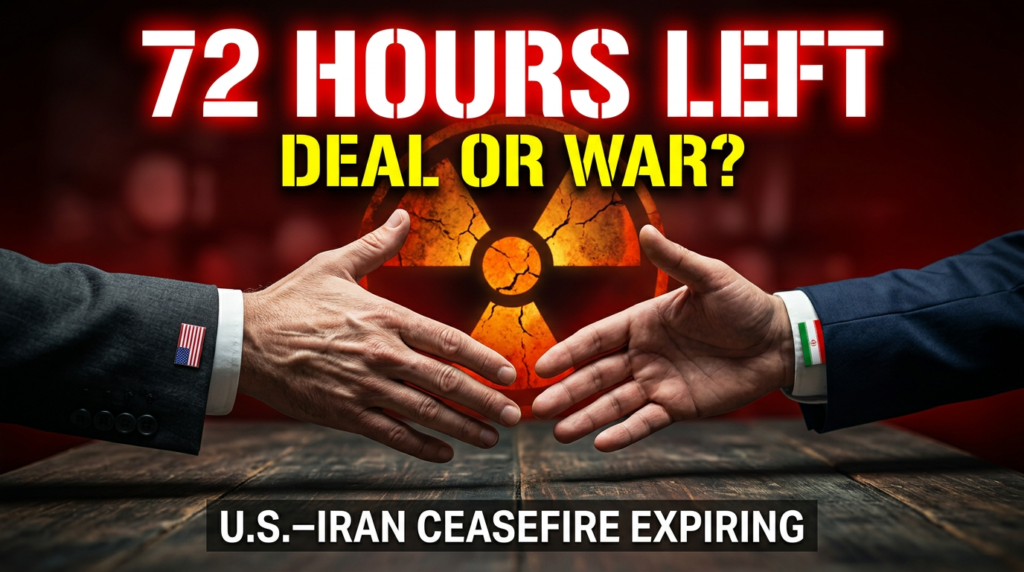
As the fragile two-week truce nears expiration and marathon talks in Islamabad collapse without agreement, America faces a defining test — stand firm against a nuclear-ambitious adversary, or repeat the mistakes of a decade of failed diplomacy.
The clock is ticking. The temporary ceasefire between the United States and Iran — announced on April 7, 2026 — is set to expire within days, and as of Monday morning, Islamabad sits under lockdown with no confirmed schedule for the next round of negotiations. The world is watching to see whether diplomacy can hold — or whether history is about to repeat itself.
What brought us here is no mystery. Decades of half-measures, poorly enforced agreements, and strategic retreats have emboldened a regime that openly funds terrorist proxies, restricts its own citizens’ freedoms, and pursues nuclear capabilities it has repeatedly promised to limit. The question now is not just whether a deal can be reached — it’s whether the deal currently on the table is one worth having.
Support Independent Local Journalism
TheTownHall.News is a non-profit reader-supported journalism. Just $5 helps us hire local reporters, investigate important issues, and hold public officials accountable across Alameda County. If you believe our community deserves strong, independent journalism, please consider donating $5 today to support our work.How We Got Here: From the Twelve-Day War to a Fragile Truce
The roots of the current crisis trace back to June 2025, when Israel launched large-scale strikes on Iranian nuclear facilities and military leadership — an escalation that ignited what became known as the “Twelve-Day War.” The United States followed with targeted strikes on Iran’s Fordow, Natanz, and Isfahan nuclear sites on June 21, 2025, before President Trump declared a ceasefire three days later.
For months, back-channel diplomacy kept the conflict from reigniting. But by February 2026, patience had expired. After Iran failed to meet a negotiating deadline, the U.S. and Israel launched a new round of strikes on February 28. In the chaos that followed, Iranian Supreme Leader Ali Khamenei and chief negotiator Ali Larijani were killed — fundamentally reshaping Iran’s internal power structure and its posture at the negotiating table.
The April 7 ceasefire was hard-won. Getting both sides to agree even to a temporary pause was a genuine diplomatic achievement. But a pause is not a peace deal — and the 21-hour marathon session in Islamabad on April 11–12 made that painfully clear. Vice President JD Vance departed without an agreement, stating that major gaps remained. Iran’s Foreign Minister Abbas Araqchi described the U.S. posture as one of “maximalism, shifting goalposts, and blockade.”
What America Is Actually Asking For — And Why It Matters
Critics in international media have framed Washington’s demands as unreasonable. But a clear-eyed look at what the U.S. is actually requesting tells a different story.

The American position requires Iran to end all uranium enrichment, dismantle its major enrichment facilities at Fordow, Natanz, and Isfahan, transfer its stockpile of highly enriched uranium out of the country, cease funding for Hamas, Hezbollah, and the Houthis, and fully reopen the Strait of Hormuz to international shipping.
These are not the demands of an aggressor. They are the requirements of accountability. Iran has used its nuclear program as leverage for decades — enriching uranium far beyond the levels needed for civilian energy production while funding armed groups responsible for civilian deaths across Lebanon, Gaza, and Yemen. Asking a nation to stop building tools capable of mass destruction is not overreach.
“Asking a nation to stop building tools capable of mass destruction is not overreach. It is the bare minimum.”
The Real Cost of a Weak Deal
Fiscal accountability doesn’t stop at the water’s edge. American taxpayers have funded decades of military deployments, naval operations, and intelligence efforts aimed at containing Iranian aggression in the Middle East. The current naval blockade of Iranian ports — confirmed by U.S. Central Command and active since April 13 — carries real operational costs. On April 19, U.S. forces fired on, disabled, and seized an Iranian-flagged cargo ship attempting to break the blockade. Enforcement is active. Escalation is always one miscalculation away.
A weak deal that leaves Iran’s nuclear infrastructure intact — or trades sanctions relief for vague commitments — is not diplomacy. It is a down payment on the next crisis. History bears this out. The 2015 Joint Comprehensive Plan of Action provided Iran with significant sanctions relief and failed to permanently eliminate its nuclear capabilities. Within years, Iran had resumed enrichment beyond agreed limits. The American people deserve a deal that actually works — one that does not require their sons and daughters to return to the same theater a decade from now.
What Critics Get Wrong About Iran’s “Flexibility”
Some analysts and foreign governments have characterized Iran as the more reasonable party in these negotiations — pointing to Tehran’s calls for “fair and balanced” talks and its February 2026 offer to dilute its 60%-enriched uranium stockpile in exchange for full sanctions relief. But flexibility in diplomacy must be judged by outcomes, not by rhetoric.
Support Independent Local Journalism
TheTownHall.News is a non-profit reader-supported journalism. Just $5 helps us hire local reporters, investigate important issues, and hold public officials accountable across Alameda County. If you believe our community deserves strong, independent journalism, please consider donating $5 today to support our work.Dilution is reversible. Dismantlement is not. A nation that retains its centrifuges, its enrichment expertise, and its facility infrastructure has not made a concession — it has made a tactical pause. The same calculation that produced the 2015 deal’s failure is embedded in Iran’s current offer.
Iran’s claim to good faith also strains credibility given its simultaneous support for regional proxy forces. Hezbollah, Hamas, and the Houthis continue to threaten civilian populations from Lebanon to Yemen to the Red Sea’s critical shipping lanes. A peace agreement that ignores this architecture of regional destabilization is not a solution. It is a subsidy.
“Dilution is reversible. Dismantlement is not.”
The Counterargument: Is Washington Overplaying Its Hand?
It would be intellectually dishonest to ignore legitimate concerns about the U.S. approach. A CNBC foreign policy expert noted this week that the American negotiating team may be “out of their league” — suggesting that the complexity of Iran’s political landscape and the intricacy of nuclear verification demand seasoned diplomatic expertise, not resolve alone.
There is also a humanitarian dimension. A prolonged conflict, or a failed ceasefire, carries devastating costs for Iranian civilians who bear no responsibility for their government’s choices. Regional mediators — particularly Pakistan and Oman — have warned that continued escalation destabilizes the broader Middle East and strains economies already battered by oil price volatility triggered by the Strait of Hormuz blockade.
These concerns deserve respect. But the answer to flawed diplomacy is better preparation and sharper negotiating strategies — not lower standards. Accountability and compassion are not mutually exclusive. America can pursue a hard-nosed deal while minimizing civilian harm and keeping channels open. That balance is the mark of statecraft — not capitulation dressed up as pragmatism.
Where Things Stand — And What Comes Next
As of April 20, 2026, Islamabad remains under lockdown in anticipation of a possible new round of talks. President Trump has stated that fresh negotiations are planned for this week, though Iran has not formally confirmed participation. Regional mediators are working behind the scenes to bridge gaps and secure at minimum a ceasefire extension.
The most optimistic scenario analysts describe is an agreement on general principles paired with an extended truce — buying time for substantive nuclear negotiations. That would be a step forward, but only if the additional time is used to pursue verifiable, permanent denuclearization rather than another round of temporary concessions.
The stakes could not be higher. A nuclear-armed Iran would permanently reshape the balance of power in the Middle East, accelerate proliferation pressures on neighboring states, and pose a direct threat to American allies and interests worldwide. This is not a moment for half-measures or symbolic agreements that paper over a structural threat.
Key Takeaway
The ceasefire is expiring, the talks have stalled, and the next 48 to 72 hours will determine whether diplomacy survives or conflict resumes. Washington’s demands — an end to enrichment, dismantlement of nuclear facilities, and cessation of proxy funding — are not extreme. They are the baseline requirements of a durable peace. The American people, who carry the human and financial costs of sustained engagement in the Middle East, deserve nothing less than a deal that holds.
Stay Informed. Make Your Voice Count.
This story is moving fast — and the decisions made in Islamabad this week will shape the security landscape for years to come. Share this article with someone who needs to understand what’s truly at stake. Follow The Town Hall for ongoing coverage of the U.S.-Iran negotiations as events develop. Independent journalism that cuts through the noise depends on readers like you. Democracy doesn’t run on autopilot. Neither does peace.