Father Pierre Death: The Christian Crisis in Southern Lebanon Explained
As the conflict in southern Lebanon continues to unfold, millions of people are asking: who is protecting the innocent—and why are the stories of traditional civic heroes being swept under the rug?
How much is a courageous life worth when it challenges the mainstream narrative? If you rely on traditional corporate media outlets for your international news, you likely have not heard the name of Father Pierre al-Rahi.
This omission matters right now because true heroes—those who embody personal responsibility and an unwavering commitment to law, order, and community survival—are being systematically ignored. In an era where digital noise drowns out traditional civic values, the tragic death of this Maronite Catholic priest demands our immediate attention and critical focus.
Who Was Father Pierre and Why Did He Stay?
Father Pierre al-Rahi was a 49-year-old Lebanese Maronite Catholic parish priest serving the historic village of Qlayaa. Nestled in the Marjayoun district of southern Lebanon, just a few miles from the border, Qlayaa is a predominantly Christian town of around 8,000 residents. When the geopolitical instability escalated into direct military actions, the civilian population faced an immediate, terrifying crisis. As foreign forces pushed across borders into what have become designated buffer zones, the local population was ordered to evacuate.
Support Independent Local Journalism
TheTownHall.News is a non-profit reader-supported journalism. Just $5 helps us hire local reporters, investigate important issues, and hold public officials accountable across Alameda County. If you believe our community deserves strong, independent journalism, please consider donating $5 today to support our work.While many fled, Father Pierre chose a path dictated by deep personal responsibility rather than personal safety. He refused to obey the evacuation orders issued to the region south of the Litani River. He understood that an abandoned community is a destroyed community. Along with a handful of other local leaders, he committed to staying behind to guard the town’s traditional civic infrastructure, protect local property rights, and provide spiritual and physical comfort to the vulnerable families who could not leave.
What Really Happened on March 9?
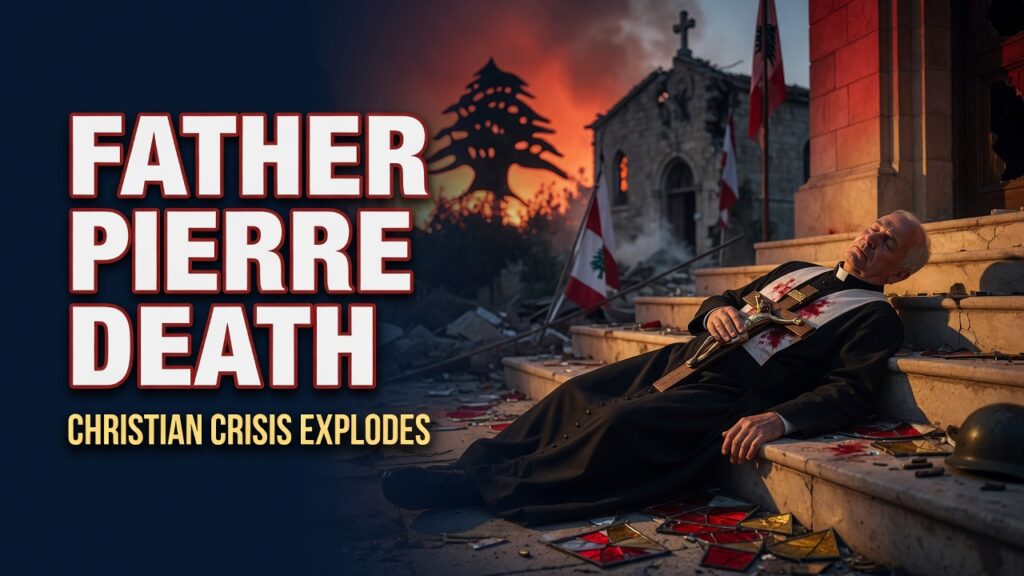
The facts of the incident, compiled from international reporting and local parish dispatches, paint a clear and devastating picture. On March 9, 2026, an Israeli Merkava tank fired a shell into a residential home located on the eastern edge of Qlayaa, severely injuring the civilian homeowners inside. This initial strike created an immediate emergency in a town already depleted of standard emergency services.
Hearing the blast, Father Pierre did not retreat to a bunker or seek safety. He immediately rushed toward the danger to administer aid and rescue the wounded. While he and several neighbors were actively helping the victims, a second tank shell struck the exact same location. The secondary blast heavily wounded the priest. He was rushed to a local hospital but succumbed to his injuries shortly thereafter, leaving behind a grieving congregation and an unanswered demand for basic accountability.
Are Our Leaders Even Listening Anymore?
The silence from major Western political capitals regarding this specific targeting of a Christian religious leader is deafening. Why do international institutions champion human rights in the abstract while ignoring the concrete slaughter of a shepherd protecting his flock? If a peaceful community leader cannot safely administer medical aid in his own parish, then international law and order have completely collapsed. This lack of institutional response highlights a growing disconnect between global elites and the traditional values of protecting innocent human life.

Local officials, including Qlayaa’s Mayor Hanna Daher, have publically confirmed that the targeted home contained absolutely no weapons or militant combatants [local municipal report]. This was a peaceful civilian zone. The failure of international observers to investigate this incident suggests a double standard in how global conflicts are reported to the public.
“We stay. We stay. We stay. We have no weapons, we have no malice, we have only our faith and our homes.” — Father Pierre al-Rahi, 24 hours before his death.
Why Are So Many Citizens Starting to Ask Questions?
Everyday citizens are growing deeply skeptical of corporate media filters that sanitize complex foreign interventions. The financial and military assistance poured into global conflict zones by Western governments makes the taxpayers stakeholders in these actions. Are you paying the price for reckless foreign foreign policies while politicians look the other way? When billions of dollars are shipped overseas under the guise of stabilizing regions, yet traditional religious and civic institutions are blown apart, fiscal accountability demands a full audit of these campaigns.
8,000. The population of a historic Christian enclave left entirely vulnerable in a geopolitical crossfire. The question no one in Washington or Geneva wants to answer: who will protect these communities when international norms fail?
Key Questions Raised by This Crisis
- How can Western nations justify uncritical support for regional operations when peaceful Christian minorities are being actively displaced and killed?
- Why is the mainstream media suppressing stories of traditional heroism and religious sacrifice in favor of polarized political narratives?
- What concrete steps must be taken to enforce law, order, and the protection of private property in recognized neutral border villages?
What Do Supporters of This Policy Actually Believe?
Defenders of intense cross-border military incursions argue that strict, uncompromising border enforcement is the only way to guarantee long-term national security against entrenched militant factions. They claim that evacuation orders are issued precisely to prevent civilian casualties, and that anyone who remains in a designated combat zone unfortunately accepts the inherent risks of active warfare.
While national defense is a legitimate function of any sovereign government, this argument fails to account for the total abandonment of proportionality and discrimination in targeting. Forcing an entire population of 8,000 peaceful citizens to abandon their ancestral lands, homes, and private property violates the very principles of justice and law and order. Furthermore, launching a secondary strike on a site where civilians are actively receiving emergency medical aid cannot be dismissed as mere collateral damage; it represents a fundamental breakdown of civilized rules of engagement.
Support Independent Local Journalism
TheTownHall.News is a non-profit reader-supported journalism. Just $5 helps us hire local reporters, investigate important issues, and hold public officials accountable across Alameda County. If you believe our community deserves strong, independent journalism, please consider donating $5 today to support our work.Is This the Accountability Moment We’ve Been Waiting For?
The tragic loss of Father Pierre must become a turning point for how free citizens evaluate international interventions. We cannot continue to fund and praise global operations that systematically dismantle traditional communities and target those performing acts of pure Christian charity. If this happened in your neighborhood, would anyone be held accountable, or would the bureaucratic machine cover it up? It is time to demand transparent investigations, strict adherence to the rules of civilized engagement, and real accountability for the loss of innocent lives.
The Vatican has officially acknowledged the tragedy, with church leadership expressing profound sorrow over a priest killed while actively providing aid. Local Lebanese political figures are now using this dark moment to demand that the Lebanese national army step in to guarantee the absolute neutrality of these Christian border towns. It is a desperate bid to restore order where chaos has been allowed to reign supreme.
Conclusion
The story of Qlayaa is a stark reminder of what happens when central governments and international bodies fail in their primary duty to maintain basic security and respect human rights. Father Pierre al-Rahi chose personal responsibility over cowardly retreat, proving that traditional civic values are worth dying for. Will we allow his sacrifice to be forgotten, or will we use our free speech to demand the truth? The real question isn’t whether this distant conflict affects your daily life—it’s whether you’ll act to defend these universal truths before it’s too late.
Call to Action
Still have questions about this developing story? Stay informed on international updates and media accountability—subscribe for our daily coverage. Think others need to hear the truth about Father Pierre? Share this article on your social platforms. Want to make your voice count? Write to your congressional representative today and demand an official inquiry into the protection of religious minorities in foreign conflict zones.