Moscow Drone Attacks Explained: Ukraine and Russia’s Claims
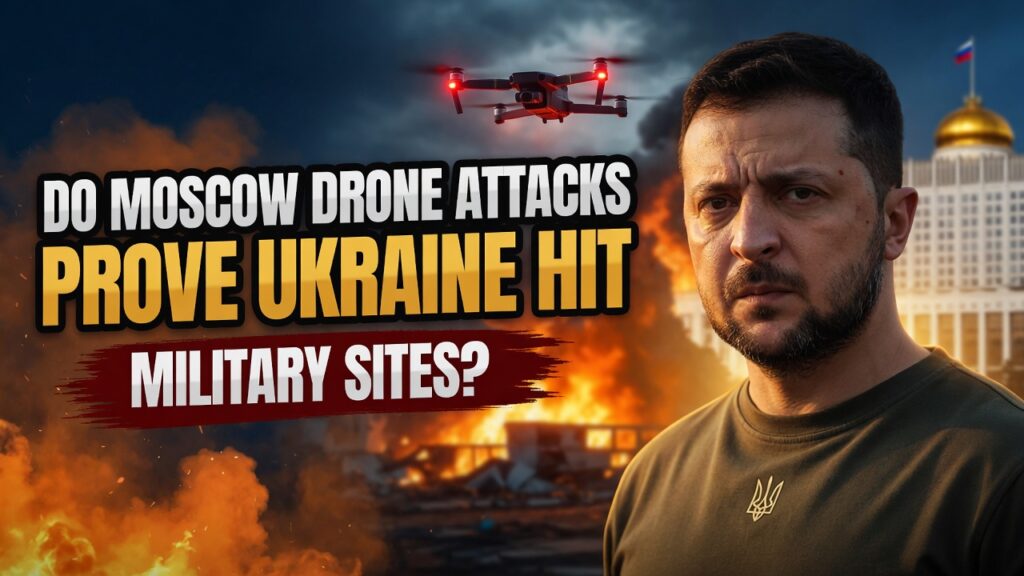
As Ukraine’s long-range drone campaign intensifies, two separate strikes on the Moscow region in the span of 48 hours have reignited a familiar question: who is actually getting hit, and why do Kyiv and Moscow tell such different stories every time?
Eight people are dead and dozens more wounded after Ukrainian drones struck a warehouse in Russia’s Tambov region on July 18. Less than 48 hours later, on July 20, Russian officials reported roughly 400 more drones over the Moscow region, this time wounding at least 10 people, including three Chinese nationals. Two attacks, two casualty counts, and once again, two irreconcilable explanations for what actually happened on the ground.
What Did Ukraine Actually Claim to Hit?
Ukrainian President Volodymyr Zelensky said the July 18 strikes hit two “significant logistical facilities” in the Moscow and Tambov regions, describing them as sites used to store sanctioned electronic components for drone production and military navigation equipment. He said an oil facility was also struck. In the July 20 strikes, Zelensky again pointed to logistics facilities and an oil depot in the Moscow region as the intended targets, framing both operations as strikes on Russia’s war-supply infrastructure rather than attacks on population centers. This is consistent with how Kyiv has described its expanding drone campaign for more than a year: as pressure on refineries, depots, and logistics hubs that keep Russia’s military supplied, sometimes called “long-range sanctions” inside Ukraine.
Support Independent Local Journalism
TheTownHall.News is a non-profit reader-supported journalism. Just $5 helps us hire local reporters, investigate important issues, and hold public officials accountable across Alameda County. If you believe our community deserves strong, independent journalism, please consider donating $5 today to support our work.What Does Russia Say Happened on the Ground?
Russian officials describe a very different picture. The Tambov regional governor said seven night-shift workers were killed at the warehouse in Kotovsk, with 25 more wounded. In the Moscow region, the governor reported 37 people wounded, one of whom later died in the hospital, and drone debris striking a kindergarten building in Elektrostal, sparking a fire. In the July 20 strikes, the Moscow region governor said a fire broke out at an industrial park in Domodedovo and that a residential building was also hit.
Whatever the intended target, real people were killed and wounded in these strikes — and both governments know it.
Why Does the Target Description Matter So Much?
Under international humanitarian law, a strike’s legality hinges heavily on whether the target has genuine military value and whether civilian harm was proportionate to it. A warehouse storing sanctioned drone components is a legitimate military target. A kindergarten is not. The trouble is a single strike can involve both — debris from an intercepted or damaged drone landing far from its intended target.
Is it possible for both sides to be telling a version of the truth — and still be talking past each other?

That’s often exactly what happens. Ukraine’s targeting claims and Russia’s casualty claims aren’t necessarily contradictory; they can both describe different parts of the same event. What’s missing, almost every time, is independent verification.
What Do the Numbers Actually Tell Us?
400 drones in a single night. That’s the scale Russian officials reported for the July 20 barrage alone — the question few are asking is what infrastructure and air-defense cost that volume imposes on Russia every single week. Russia’s Defense Ministry has previously claimed interception rates above 90 percent. Even discounted for messaging purposes, the sheer volume points to a sustained, resource-intensive campaign on both sides.
Are Civilians Bearing the Cost of This Escalation?
Yes, in both directions. Russian strikes on Ukrainian cities have killed civilians throughout the war, and Ukrainian long-range strikes on Russian territory have now done the same. Neither side disputes that civilians have died. What they dispute is intent — and intent can’t be verified from a governor’s Telegram channel alone.
If a strike is aimed at a legitimate military target but kills civilians nearby, is that an accident of war — or a war crime? The answer usually depends on which government is asked.
What Do Defenders of Ukraine’s Drone Campaign Actually Argue?
Supporters of Kyiv’s strategy argue Russia’s war machine runs on infrastructure well behind the front line, and that degrading it is both legitimate strategy and one of Ukraine’s few levers to pressure Moscow. They cite Ukraine’s public identification of specific facilities, like the Dubna Satellite Communications Centre, as evidence of military-focused targeting. Critics counter that repeated strikes near residential areas and now a kindergarten building suggest inadequate precision or insufficient regard for civilian proximity, regardless of stated intent. Both arguments can be weighed against the same facts: stated targets, reported casualties, and the distance between them.
Support Independent Local Journalism
TheTownHall.News is a non-profit reader-supported journalism. Just $5 helps us hire local reporters, investigate important issues, and hold public officials accountable across Alameda County. If you believe our community deserves strong, independent journalism, please consider donating $5 today to support our work.Where Does This Leave Readers Trying to Follow the War Honestly?
With two governments that have every incentive to shape the story in their favor, four-plus years into the war. Readers are left checking casualty figures against multiple sources and staying skeptical of any account — from either side — that arrives without attribution.
Can two governments both be telling a partial truth, and still leave the public with no way to know what actually happened?
Key Questions This Story Raises
- Were the July 18 and July 20 targets genuinely military-linked, or did civilian harm outweigh their military value?
- How many casualties came from direct hits versus drone debris and intercepted wreckage?
- Will either account ever be independently verified — and if not, why not?
What Happens If Neither Side’s Account Is Ever Verified?
Then the pattern repeats: another barrage, another casualty count, another set of dueling statements. That isn’t a sustainable way to understand a war escalating from dozens of drones a night to hundreds.
The real question isn’t which government’s press release to believe — it’s whether anyone outside Kyiv and Moscow will ever be allowed to check.
Still have questions about how this war is being covered? Stay informed — subscribe for daily coverage. Think others need to see both sides of this story? Share the article. Want your voice heard? Contact your congressional representative and ask where they stand on continued military aid to Ukraine.