World Cup Final Referee, Slavko Vincic, Was Detained at Bosnia Sex Party Raid
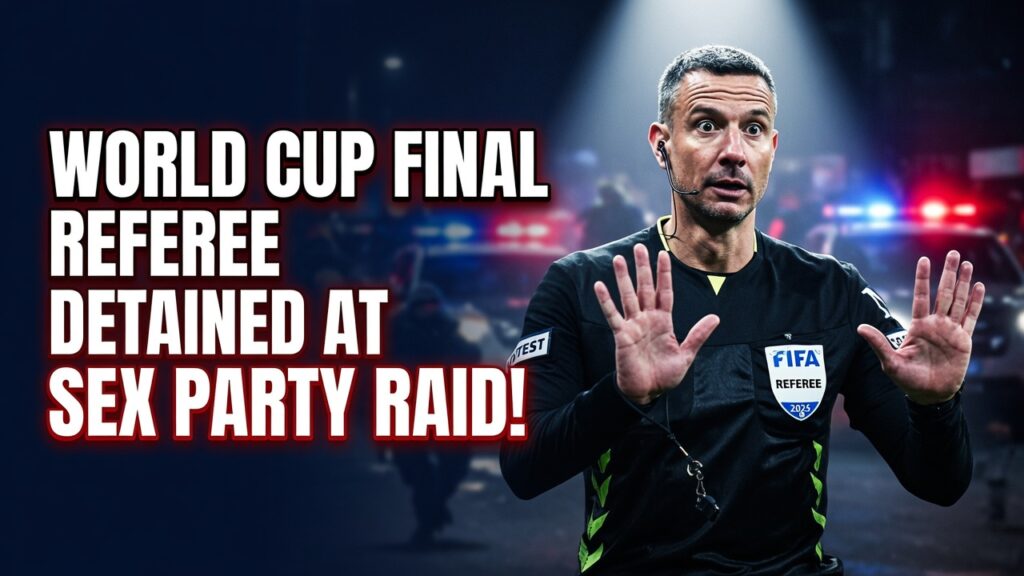
As millions of fans tune in for the Argentina-Spain final, a resurfaced 2020 police raid is raising a simple but pointed question: how closely does FIFA actually vet the officials it hands the biggest stage in sports?
Should a six-year-old police raid matter on the biggest day of a referee’s career? That is the question football fans are asking this week.
FIFA confirmed Slovenian official Slavko Vincic will referee Sunday’s World Cup final between Argentina and Spain at MetLife Stadium. Within hours, social media users resurfaced footage and reports tied to a 2020 Bosnian police operation, and the timing has reignited a broader debate about institutional transparency at the sport’s governing body.
Who Is Slavko Vincic, and Why Does His Past Matter Now?
Vincic, 46, is one of European football’s most respected officials. He has refereed a Champions League final, a Europa League final, and matches at multiple World Cups and European Championships since earning his FIFA badge in 2010 [FIFA/UEFA records].
His resume is not in dispute. What is in dispute is whether FIFA’s vetting process adequately weighed a 2020 incident before placing him in charge of the sport’s single most-watched match. That is a fair question for any institution entrusted with global credibility.
Support Independent Local Journalism
TheTownHall.News is a non-profit reader-supported journalism. Just $5 helps us hire local reporters, investigate important issues, and hold public officials accountable across Alameda County. If you believe our community deserves strong, independent journalism, please consider donating $5 today to support our work.What Actually Happened in Bosnia in 2020?
In May 2020, Bosnian police carried out a raid near Bijeljina targeting a suspected prostitution, drug, and weapons operation [law enforcement reporting]. Officers detained roughly 30 to 35 people at the scene and seized cocaine, handguns, body armor, and thousands of euros in cash.
Vincic was among those detained. He was never arrested or charged. He was questioned as a witness and released the same day, maintaining he had traveled to Bosnia for a business meeting and accepted what he believed was a routine lunch invitation. Slovenian football officials publicly backed his account, stating no formal proceedings were ever opened against him.
That distinction matters. Being present at the scene of a police operation is not the same as being implicated in one. Readers deserve the full, accurate context rather than a sensational headline stripped of it.
The alleged operator of the property later pleaded guilty to a prostitution-related charge, according to court proceedings [law enforcement reporting]. Vincic was never named as a defendant in that case, and no court record ties him to the underlying criminal enterprise. Slovenian refereeing officials went on record at the time stating he was not under investigation and no proceedings had been instituted against him. Six years later, that account has not changed, and no new evidence has surfaced to contradict it.
Is FIFA’s Vetting Process Actually Transparent?
Here is where accountability enters the picture. FIFA has never publicly detailed how it evaluates referees’ personal histories before major appointments, nor has it addressed whether the 2020 incident factored into Sunday’s decision.
If an institution won’t explain how it vets its most visible representatives, can the public actually trust the process? That is not an accusation against Vincic. It is a question about whether FIFA owes fans transparency when controversy resurfaces days before its championship match.
FIFA has a pattern of prioritizing on-field competence over public disclosure. Vincic’s officiating record at this tournament, including four matches before the final, suggests the federation weighed performance heavily. Whether it weighed public trust at all remains unclear.
What Do the Numbers Actually Tell Us?
35. That is roughly how many people Bosnian police detained during the 2020 raid the referee was swept up in. The question no one at FIFA has answered: did that number ever appear in his internal review file?
Vincic has officiated eight World Cup matches across two tournaments and averaged fewer cautions per game at the World Cup than in his broader career [Transfermarkt data], a record FIFA likely views as evidence of composure under pressure. But statistical performance and institutional disclosure are two separate questions, and conflating them lets FIFA avoid the harder one.
Why Are Fans Starting to Ask Bigger Questions?
This moment resonates beyond one referee. Fans invested in fair play, rule of law, and institutional accountability are increasingly skeptical of global organizations that operate with minimal public oversight. FIFA generates billions in tournament revenue while facing limited independent scrutiny over its internal decision-making.
A referee who was never charged with a crime should not be treated as guilty. But an institution that won’t explain its process shouldn’t get a free pass either. Both things can be true at once, and pretending otherwise flattens a legitimate story into a tabloid one.

“If FIFA can’t explain how it vets the man standing between two nations and a championship, what exactly is the vetting for?”
What Do Supporters of Vincic’s Appointment Actually Believe?
Supporters of the appointment make a reasonable case. Vincic was cleared of wrongdoing, never charged, and has spent six years building an unblemished professional record since 2020. They argue that resurfacing an old, unrelated police matter days before his biggest assignment amounts to guilt by association rather than legitimate scrutiny.
That argument carries real weight. Due process matters, and Vincic’s account has held up consistently across six years and multiple independent Slovenian football officials backing him. Punishing a cleared witness for someone else’s alleged crimes would set a troubling precedent.
But due process for Vincic does not resolve the separate question of institutional transparency. FIFA can treat him fairly while still owing the public clarity on how it screens officials for its highest-profile assignments. Those two obligations are not in tension, and conflating them is how accountability gets quietly dropped.
Key Questions This Story Raises
- Did FIFA’s vetting process account for the 2020 Bosnia incident before Sunday’s appointment?
- Should organizations with FIFA’s global reach be required to disclose how they screen officials for major assignments?
- Where should the line sit between a cleared witness’s right to privacy and the public’s interest in transparency?
What Would Real Accountability Look Like Here?
Real accountability would not require FIFA to punish a cleared witness. It would require the organization to state, on the record, what criteria it uses to evaluate officials’ backgrounds before major tournament assignments, and whether the 2020 incident was reviewed and considered before Sunday’s decision.
That standard is not radical. Publicly traded companies disclose governance practices to shareholders. Government agencies publish vetting standards for sensitive positions. FIFA, an organization that controls a tournament watched by billions and generates enormous commercial revenue, should be able to meet a comparable bar without compromising any individual’s privacy.
Has FIFA Gone Too Far in Avoiding This Question?
Not yet. But silence has a cost. Every hour FIFA declines to address its vetting standards is an hour the story stays framed around scandal rather than substance. That framing hurts everyone: it is unfair to Vincic, and it lets FIFA off the hook for a legitimate governance question.
Limited government and institutional accountability are not slogans reserved for domestic politics. They apply equally to global organizations that wield outsized influence over public trust, revenue, and, in this case, the outcome of the world’s most-watched sporting event.
The real question is not whether Vincic did anything wrong. The evidence says he did not. The real question is whether FIFA will ever explain how it decides who it trusts with the world’s biggest stage — or whether fans will simply have to take it on faith.
What do you think — should FIFA be required to disclose its vetting standards for major tournament officials? Share this article and let us know.
Support Independent Local Journalism
TheTownHall.News is a non-profit reader-supported journalism. Just $5 helps us hire local reporters, investigate important issues, and hold public officials accountable across Alameda County. If you believe our community deserves strong, independent journalism, please consider donating $5 today to support our work.Still have questions about how global sports institutions operate? Stay informed — subscribe for daily accountability coverage. Think others need to see this? Share the article. Want your voice to count? Contact FIFA’s ethics and governance committee directly or support outlets pushing for greater transparency in international sports governance.