
Who Funded Genocide Database: Is It Real Transparency or Targeting?
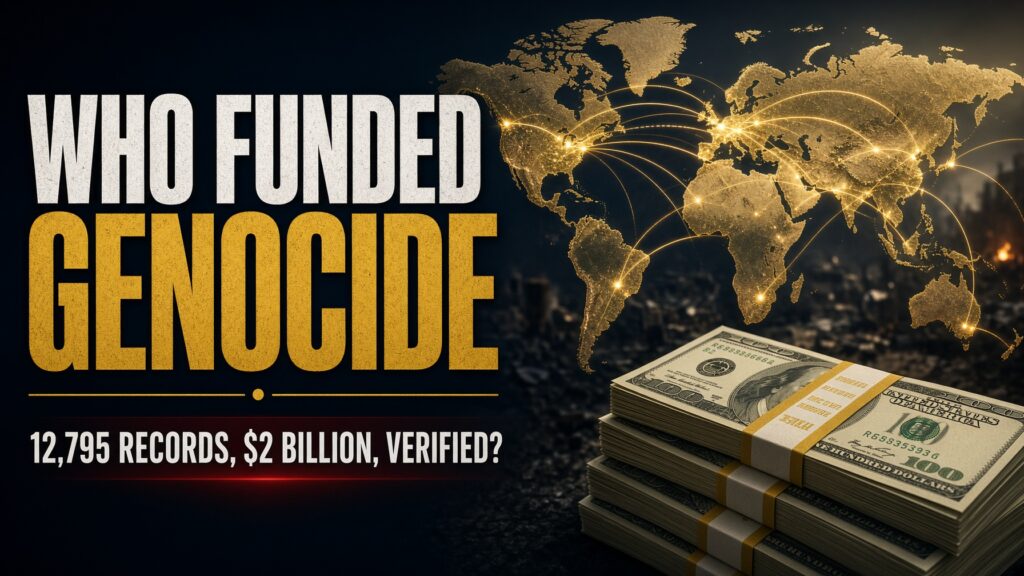
A new interactive map promises to trace more than 10,000 money links back to public records, but its name asks readers to accept a conclusion that remains contested.
Can one website be a research tool and an accusation at the same time? A website just put 12,795 financial links on a single map. The project behind whofundedgenocide.com says its new interactive map organizes political donations, foreign-agent filings, charity transfers and lobbying records into one searchable network. It arrives as Gaza policy dominates Democratic primaries and AIPAC’s super PAC has spent roughly $62 million this cycle, according to OpenSecrets figures cited by NPR [NPR, citing OpenSecrets]. Before anyone shares it, readers deserve to know what the map proves, and what it only implies.
What Exactly Did the Project Release?
The live page describes six “boards”: Israeli state contracts, U.S. political money, charity flows, lobbying registers, organization families and settlement funding. It lists 9,626 entities and 12,795 documented links, 10,621 of them involving money [project’s own data, accessed October 24, 2026]. Every link cites the record it came from. Those figures differ slightly from the announcement circulating on social media, which cites 9,641 entities, 10,654 money links and $1.1 billion. The database is evidently still changing, so any total should be treated as provisional. The tables can be downloaded as CSV and JSON files under a Creative Commons license, with checksums so researchers can confirm the files are unaltered. That openness is the project’s strongest feature. Anyone can audit it, including its critics.
Support Independent Local Journalism
TheTownHall.News is a non-profit reader-supported journalism. Just $5 helps us hire local reporters, investigate important issues, and hold public officials accountable across Alameda County. If you believe our community deserves strong, independent journalism, please consider donating $5 today to support our work.Where Does the Money Actually Come From?
The largest board, U.S. political money, holds 8,770 money links drawn from Federal Election Commission filings [FEC data, per the project]. Its biggest entries are contributions to super PACs and spending in individual House and Senate races, activity any voter can already look up at FEC.gov. The Israeli-government board draws heavily on Foreign Agents Registration Act filings. One entry shows a $31.5 million order for seven months of work, while a separate entry between the same two parties records $15 million actually received in six payments [FARA filings, per the project]. An order is not a payment. The map draws that distinction, and readers should too. The charity board relies on Canadian and Australian registers. Its largest lines include transfers to hospitals and medical centers and a food-rescue organization [Canadian charity filings, per the project]. Whether those flows belong under a title containing the word genocide is a judgment the data cannot make for anyone.
Why Can’t the Totals Simply Be Added Up?
The map’s own fine print is more careful than some of the coverage. It never adds shekels, dollars, pounds and Canadian and Australian dollars together, because no exchange rate appears in its records. Yet at least one foreign-language outlet has already published a “$2 billion” headline by combining them. Solid lines mark money a record says moved. Dashed lines mark approved ceilings, unpaid orders or entities merely named together. The project also states that no document it holds joins Israeli state contracts to a U.S. political committee, so the map draws no line between them. 10,621. That is how many of the map’s links involve money. The question the data cannot answer alone: how many show cash that moved, and how many show only a ceiling someone approved? Public records are a public good. A verdict in a website’s name is not a finding.
Is This Transparency or Targeting?
Conservatives have good reasons to welcome disclosure. Voters are entitled to know who funds campaigns, who lobbies for foreign governments and where nonprofit dollars land, just as taxpayers are entitled to know how Washington spends theirs. Every document type on this map exists because a legislature or regulator required it to be public. Yet the same readers know the other edge of that sword. Disclosure serves voters, while exposure can invite harassment. The database names thousands of private citizens whose act was a lawful, publicly filed political donation, under a title that implies guilt. An FEC filing, by itself, shows who gave and who received. It says nothing about intent. Whether the war in Gaza meets the legal definition of genocide is contested, and the label here is the project’s own characterization. When lawful, publicly filed donations are labeled “funding genocide,” who decides where accountability ends and accusation begins?
Is a database still a research tool if its verdict is written into its name?
What Do Supporters of This Spending Actually Believe?
AIPAC’s defenders make a real argument. A spokesperson for its super PAC, the United Democracy Project, says critics single out AIPAC while ignoring other large political spenders [NPR]. Defenders add that it is dangerous to suggest Americans cannot donate to causes backing a country of their choice, and the group says hundreds of candidates it backed have won their primaries [NPR; AFP]. NPR also notes the super PAC trails the biggest spenders in American politics, such as super PACs tied to party leadership. Those points hold on the facts. The spending is lawful, disclosed, and often unsuccessful: the super PAC spent about $30 million in Michigan’s Senate primary, and its preferred candidate lost to Abdul El-Sayed [NPR, citing OpenSecrets]. But disclosure is exactly why the spending is searchable. The super PAC’s spending rose from $26 million in its first cycle to $37.9 million in 2024 and about $62 million this year [OpenSecrets, via NPR]. Voters can weigh that growth without adopting the map’s moral label. Both things can be true: the money is protected political speech, and voters are entitled to a clear map of it.
What Should Readers Do With a Map Like This?
Start with the primary sources. Every link cites a filing, and most can be traced to FEC.gov, the federal foreign-agent database or a national charity register. Check the document, not the caption. Treat every figure as a moving target: the totals changed between the announcement and the live page, and they will likely change again. Separate three claims. Who gave, to whom and how much is something filings can show. What the money influenced is something they cannot. What it all means morally is argument, not data. The project says two further tabs catalog quotations from Israeli officials and Palestinian films and books, and it promotes a flight-tracking site, sadawatch.com. We did not independently verify those components, and readers should not treat them as established. A filing shows where money went. It does not show why, and it does not show guilt. Key Questions This Story Raises:
- How many of the map’s 10,621 money links show payments that actually moved, rather than approved ceilings or orders?
- Should lawful, publicly filed donations by private citizens sit under a label that implies complicity in a crime?
- If all political and charitable giving can now be mapped, who protects donors from harassment and voters from one-sided narratives? So is whofundedgenocide.com a landmark transparency tool or a targeting list with footnotes? The records may prove useful, while the label remains contested. Money in politics deserves scrutiny from every direction, but scrutiny works best when a slogan isn’t doing the thinking. The real question isn’t whether the money is public. It’s whether the public will read the records before it reads the verdict. Still have questions? Stay informed: subscribe for daily coverage of government accountability and money in politics. Think others need to see what the records actually say? Share this article. Want your voice to count? Look up your own representative’s campaign committee at FEC.gov and ask their office to explain the largest sources of outside spending in your district.