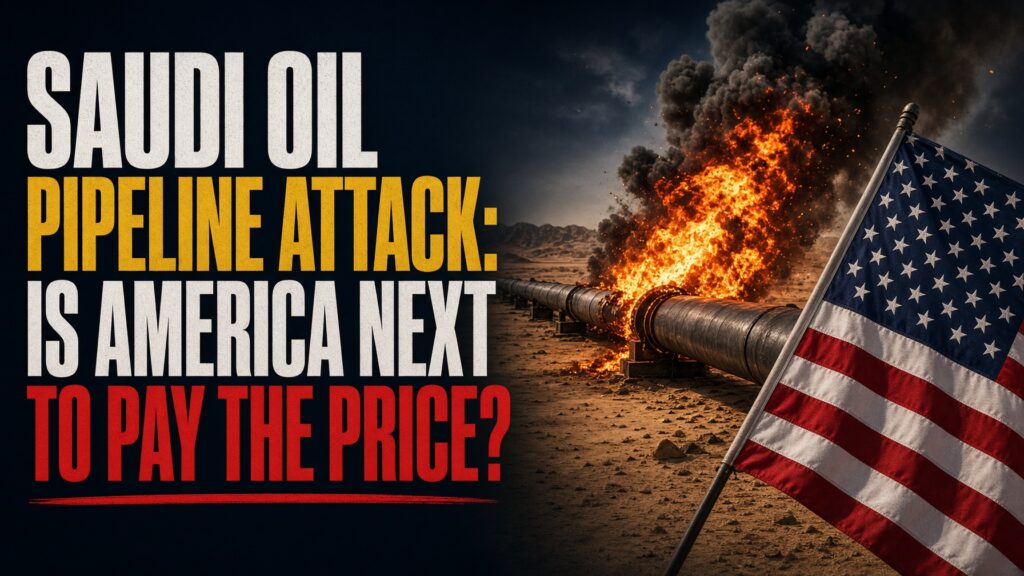
Saudi Oil Pipeline Attack Explained: What It Means for Gas Prices
As Houthi missiles knock out Saudi Arabia’s last working oil export route, millions of Americans are asking a blunt question: who’s actually protecting the energy supply this country still depends on?
A pipeline just went dark 7,000 miles from home. Saudi Arabia’s East-West Pipeline, the line that now carries almost all of the kingdom’s oil exports to the Red Sea, was struck this month and will be largely out of service for weeks while crews repair the damage [wire-confirmed, AP]. Two regional officials told the Associated Press that satellite imagery shows at least one pump station badly damaged, with a second possibly hit as well [wire-confirmed, AP]. The timing matters. This is happening while the Strait of Hormuz remains effectively closed off by Iran, meaning the pipeline to the Red Sea port of Yanbu was Saudi Arabia’s last major way of getting oil to the rest of the world.
What Just Happened to Saudi Arabia’s Oil Lifeline?
Saudi Aramco built the pipeline decades ago as a contingency, a way to move crude to the Red Sea if the Strait of Hormuz was ever blocked. For most of its life, it sat as backup infrastructure nobody thought much about. In 2026, it became the kingdom’s primary crude-export route after Iran effectively shut down Hormuz, and Aramco reportedly pushed its throughput toward 7 million barrels a day by converting parallel natural-gas pipelines to crude service. That emergency fix is now the thing under direct attack.
Support Independent Local Journalism
TheTownHall.News is a non-profit reader-supported journalism. Just $5 helps us hire local reporters, investigate important issues, and hold public officials accountable across Alameda County. If you believe our community deserves strong, independent journalism, please consider donating $5 today to support our work.Why Does One Pipeline in Saudi Arabia Matter to You?
Because there’s no meaningful backup left. Shipping-data firm Kpler, cited by AFP, found that Yanbu handled roughly 92 percent of Saudi Arabia’s seaborne crude exports in June 2026 and 78 percent in July [Kpler data via AFP]. When Hormuz closed, the world’s oil markets bet on this one Red Sea corridor holding. Brent crude, the global benchmark, has already pushed back above $100 a barrel amid the latest strikes [wire-confirmed]. That is not an abstract commodities-desk number. It shows up at the pump, in shipping costs, and in every price tag that depends on fuel to get to a shelf.
92 percent. That’s the share of Saudi Arabia’s oil exports now riding on a single port and a single pipeline, and the question no one in Washington has answered is why the world let its energy security get this fragile.
How Bad Did the Attacks on Saudi Arabia Get This Week?
On September 15, Houthi missiles and drones hit six Saudi locations at once: Yanbu, Jeddah, Taif, Abha, Al-Ula, and Khamis Mushait, triggering civil-defense alerts across the kingdom [wire-confirmed, regional reporting]. Unconfirmed reports circulated of a strike near King Fahd Air Base outside Taif, though Saudi authorities have not confirmed damage there [unverified — flagged for reader caution]. Saudi officials said earlier Houthi strikes this month injured 13 people and damaged homes and vehicles in several cities [wire-confirmed]. Nearly 94,000 people have reportedly been displaced by the broader fighting in Yemen tied to this escalation [regional reporting].
Is Washington Actually Prepared for a Crisis Like This?
If a single missile strike can take nine of every ten barrels of a major oil producer’s exports off the map, is energy security even the right term for what Washington has built? That is not a rhetorical throwaway. The United States has spent decades treating a handful of foreign chokepoints — the Strait of Hormuz, a single Saudi pipeline, a handful of Red Sea ports — as reliable enough to build an entire economy’s fuel supply around. This month is a live demonstration of what happens when one of those choke points gets hit.

Fiscal conservatives have raised this point for years: dependence on foreign energy infrastructure is not just a national-security liability, it is a bill that eventually comes due for American households, in the form of higher gasoline prices, higher shipping costs, and higher costs for anything that requires fuel to produce or move. A pipeline built as a Cold War-era hedge should not be the thing standing between global oil markets and a genuine supply shock.
Is it energy security if one missile strike can turn off nine out of every ten barrels a country sells to the world?
What Do Defenders of Deep U.S. Involvement in the Middle East Actually Believe?
Supporters of continued, close U.S. engagement in Gulf security make a real argument, and it deserves a fair hearing rather than a dismissal. They argue that Saudi Arabia remains the world’s second-largest oil producer and a critical U.S. security partner, that walking away from Gulf commitments would hand Iran and its proxies more leverage over global energy markets, and that American diplomatic and military support has, in the past, helped contain exactly this kind of escalation before it spread further.
That argument has real merit, and it is not something to wave away. But it does not answer the more basic question raised by this week’s attacks: why, after decades of instability in this exact region, has the United States not built enough domestic production, refining, and strategic reserve capacity to make a single foreign pipeline strike a footnote rather than a global price event? Supporting allies and reducing exposure to their vulnerabilities are not mutually exclusive goals. Treating them as one and the same is what has left American consumers exposed every time a missile lands near a Saudi port.
Why Does This Keep Happening — and Why Hasn’t It Been Fixed?
This is not the first time Yanbu or its surrounding Aramco facilities have been hit. Houthi forces have struck the port, its refinery, and nearby oil infrastructure repeatedly since a Red Sea blockade was declared in July 2026 [wire-confirmed, regional reporting]. Aramco’s own leadership has previously said such attacks caused only temporary disruptions with no material financial impact. This time is different in scale: a multi-week shutdown of the export route the entire kingdom now depends on, not a single tank fire that gets patched over in days.
A pipeline meant to be a decades-old insurance policy is now the single point of failure for the global oil market, and it just failed. That is not a talking point. It is the plain description of what regional officials told the wire services this week. Whether Washington treats it as a wake-up call or waits for the next headline to move on is an open question.
Key Questions This Story Raises:
Support Independent Local Journalism
TheTownHall.News is a non-profit reader-supported journalism. Just $5 helps us hire local reporters, investigate important issues, and hold public officials accountable across Alameda County. If you believe our community deserves strong, independent journalism, please consider donating $5 today to support our work.- Why has the United States allowed so much of global oil-market stability to depend on a single foreign pipeline and a single port?
- If Brent crude is already above $100 a barrel on a weeks-long outage, what happens to American gas prices if the damage takes longer to repair than officials currently expect?
- Is continued deep U.S. involvement in Gulf security actually reducing this vulnerability, or simply managing a risk that domestic energy policy should have addressed years ago?
Is This the Wake-Up Call America Needed?
Strip away the geopolitics, and one question remains: does the United States actually learn something from a foreign pipeline strike that moves global oil prices, or does it simply wait for prices to fall back down and move on to the next crisis? A multi-week outage at the world’s most important export corridor is not a distant problem. It is a preview of what happens every time this country treats foreign infrastructure as a substitute for its own energy security.
What do you think — should the United States be building real energy independence, or is managing foreign chokepoints good enough? Share this and let us know.
The real question isn’t whether a missile strike thousands of miles away can move the price at your local gas station. It already has. It’s whether anyone in Washington does anything about it before the next one lands.
Still have questions about where this is headed? Stay informed — subscribe for daily coverage of the policies and events shaping American energy security. Think your neighbors need to see this? Share the article and start the conversation in your own community. Want your voice to count? Contact your member of Congress and ask where they stand on expanding domestic oil production and refining capacity, and on the current level of the Strategic Petroleum Reserve — most congressional websites list direct contact information for your representative and senators.