Israel’s Right to Self-Defense Under International Law Explained
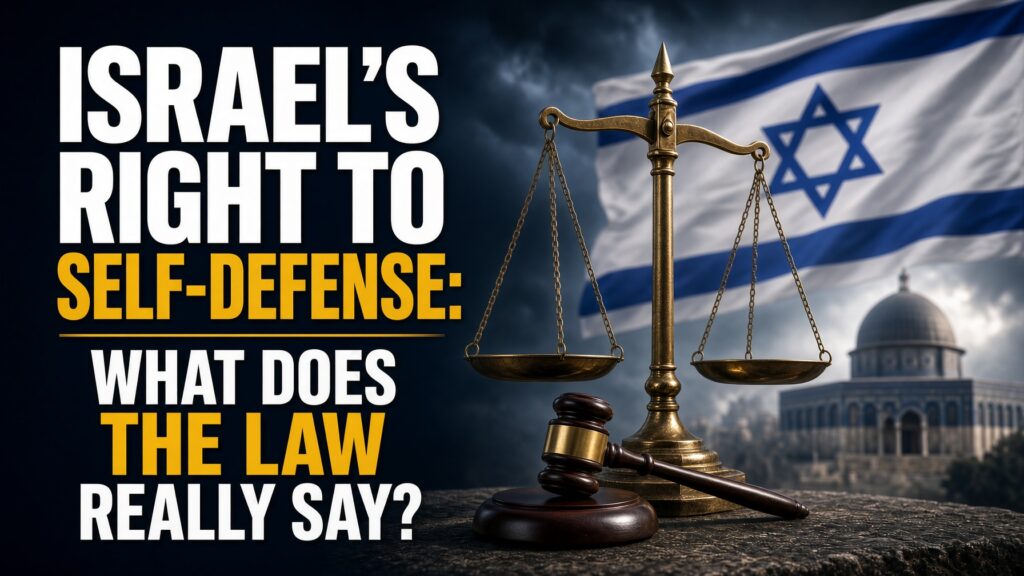
As a viral argument claims that occupation cancels Israel’s legal right to defend itself, the law turns out to be far less settled than either side’s slogans suggest, and the answer matters well beyond one war.
A viral argument says Israel has no right to defend itself.
The claim spreads through short clips and group chats, usually delivered with total confidence. It deserves a closer look than either side usually gives it.
Why now? The International Court of Justice’s July 2024 advisory opinion on the occupation keeps resurfacing in debates over Gaza, and its logic is often stretched far beyond what the court actually said. Whether a nation may lawfully answer an attack like October 7 decides what the law of war permits, and forbids, for everyone.
Where Does the “No Right to Self-Defense” Argument Come From?
It comes from a real source. In its 2004 advisory opinion on Israel’s West Bank barrier, the ICJ said Article 51 of the UN Charter did not apply, because the threats Israel cited originated inside territory it controlled rather than from another state [ICJ 2004 advisory opinion]. In 2024, the court separately found Israel’s continued presence in the occupied Palestinian territory unlawful [ICJ 2024 advisory opinion]. Critics combine the two: an occupier, they say, cannot claim self-defense against the people it occupies.
That is a serious argument, but it is one reading of the law rather than the law itself. Advisory opinions answer questions posed by UN bodies. They are not binding judgments in a contested case between parties [ICJ Statute].
Support Independent Local Journalism
TheTownHall.News is a non-profit reader-supported journalism. Just $5 helps us hire local reporters, investigate important issues, and hold public officials accountable across Alameda County. If you believe our community deserves strong, independent journalism, please consider donating $5 today to support our work.What Does the UN Charter Actually Say?
Article 51 preserves the “inherent right” of self-defense “if an armed attack occurs.” The text does not say the attacker must be a state [UN Charter]. Several judges, including Rosalyn Higgins and Pieter Kooijmans, questioned the 2004 court’s Article 51 reasoning in their separate opinions [ICJ separate opinions].
State practice also cuts against a narrow reading. After September 11, 2001, the Security Council recognized the right of self-defense against terrorist attacks, and the United States invoked Article 51 against al-Qaeda in Afghanistan [UN Security Council Resolution 1368]. If self-defense vanished whenever the attacker wasn’t a state, no country could lawfully answer a terrorist group, a rule most governments have declined to adopt.
1,200. That is roughly how many people were killed in the Hamas-led attacks of October 7, 2023, with about 250 more taken hostage [Israeli government figures]. The question the “no right” argument struggles to answer: if that was not an armed attack, what was it?
Is Gaza Still Occupied?
Here the facts are messier than the slogans. Israel withdrew its troops and roughly 8,000 settlers from Gaza in 2005 [historical record]. Hamas won the 2006 legislative elections and seized full control of Gaza from Fatah by force in 2007. Israel and Egypt then tightened restrictions on the territory’s borders, and Israel retained control of Gaza’s airspace and coastline [historical record].
The ICJ’s 2024 opinion did not issue a simple verdict on Gaza. It held that Israel’s obligations there continue to the extent of its effective control, a standard that is itself contested [ICJ 2024 advisory opinion]. Israel rejects the view that Gaza has been occupied since 2005, and serious legal scholars disagree with one another. Anyone who calls this question closed is selling certainty the law does not offer.
Did Israel Really Create Hamas?
Hamas was founded in 1987 during the first intifada. Its 1988 charter called for Israel’s destruction, and a 2017 policy document softened the language without recognizing Israel [Hamas documents]. Nearly half of Gaza’s population is under 18 [UN and Palestinian statistical data], so critics are right that many Gazans never voted for Hamas.
The claim that Israel “propped up” Hamas has a kernel of truth. Israeli authorities tolerated Islamist charities in the 1970s and 1980s as a counterweight to the secular PLO, and some former officials have acknowledged the strategy backfired [historians and press reporting]. But tolerating a social network is not the same as creating a militant organization.
Is a rule really a rule if it protects only against enemies who wear uniforms?
Hamas’s suicide bombings, rocket fire and the October 7 massacre were its own choices. Personal responsibility applies to organizations as much as to individuals.

What Do Critics of Israel’s Self-Defense Claim Actually Believe?
They argue that people under military control for decades have a right to resist, and that blockade and bombardment cannot be relabeled as defense. They point to Gaza health ministry reports of deaths in the tens of thousands, figures Israel disputes in part but which UN agencies have generally relied upon [Gaza Health Ministry; UN]. Aid groups have documented severe restrictions on relief [UN OCHA]. Those concerns are serious and deserve answers.
They also run into limits. International law recognizes resistance to occupation, but not the deliberate killing of civilians or the taking of hostages, which are war crimes whatever the grievance [Geneva Conventions]. And self-defense is no blank check: necessity, proportionality and humanitarian law constrain it. Israel’s right to respond to October 7 and the question of how it has fought are separate questions, and honest debate keeps them apart.
Why the Rule of Law Cuts Both Ways
Conservatives have long argued that laws mean little without enforcement and that no institution is exempt from accountability. That logic applies here. In 2024, the International Criminal Court’s judges issued arrest warrants for Prime Minister Benjamin Netanyahu, former defense minister Yoav Gallant and a senior Hamas commander [ICC]. Israel rejects the court’s jurisdiction, and many critics say it wrongly equates elected officials with terrorist leaders. Whatever one thinks of the ICC, legitimacy in war comes from following the rules and investigating violations by one’s own side.
Self-defense is a legal right, not a license. A government that claims the first while ignoring the limits invites the world to question both.
The same standard applies to the institutions judging that conduct. Non-binding opinions should not be treated as binding rulings, and slogans should not be treated as law.
Key Questions This Story Raises:
- If the right of self-defense ends whenever an attacker lacks statehood, how can any country lawfully respond to terrorism?
- What standards of necessity and proportionality should apply, and who decides whether they have been met?
- How should the world hold both Hamas and Israel accountable under the same rules, without double standards?
The Question That Outlasts the Slogans
The core issue is not whether Israel has a right to self-defense. Under the text of the UN Charter and decades of state practice, it very likely does. The harder question is what the law demands of a government exercising that right, and who has the standing to hold it, and its enemies, to account.
That question is worth answering carefully because the rules written for this war will govern the next one. What do you think: does the law protect citizens from massacre, or only the arguments made afterward? Share this and tell us where you stand.
Still have questions? Stay informed: subscribe for daily coverage. Think others need to see this? Share the article. Want your voice to count? Contact your member of Congress and ask what standards the United States applies to self-defense claims against non-state actors, and whether Congress will hold public hearings on them.
Support Independent Local Journalism
TheTownHall.News is a non-profit reader-supported journalism. Just $5 helps us hire local reporters, investigate important issues, and hold public officials accountable across Alameda County. If you believe our community deserves strong, independent journalism, please consider donating $5 today to support our work.The real question isn’t whether a nation may defend itself. It’s whether the rules that govern that defense will bind everyone equally.